Mexican Muralism is often introduced through three famous names—Diego Rivera, José Clemente Orozco, and David Alfaro Siqueiros. That is useful, but incomplete.
The stronger reading is infrastructural: after the Mexican Revolution, walls in schools, ministries, and civic buildings were turned into a mass visual system for historical memory and political education.[1][2] In that system, style was not just aesthetics. Style was delivery logic.
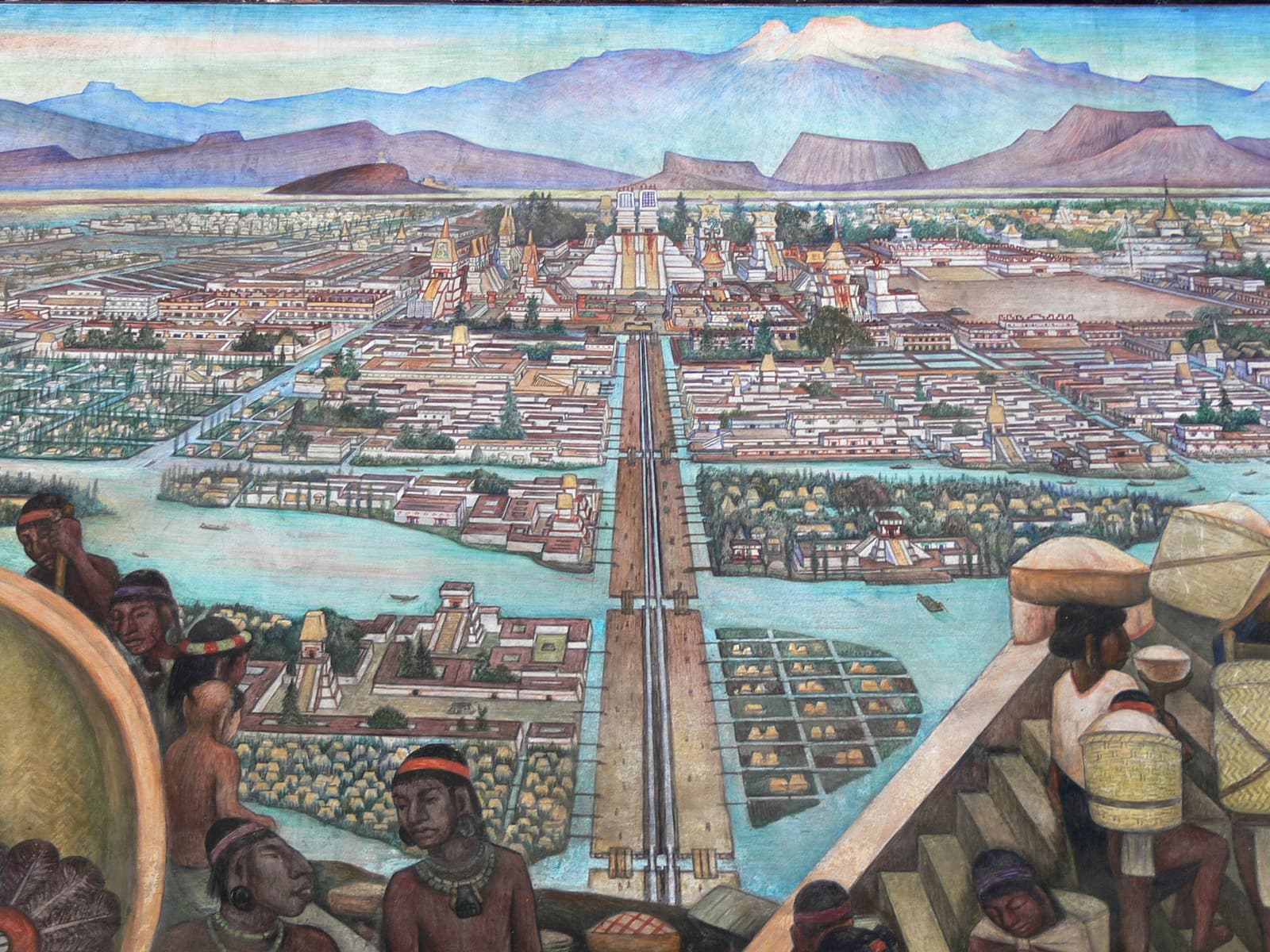
Image note: The header image (Rivera mural detail, "Markt in Tlatelolco") is used as a concrete example of muralism’s public-history method: crowded civic scenes, legible social roles, and narrative compression designed for viewing on architectural surfaces rather than in easel scale.[9]
1920s starting conditions: state walls, mass audience, compressed history
Most accounts anchor the movement’s launch in the years immediately after the Mexican Revolution (1910–1920), when public mural programs were funded and scaled in the 1920s.[1][2][3] The practical problem was clear: how do you address a broad public across class and literacy gaps, at city scale, in durable form?
Murals solved that with three built-in advantages:
- Architecture as distribution. A wall in a ministry or school guarantees recurring foot traffic.
- Large-format sequencing. Multi-panel cycles can stage long political timelines without requiring a book-like reading context.
- Shared civic placement. Viewers encounter the work as part of daily institutional life, not as a special museum trip.
This is why the movement should be read as a public communication system, not only as a studio movement.
The movement’s style grammar: legibility at distance, narrative in modules, conflict in composition
Across different artists and political positions, the movement converged on a recognizable formal grammar.[1][3]
- Legibility at architectural distance: strong silhouettes, high-contrast figure-ground choices, and clear directional movement.
- Narrative modularity: scenes arranged in clusters or bands so viewers can read history in segments rather than one frozen climax.
- Conflict as structure: labor/capital, indigenous/colonial, machine/body, church/state staged as compositional tensions, not only iconographic labels.
In other words, the core innovation was not “paint big.” It was to make social argument readable on public surfaces.
Three anchors show the movement’s range (1929–1934)
A tight way to see the movement is to compare three major cycles within a five-year window:
- Rivera, The History of Mexico (National Palace, 1929–1935): an explicit national-historical program in a federal seat of power.[4][5]
- Rivera, Detroit Industry Murals (Detroit Institute of Arts, 1932–1933): industrial production rendered as a modern epic in 27 panels, showing the movement’s transfer into a U.S. manufacturing context.[6]
- Orozco, The Epic of American Civilization (Dartmouth, 1932–1934): a 24-panel cycle that shifts from nationalist consolidation toward a broader hemispheric and civilizational argument.[7]
Read together, these projects show a movement flexible enough to keep its visual grammar while changing its institutional host and political address.
Why this was more than propaganda craft
It is easy to flatten muralism into state messaging. The historical record is messier and more interesting.[1][2][3] Government commissioning created a platform, but artists used that platform to stage internal contradictions—revolutionary promise vs. violence, industrial progress vs. worker precarity, national unity vs. social fracture.
That tension is a key reason the work remains visually alive. The murals do not just celebrate a line; they dramatize pressure between lines.
Afterlife: portable civic visual language
By the mid-20th century, the movement’s methods had traveled well beyond its first Mexican institutional sites, shaping public art approaches in the United States and later community mural traditions.[1][3][8]
What traveled was not a single icon set. What traveled was a workflow:
- choose a shared public surface,
- compress history into legible scene modules,
- tie aesthetic rhythm to civic argument.
That workflow still describes much contemporary public art, including projects that now operate through schools, transit corridors, and neighborhood walls rather than ministries.
If we read Mexican Muralism this way, its real legacy is not a canon of heroic images. It is a reproducible method for building public memory in plain sight.
Sources
- Wikipedia, Mexican muralism
- Khan Academy, Mexican muralism: Los Tres Grandes
- TheArtStory, Mexican Muralism Movement Overview
- Wikipedia, The History of Mexico (mural)
- Wikipedia, National Palace (Mexico)
- Wikipedia, Detroit Industry Murals
- Wikipedia, The Epic of American Civilization
- City College of San Francisco, Diego Rivera Mural Project (Pan American Unity context)
- Wikimedia Commons file record, Murales Rivera - Markt in Tlatelolco 3