German Expressionism is often taught as one emotional category—distortion, anxiety, color turned loud. That summary is easy to remember and too flat to be useful.
A higher-value read is to treat Expressionism as a movement-level language project with two different engines: Die Brücke (Dresden, 1905) pushed an urban, bodily, anti-academic rawness; Der Blaue Reiter (Munich, 1911) pushed symbolic color and abstraction as a route to inner life.[1][2][3] They overlap in intensity, but they do not solve the same formal problem.
1905: Die Brücke builds pressure through line, edge, and social friction
Die Brücke formed in Dresden in 1905 around Ernst Ludwig Kirchner, Erich Heckel, Karl Schmidt-Rottluff, and Fritz Bleyl.[1][2] Their visual wager was not "paint badly on purpose." It was to reject polite naturalism and recover urgency through hard outlines, compressed space, and unstable figure-ground relations.
Two technical choices matter for how the style feels in the body of the viewer:
- Woodcut logic inside painting. The blocky, cut-like edge behavior from print practice enters painted composition and sharpens tension.[1][4]
- Crowd-space compression. City scenes push figures toward the picture plane so distance collapses; social contact starts to read as pressure rather than narrative.[4][5]
That is why many Brücke works still feel contemporary: they model the city as a sensory load problem before they model it as a place.
1911: Der Blaue Reiter shifts from social pressure to symbolic structure
Der Blaue Reiter consolidated in Munich around 1911, with Kandinsky and Franz Marc as central figures.[2][3] If Die Brücke asks what modern life does to perception in streets and interiors, Der Blaue Reiter asks what color and form can do once depiction is loosened.
Its strongest contribution is not simply "more abstract painting." It is a transfer of pictorial authority from object likeness to relations among hue, rhythm, and directional force. Kandinsky’s theoretical writing and the group’s almanac frame this directly: color is not decorative finish, it is structural meaning.[2][3]
So inside one movement umbrella, two distinct grammars emerge:
- Brücke grammar: edge aggression, urban nearness, corporeal tension.
- Blaue Reiter grammar: chromatic-symbolic relations, spiritual interiority, compositional autonomy.
Seeing both grammars at once prevents the usual classroom blur where every distorted figure gets filed as the same style event.
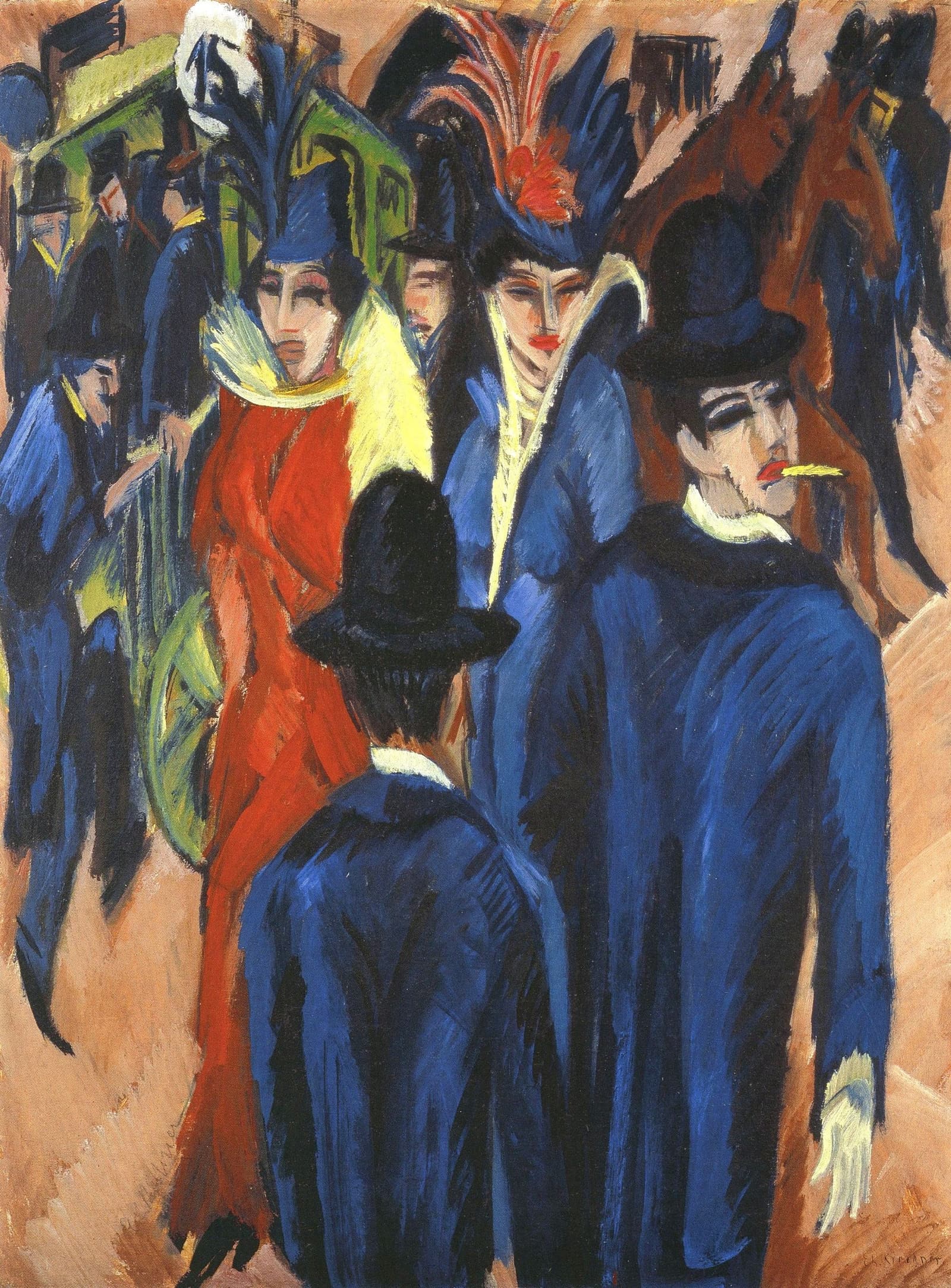
1913 as hinge: why Street, Berlin is still a high-signal image
Kirchner’s Street, Berlin (1913) is useful because it sits exactly at the movement hinge between social reportage and formal construction.[5][6] The painting is often read for subject matter—modern city, sex work, alienation—but its lasting force is compositional engineering:
- Diagonal crowd vectors force the eye into unstable movement.
- Mask-like faces reduce portrait individuality and increase typological tension.
- Acidic color opposition substitutes affective pressure for descriptive light.
In other words, the work does not merely show urban anxiety; it builds it through a reproducible visual syntax. That is what makes it movement-relevant instead of only biographical.
1933 rupture: suppression did not end the language, it redistributed it
The Nazi campaign against so-called "degenerate art" accelerated after 1933, including museum removals and the 1937 Entartete Kunst exhibition, materially disrupting Expressionist circulation inside Germany.[7][8] This is often narrated as an endpoint. Formally, it functioned more like forced redistribution.
Artists emigrated, collections moved, and institutional centers shifted. Parts of the Expressionist language—high-contrast contour, psychic color, spatial disquiet—continued through exile trajectories, postwar teaching environments, and later film/design vocabularies.[7][8]
So the historical curve is not simply rise-and-fall:
- 1905–1914: grammar construction,
- 1914–1918: war-shock transformation,
- 1933–1937: coercive break in domestic institutions,
- after: transnational afterlife rather than local continuity.
That sequence helps separate stylistic essence from institutional conditions.
How to read German Expressionism now without flattening it
Three practical moves improve reading quality immediately:
- Name the subgroup before naming the feeling. Ask Brücke or Blaue Reiter first; emotion labels come second.[1][2][3]
- Track operations, not adjectives. Line pressure, palette logic, distance compression, and figure-ground tension are more informative than saying "intense" or "angsty."[4][5]
- Keep 1933 in the frame. Without the institutional rupture, you miss why the movement’s later influence appears in displaced geographies and media.[7][8]
German Expressionism matters less as a mood and more as a toolkit: two early 20th-century experiments in how modern experience can be structured when representation is no longer the only contract between image and viewer.
Sources
- Tate, art term overview, Expressionism
- Encyclopædia Britannica, German Expressionism
- Guggenheim, Collection Online, Expressionism movement context
- MoMA, Collection, Ernst Ludwig Kirchner and German Expressionist works
- MoMA Collection, Ernst Ludwig Kirchner, Street, Berlin (1913)
- Smarthistory, Kirchner, Street, Berlin
- United States Holocaust Memorial Museum, Degenerate Art 1937 overview
- The Met Museum, Entartete Kunst historical context in German modernism resources
- Wikimedia Commons file record, Kirchner Berlin Street Scene 1913