
Ralph Fasanella is easy to praise in a way that leaves him smaller than he was. The summary version goes like this: a self-taught New York painter of baseball games, labor strikes, and immigrant neighborhoods, discovered late, beloved for crowded canvases full of ordinary life.[1][2][5] None of that is false. It is also not quite enough. The 1992 documentary that The Met has preserved is valuable because it shows that Fasanella did not treat painting as a retreat from politics or as a private compensation for obscurity.[1] He treated it as another kind of address, one continuous with organizing, teaching, arguing, remembering, and speaking in rooms full of people.
That distinction matters because Fasanella's pictures can look, at first glance, like exuberant memory maps.[1][2][4] There are street festivals, corner stores, ball fields, garment shops, ice wagons, strike scenes, and tenement interiors. A viewer could stop there and call the work affectionate social history. The film pushes harder. In the classroom segments, Fasanella repeatedly links painting to recognition: union meetings gave workers a place to speak, labor history gave him a philosophy, and pictures gave him a way to honor people usually described only through misery or condescension.[1] His paintings are crowded because his subject is not the isolated self. It is collective life trying to stay visible.
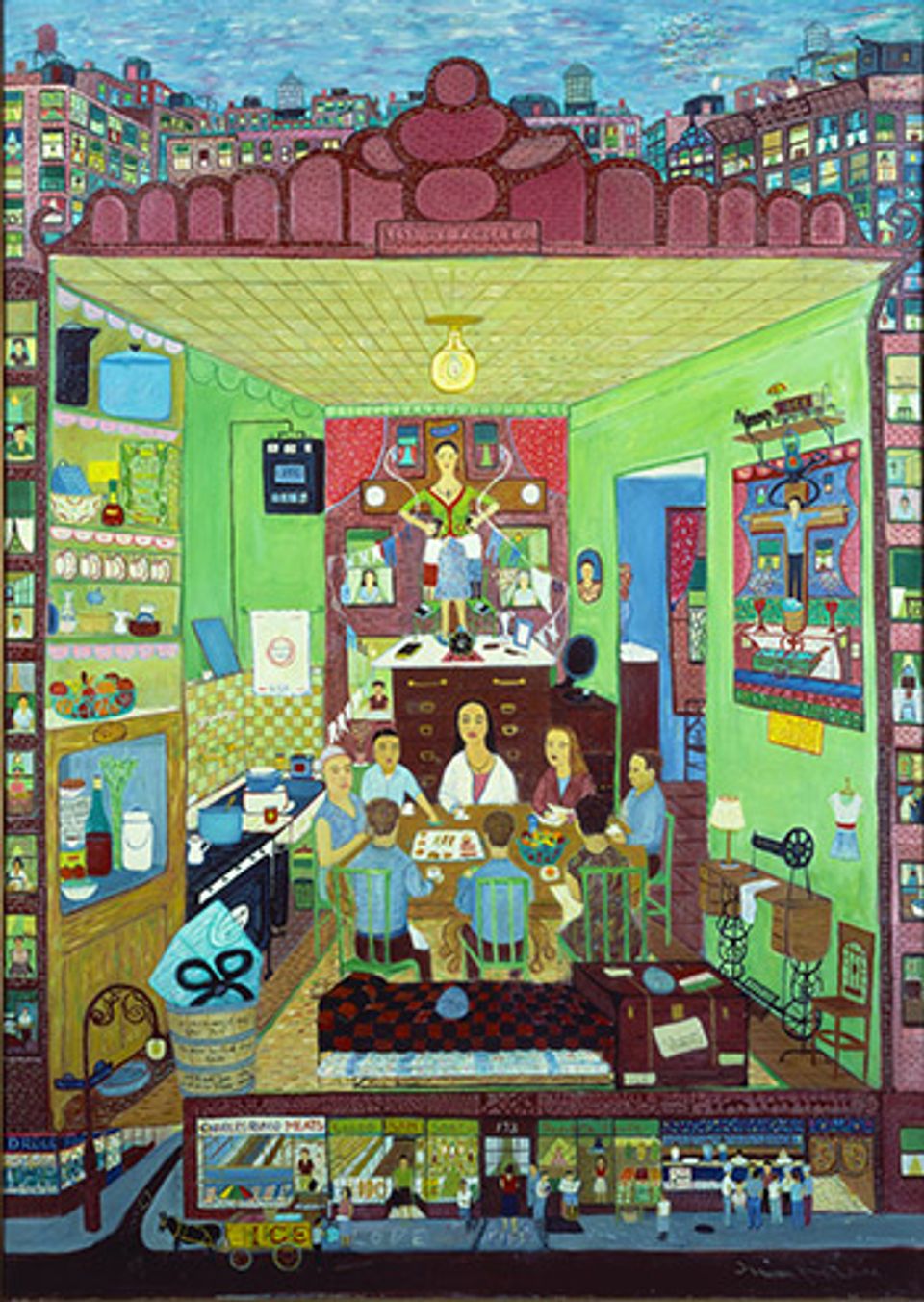
That is why Family Supper makes such a strong center for an archival spotlight.[1][2][3] The film builds toward the 1991 installation of the painting at Ellis Island, but it does not present the canvas as a museum trophy finally receiving its due.[1] It presents it as a return route. The kitchen table, the immigrant apartment, the mother, the father, the trades, the radiance of food and argument, and the memory of cramped living all become a political origin scene. Fasanella's later labor pictures do not leave that room behind. They enlarge it.
Image context: the cover uses the Smithsonian American Art Museum's reproduced image of Family Supper from the Fasanella exhibition materials. That choice fits the essay because the documentary treats the painting less as one masterpiece among others than as a portable model of his whole world: immigrant labor, domestic density, and an ethics of shared life that extends outward into union halls, streets, and schools.[2][3]
Historical context: Fasanella painted as an organizer who never accepted the split between art and ordinary people
The Smithsonian American Art Museum's centennial exhibition text provides the clearest written frame for Fasanella's larger project.[2] Born in the Bronx in 1914 and raised in working-class New York neighborhoods, he spent years as an ice delivery helper, garment worker, truck driver, gas station operator, and union organizer before devoting himself full-time to painting.[2] That background is not incidental biography. It is the internal grammar of the work. SAAM describes the paintings as memorial documents, didactic tools, and rallying cries, all aimed at making a better society palpable to his own community and others like it.[2]
The documentary gives those museum phrases their living rhythm.[1] Fasanella tells students that labor struggle gave him a base of operation, that unions produced concrete gains such as pensions, shorter hours, and hospitalization, and that the union meeting mattered because people who did not have all the answers still had part of the answer.[1] That language is crucial. It means his paintings should not be read as illustrations attached to preexisting politics. Painting arrives from the same democratic practice: many voices, partial knowledge, shared stakes, and a need to keep ordinary people from vanishing into abstraction.
SAAM's object page for Modern Times makes the anti-elitist edge even plainer.[4] In that 1966 canvas, Fasanella contrasts the papal visit, workers, protesters, and returning soldiers with a detached technological and fine-art sphere, and the museum notes that he believed art did not need to be aloof or conceptual; it could function like a hammer.[4] That remark illuminates the whole film. Fasanella is not hostile to art because he is self-taught. He is hostile to any art world that mistakes distance for seriousness. The American Folk Art Museum's presentation of Lest We Forget sharpens the same point from another side: he celebrated the common man, kept labor at the center of postwar American painting, and left behind not just canvases but notebooks, correspondence, photographs, and films documenting a deliberately public career.[5]
Video provenance
The embedded video is The Met's official YouTube upload of Fasanella, 1992 | From the Vaults.[1] The museum's description identifies it as a 1992 documentary by Glen Pearcy, narrated by Julian Bond, and summarizes its structure with unusual clarity: Fasanella speaks to high-school students, revisits Greenwich Village, recalls work in garment and truck jobs and in union organizing, and oversees the permanent installation of Family Supper at Ellis Island.[1] That provenance matters for an archival spotlight. This is not a detached clip floating online without context. It is a preserved institutional release of a late-career portrait, built around a specific public event and a specific painting's afterlife.
Close reading: what the film shows about painting as speech addressed to workers, immigrants, and students
The opening Ellis Island sequence immediately refuses the usual art-documentary arc.[1] The narration does mention Fasanella's long obscurity and his belated fame after a 1972 New York Magazine cover story, but the film does not settle there.[1] It moves from Wall Street by boat to Ellis Island, where Family Supper will enter the Great Hall that millions of immigrants, including Fasanella's parents, had passed through.[1] That shift changes the meaning of recognition. Success is not staged as market arrival or elite validation. It is staged as a return of immigrant memory into public space. The painting is installed where family history and national processing once crossed.
The middle classroom section is even more revealing because it shows Fasanella teaching the relation between labor and form in plain speech.[1] He tells students that when he entered art school through a labor school, people were startled that an organizer had walked into an art class.[1] That anecdote is more than charming self-mythology. It names the false division the film keeps undoing. In Fasanella's account, labor history gave him subject matter, political feeling, and a language of recognition before he ever became a painter.[1] When he discusses the 1912 Lawrence strike, he emphasizes women as the strike's spearhead and admires the way different ethnic groups were brought together to beat the company.[1] The paintings inherit that same multi-figure pressure. Crowds are not background decoration. They are the form social solidarity takes on canvas.
The family section moves the argument inward without making it private.[1][3] Fasanella says directly that he paints his family, his work, his unions, the kids going to school, and his surroundings, then tells the students not to forget their roots.[1] In a weaker artist portrait, that advice would become sentimental autobiography. Here it becomes a theory of political memory. Marc Fasanella's SAAM essay on Family Supper helps explain why. He describes the kitchen as both a concrete tenement interior and an emotional center, full of immigrant trades, local food, family tensions, and the radiance his father put into every detail.[3] The painting therefore does not preserve roots as static heritage. It turns domestic life into the energy source for a broader ethics of empathy and public attachment.
The documentary's late garment-shop sequence makes that ethics contemporary rather than merely ancestral.[1] On the very day of the Ellis Island ceremony, Fasanella visits a shop now staffed by Chinese workers, begins sketching, and says that when he is finished they will not remain distant others: they are us, and we are them.[1] That is one of the film's decisive moments. It prevents immigrant memory from hardening into ethnic nostalgia. The old Italian and Jewish garment world does not return as a closed lost world. It reappears as a transferable structure of work, exploitation, kinship, and identification.
The final exchange with the students completes the argument.[1] Asked who he paints for, Fasanella answers that he has to paint for an audience like them or he fails; his audience is his people, the working guy, the factory worker, the cop in Brooklyn, wherever most people are.[1] He explicitly excludes Wall Street and the rich from that primary horizon, then insists that art has to be taken in a social context.[1] That is the key to the whole documentary. Fasanella's canvases are not private diaries later shown in public. They are public address by other means.
Legacy: why this archive still matters now
The archive matters because it protects Fasanella from being reduced to an outsized folk stylist with a crowded picture plane.[1][2][5] It shows a painter who never accepted the prestige bargain in which art rises by separating itself from workers, immigrants, and common speech. The written sources preserve the themes, but the film preserves the cadence: the argument, the classroom repartee, the return to Sullivan Street, the Ellis Island ceremony, and the insistence that painting should answer to people who actually live inside history rather than hover above it.[1][2][3][4]
Seen from 2026, that feels more demanding than nostalgic.[1][2][5] Fasanella's question is not whether ordinary life deserves representation in the abstract. It is whether artists are willing to locate an audience, a neighborhood, a social base, and a memory structure sturdy enough to keep their work from floating free of consequence. The documentary answers by example. Family Supper hangs at Ellis Island, but it still points back to the kitchen and outward to the garment shop. That double motion is the measure of Fasanella's art. It remembers, and then it speaks.
Sources
- The Met, "Fasanella, 1992 | From the Vaults," YouTube video, published June 18, 2021.
- Smithsonian American Art Museum, "Ralph Fasanella: Lest We Forget" - exhibition page on Fasanella's labor background, social aims, and major paintings including Family Supper and Modern Times.
- Smithsonian American Art Museum, "Family Ties: Marc Fasanella on his Father's Painting Family Supper" - essay on the tenement kitchen, immigrant family structure, and the painting's emotional world.
- Smithsonian American Art Museum, "Modern Times" - object page describing Fasanella's critique of elitist art and his belief that painting could be used like a hammer.
- American Folk Art Museum, "Ralph Fasanella: Lest We Forget" - exhibition page on Fasanella's working-class subject matter and the museum's archive of his paintings, records, photographs, and films.