Mark Rothko's mature paintings are among the most physically demanding objects in modern art — not because they are difficult to understand, but because they refuse to work at a distance.[1][2] Standing close to one of the large canvases from the late 1950s or early 1960s, a viewer cannot take in the full field of soft-edged color without peripheral vision beginning to lose the edge. The rectangle fills the eye rather than presenting itself to it. The effect is less like viewing a picture than entering a room whose walls are made of light that has weight.[1][2][3]
That quality was not a stylistic starting point. Rothko arrived at it through two decades of discarded approaches. The route matters because it shows that the large color field was his conclusion — a formal position earned through sustained argument with his own earlier work.[2][3]
From figuration to the first fields
Born Marcus Rothkowitz in Dvinsk (now Daugavpils, Latvia) in 1903, Rothko emigrated to the United States as a child and eventually settled in New York, where his painting career began in the late 1920s.[2][3] His early canvases are figurative: urban scenes, subway interiors, figures in isolated domestic space. They are capable but not yet distinctive. In the late 1930s and early 1940s, Rothko moved through a phase of Surrealist-inflected mythology, using hybrid creatures and archaic symbols as structural devices — work that placed him loosely inside the New York Surrealist circle.[2][3]
The crucial transition came in the mid-to-late 1940s. He began eliminating the figure, then the symbolic reference, then the horizon. By around 1949–1950, he had arrived at the format he would refine for the rest of his life: two or three soft-edged rectangles of color, stacked vertically on a colored ground, with the whole canvas reading as a single luminous presence rather than a composition of parts.[1][2]
He later described the direction as a drive to eliminate obstacles between painter and idea, and between idea and viewer.[3] Whatever that language explains or overstates, the formal result was a kind of painting that functioned more like suffused light than like representation. Color was no longer filling in a shape; it was the structure itself.
Scale as argument, not statement
What separated Rothko from other painters working with color fields in the same period was his insistence that scale was a content decision.[1][2] His canvases grew until a viewer standing at close range — Rothko was specific about installation distance — could not take in the whole field without the edges entering peripheral blur. The painting pressed at the boundary of sight.
He framed this explicitly: he wanted paintings that were intimate despite their size, that surrounded rather than impressed.[3] In his terms, the large canvas was a device for closing distance rather than commanding a room. A painting that fills the visual field produces a different encounter from one that asks to be read from across a gallery. It changes the tempo of attention.
The surface technique reinforced this. Rothko built up multiple thin glazes over a base layer, producing luminosity that appears to come from within the surface rather than reflect off it.[1][2] The boundary between one color rectangle and the next is a soft transition — more membrane than line — and the eye keeps probing it for a definition it never supplies. The uncertainty this creates is not frustrating; it keeps the viewer attending. The paintings hold the body in place.
The Seagram Murals: commission, withdrawal, donation
In 1958, Rothko accepted a commission to create murals for the Four Seasons restaurant in Mies van der Rohe's Seagram Building in New York.[1][4] He received a substantial advance, traveled to Europe, and spent more than a year producing the canvases — large, architecturally scaled works dominated by deep reds, burgundies, and maroons, with forms that suggested classical doorways or arched apertures without naming them directly.
Then, after dining at the restaurant upon its opening, he returned the advance and withdrew the paintings.[1][4]
What Rothko said, in various accounts, was that he understood on sitting in that room that his paintings would hang there while prosperous people ate very good food, and that he had not made them for that position.[4] The Seagram Murals were eventually distributed across several institutions: a group went to Tate Gallery in London (now Tate Modern), others to the Museum of Fine Arts Houston, the National Gallery of Art in Washington, and the Kawamura Memorial DIC Museum in Japan.[1][4]
At Tate Modern, the murals occupy a dedicated room with controlled low light and simple seating along the walls. The installation approximates what Rothko believed a viewing environment should be: no competing objects, no noise, slow adaptation as eyes adjust. In that room, the commission's strange arc becomes legible. The paintings are not decorative additions to an interior. They are environments that would have consumed the restaurant rather than ornamented it. The withdrawal was formally consistent.[1][4]
The Rothko Chapel: painting as total space
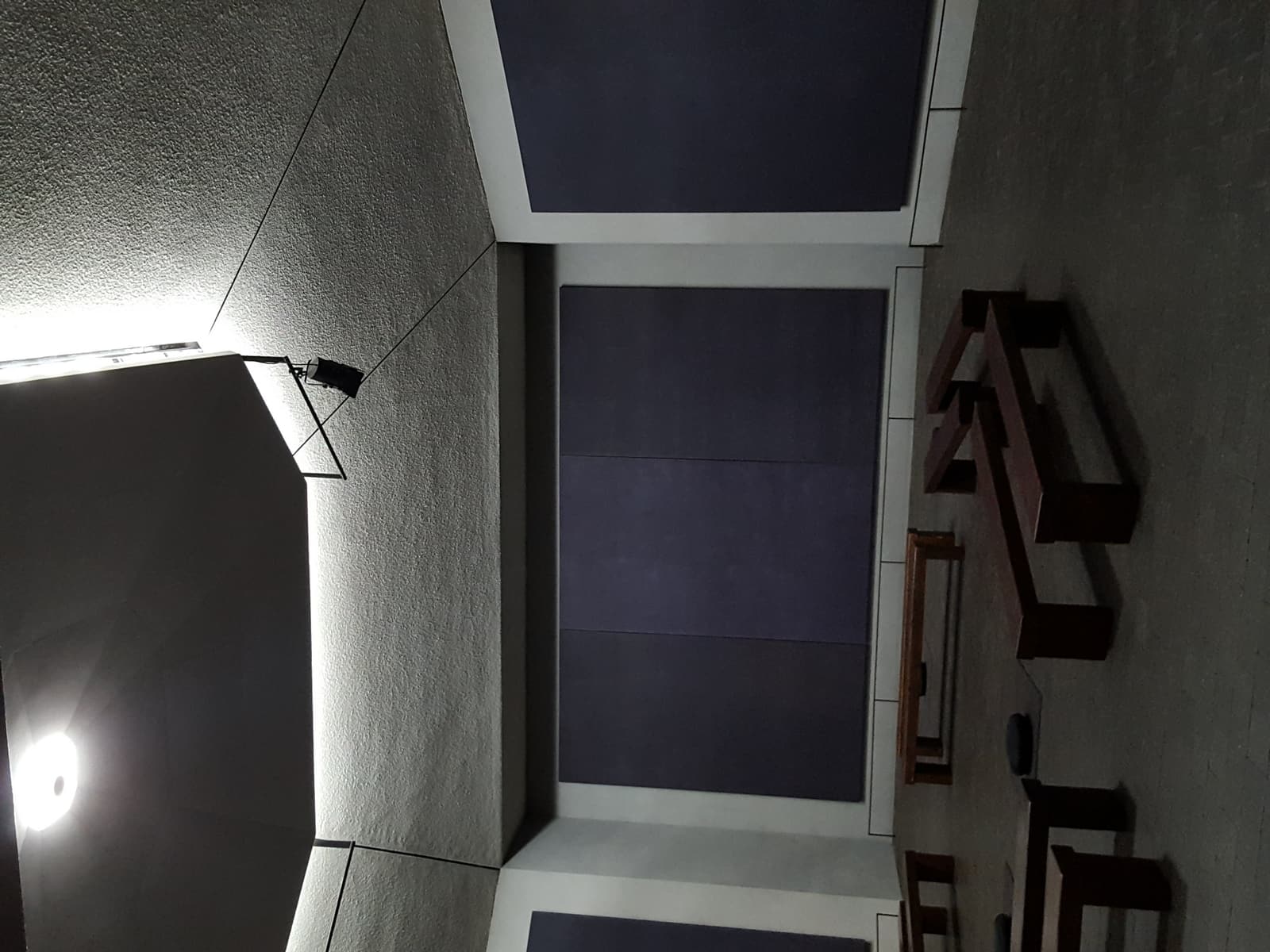
The last major commission came from Houston philanthropists John and Dominique de Menil, who asked Rothko to design both the paintings and the architectural environment they would inhabit.[5] The result, completed in construction after Rothko's death and dedicated in February 1971, is the Rothko Chapel: a small, octagonal, non-denominational space in Houston containing fourteen large canvases in deep mauves, near-blacks, and plum tones arranged across the walls and in triptych format.[5]
The Chapel is not a gallery in the museum sense. Visitors sit in it, meditate in it, hold interfaith services in it. It functions as a space of reception for Houston civic grief; it has been used for political events, marriages, and moments of mourning.[5] The paintings in this context operate entirely differently from museum works. There are no labels, no interpretive panels, no neighboring canvases for comparison. The only context is the building, the diffuse natural light entering from the oculus above, and the presence of other people in the same silence.
What Rothko built in the Chapel was the logical endpoint of the trajectory begun twenty years earlier. If the paintings were designed to surround rather than display, and if scale and installation controlled the terms of the encounter, then the final move was to design the encounter itself — to make the architecture part of the work. The Chapel achieves a total integration of painting and space that most public art aims at and almost none manages.[5]
February 1970
Rothko did not live to see the Chapel dedicated. He died in his New York studio on February 25, 1970, from an aortic rupture. The years following his death were marked by a protracted legal dispute over his estate that resulted in a landmark 1975 fraud ruling — one of the formative cases in American artist estate law.[2]
The foundation established from the estate has since become a significant institutional funder. But the primary case remains the paintings themselves: the mature canvases from roughly 1949 to 1970, which appear in major collections across North America, Europe, and Asia and still produce the quality Rothko described as his aim — an intimacy that operates at very large scale, the sense of something being said quietly in a very large room.[1][2][3]
Why the argument holds
There is a recurring failure mode in writing about Rothko that reduces the paintings to mood machines — instruments for producing sadness or transcendence on demand. That reading is not wrong so much as incomplete. What the mature canvases demonstrate is a formal argument: that painting's primary resource is the physical environment of attention, and that color relationships, surface quality, and scale can restructure that environment without narrative or symbolic content.[1][2][3]
The argument has not aged out. In an image environment where most visual objects compete through novelty, density, or immediate recognition, the large Rothkos ask for something else: sustained presence, willingness to stay at the edge of the soft boundary, patience with a resolution that never arrives. Whether that registers as transcendence or as careful sustained looking, the paintings keep making the case.[1][2][3][5]
Sources
- Tate Modern, Mark Rothko — artist page and Seagram Murals collection context.
- Museum of Modern Art (MoMA), Mark Rothko — collection page and career overview.
- TheArtStory, Mark Rothko — overview of career development, technique, and critical reception.
- National Gallery of Art, Washington D.C. — Mark Rothko collection, including Seagram Mural provenance.
- Rothko Chapel, Houston — official site, commission history and chapel context.