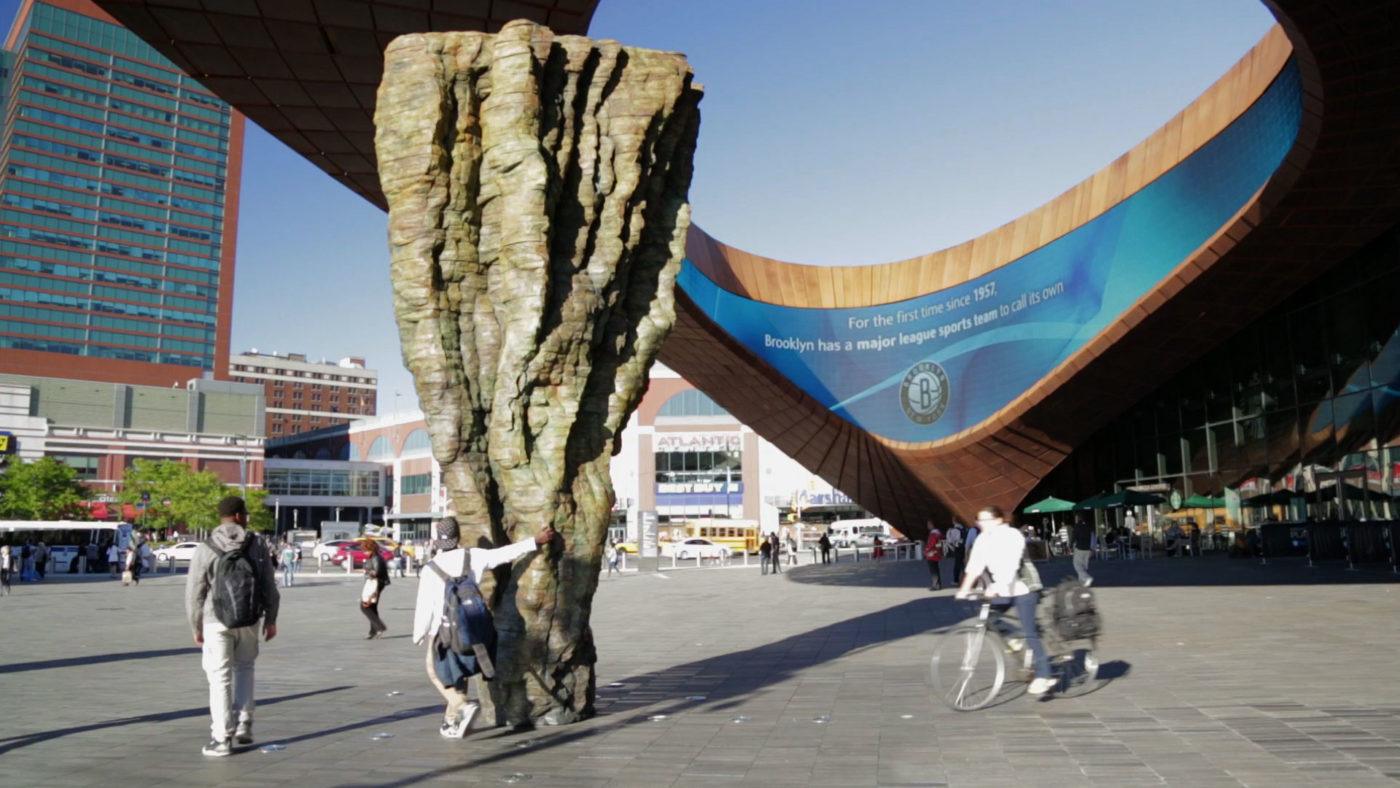
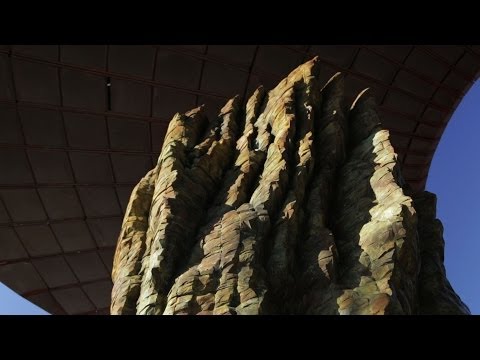
From a distance, Ursula von Rydingsvard's Ona could be a split tree trunk, a weathered cliff, or an enormous vessel caught midway between standing and opening. Up close, those analogies break apart. Its surface is bronze, yet it carries grooves, ledges, cuts, and compressed layers that seem to belong to worked timber. The sculpture does not ask the viewer to choose between natural growth and deliberate construction. It makes both readings remain active.
That doubleness begins in the studio. Von Rydingsvard first built Ona from cut cedar beams, then had the form cast in bronze at Polich Tallix Fine Art Foundry for permanent installation outside Barclays Center in Brooklyn.[2][3] The finished work rises more than 19 feet and weighs nearly 12,000 pounds, but its force is not simply monumental. The important fact is that a public metal sculpture was conceived through a material von Rydingsvard could draw on, cut, stack, glue, and revise by hand.[3][6] Bronze gives the work durability; cedar gives it a memory of decisions.
Art21 filmed von Rydingsvard at the foundry and in the plaza in August 2013, close to the work's installation.[2] Its six-minute film is worth watching as a study in translation rather than fabrication spectacle. Look for three transfers: from cedar into bronze, from a dark studio vocabulary into colored patina, and from the artist's control into the unpredictable touch and weather of a public site. The film's strongest claim is that none of those transfers is exact. Each preserves something by allowing something else to change.
Before bronze, a vocabulary of cut wood
The film assumes a process that deserves to be made explicit. Von Rydingsvard has worked primarily with cedar since the mid-1970s. For her large wood sculptures, an outline begins on the studio floor; lengths of milled cedar are marked, cut, stacked, and glued, while successive layers answer what has already been built.[6] The procedure is additive and subtractive at once. A volume accumulates beam by beam, but the saw keeps biting into it. What looks from across a room like one swelling body is, at close range, a record of many joins and removals.
That is why Ona's bronze should not be treated as a disguise. Art21's photographic record includes the original cedar form, separate cast sections, welding at the foundry, the application of patina, and the installed sculpture.[4] Casting carries the cedar construction's ridges into another material, but it does not turn bronze back into wood. The surface remains metallic, capable of reflecting light, receiving chemicals, weathering outdoors, and carrying loads that a permanent plaza commission demands.
Around the 3:00 mark, von Rydingsvard describes the difference as a limit on control.[1] Cedar can be pushed through cuts and revisions while metal cannot be manipulated in quite the same intimate way. Her response is not to erase that frustration. She lets it define the finished work. The bronze is an afterlife of the wood, not its identical twin. Its authority comes from keeping the trace of one medium while accepting the behavior of another.
Around 0:37: color becomes a decision about place
The film opens not with a heroic reveal but with tests. Von Rydingsvard and patina artist Philip Castore examine variations in the bronze surface, including irregular runs that the process has produced.[1] This is an unusually useful beginning because it shows color as negotiated, local, and uncertain. Patina is not a final cosmetic coat added after the real sculptural work. It determines how recesses hold darkness, how projecting ridges catch daylight, and how the whole object separates from its surroundings.
The surroundings matter. At roughly 2:30, von Rydingsvard explains that the arena's broad Corten-steel facade made her want a surface lighter and brighter than her customary black.[1][2] That choice prevents Ona from becoming a smaller echo of the building. Its green, gold, brown, and darkened passages answer the rusty architecture without disappearing into it. A studio preference yields to a site-specific contrast.
This passage also corrects a common fantasy about public art: that an artist simply enlarges a familiar form and places it outdoors. Scale changes fabrication, but site changes judgment. Ona had to meet an arena, a subway entrance, open sky, pedestrian movement, and the hard visual field of a major intersection. The patina is where those conditions enter the sculpture most visibly. It gives a surface born from cedar enough optical range to hold its place beside metal architecture.
Around 3:38: translation refuses imitation
The conceptual hinge arrives when von Rydingsvard says she is not trying to make the bronze pass for wood.[1] That distinction is crucial. If perfect imitation were the goal, every green streak or metallic glint would count as a failure. Instead, the work preserves the cedar's carved information while making bronze's own qualities legible. The casting keeps an index of pressure and cutting; the patina announces heat, chemistry, oxidation, and time.
The National Museum of Women in the Arts notes that von Rydingsvard expected the finish to change as passersby rubbed and touched it.[3] This makes weathering part of the material argument. Cedar gave the original its worked surface, the foundry translated that surface into bronze, and the plaza continues to edit the patina. Durability here does not mean visual stasis. It means the object can survive change long enough for change to become visible.
There is a productive reversal in that sequence. Bronze is conventionally associated with permanence and memorial authority; wood with organic vulnerability and the direct trace of tools. Ona gives the permanent material a vulnerable-looking skin. Its folds appear eroded, split, and handled even when the metal is structurally secure. The result is not a monument pretending to be nature. It is a monument that keeps evidence of touch at every stage of its making.
Around 5:02: the plaza completes the work
In the film's final movement, von Rydingsvard stresses that this is not a museum situation.[1][2] There are no protective rails around Ona. She wanted psychological approach and physical approach to meet, so that visitors might, in her compact phrase, "see with one's hands."[1] Art21's installation photographs make the proposition concrete: pedestrians pass within arm's reach, and one image catches a visitor pressing a palm to the ridged bronze.[4]
Touch is not an interactive flourish laid over a finished object. It resolves the work's transfer between materials. A hand cannot feel the original cedar, but it can read the cedar's former topography in bronze: rises, channels, interruptions, and seams translated into a colder, harder surface. The body learns that the sculpture was cut before it was cast. Looking supplies scale and silhouette; touch supplies sequence.
The public setting also removes the institution's ability to choreograph a single ideal encounter. Commuters can hurry past. Event crowds can use the sculpture as a landmark. Someone can stop, circle it, touch it, or ignore it. Barclays Center's current public-art page still lists Ona on view, more than a decade after its 2013 installation.[5] That continuity matters because the work was designed for repeated, ordinary exposure rather than a temporary exhibition's concentrated attention.
What the camera adds
Art21's camera links sites that a plaza visitor cannot see at once: patina tests at the foundry, separated pieces, the artist working at close range, and the assembled form in Brooklyn.[1][2][4] The edit therefore restores the sequence hidden by the finished sculpture. Without that sequence, Ona may look geological, as if it arrived fully formed. With it, the surface becomes legible as a chain of labor distributed among artist, studio assistants, foundry specialists, installers, and eventually the public.
The video does not make the sculpture easier by assigning it one symbol. Von Rydingsvard gives the Polish title a feminine reference—ona means “she”—but she does not turn the form into an illustrated body.[1][2] Vessel, trunk, cliff, garment, and figure remain possible without becoming compulsory. The more precise meaning lies in the material passage itself: a form can carry history without freezing it, and a cast can preserve contact without pretending that nothing was lost in translation.
That is the best reason to watch this short film. It changes Ona from a large object into a material verb. Cedar is cut, the cut is cast, bronze is colored, color is weathered, and weathering is accelerated by hands. The sculpture remembers its origin precisely because it does not remain there.
Sources
- Art21, “Ursula von Rydingsvard: ‘Ona’ | Art21 ‘Extended Play,’” YouTube video, November 29, 2013.
- Art21, “Ursula von Rydingsvard: ‘Ona’ (Short)” — official film page with August 2013 provenance, production credits, and project context.
- National Museum of Women in the Arts, “Ursula von Rydingsvard: Monumental Public Art” — dimensions, cedar-to-bronze process, and the intended evolution of Ona's touched patina.
- Art21, “Ursula von Rydingsvard: ‘Ona’ (2013)” — photographic record of the cedar original, foundry work, patination, installation, and the production still used for this article.
- Barclays Center, “Brooklyn Art Encounters” — current public-art page listing Ona on view in the arena's public spaces.
- Bruce Museum, “Ursula von Rydingsvard: states of becoming” — museum account of the artist's five-decade practice and her additive-and-subtractive cedar construction process.