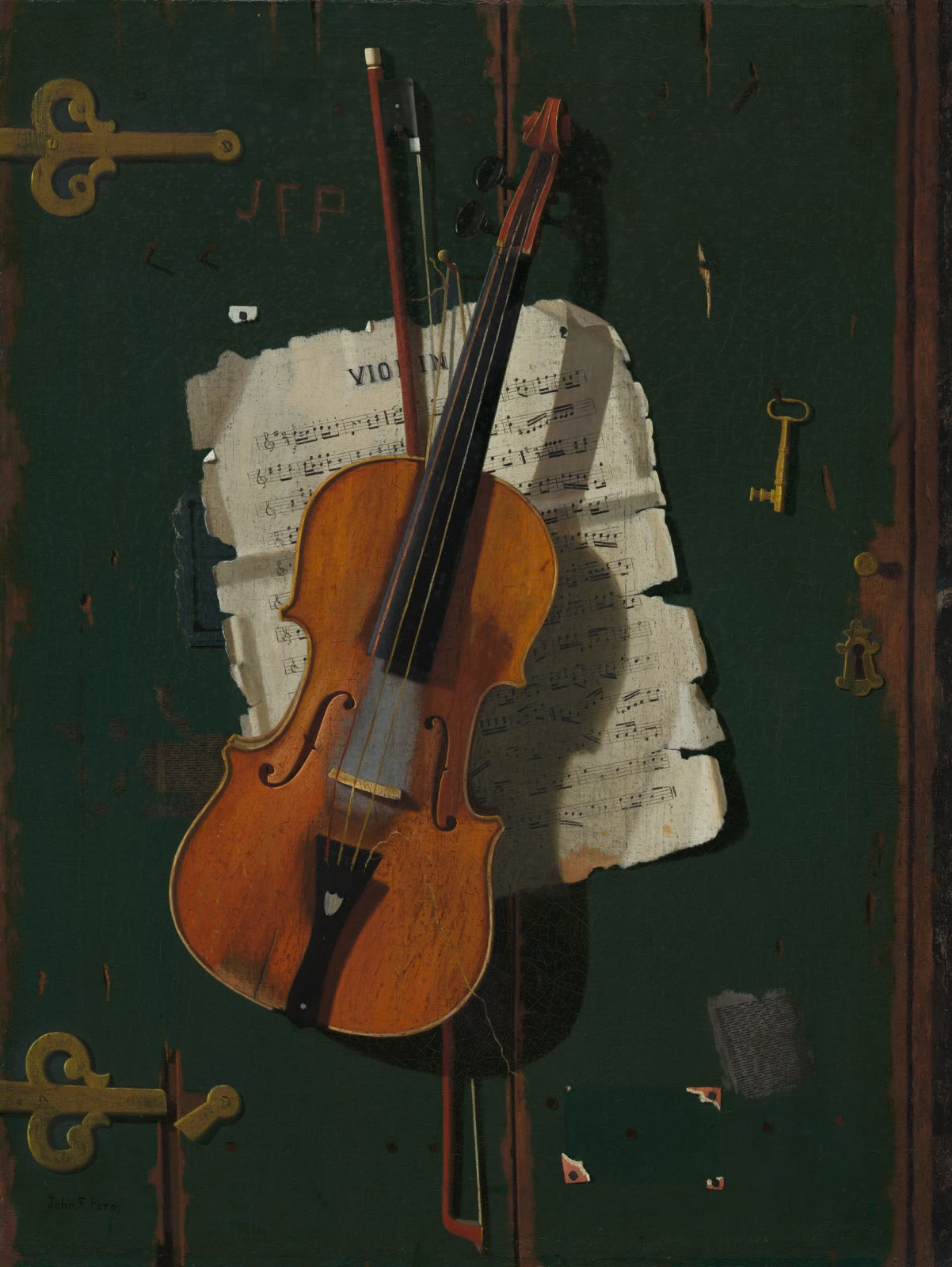
A violin hangs where someone once put it, but almost nothing in John Frederick Peto's The Old Violin suggests that a player will return. One string has snapped. Rosin has accumulated beneath the others. The sheet music is torn and rubbed, the green door is split, and fragments of paper cling to it after their messages have become unreadable. Even the lower hinge has lost part of itself.[1][2]
The painting is a trompe-l'oeil, an image made to “deceive the eye,” but deception is only its opening move. Peto gives the violin life-size scale, a cast shadow, and just enough projection to make it seem temporarily present. Then he spends that credibility on wear. The closer the viewer gets, the less the picture feels like a trick and the more it feels like a record: not of music being performed, but of all the handling, waiting, and neglect that remain after performance ends.
That is what separates this circa 1890 canvas from a virtuoso demonstration of realism. Peto did not merely paint an old object convincingly. He made damage behave like memory.
The diagonal refuses display
At first, the composition appears almost too spare. The National Gallery of Art records a canvas 77.2 by 58.1 centimeters, large enough for the suspended instrument to confront the viewer at something close to bodily scale.[1] A dark green door fills the field. The violin crosses it on a descending diagonal, its neck leaning right while the bow drops behind it in a near-vertical line. Pale music lies underneath, caught partly in the violin's shadow.
That diagonal matters. A prized instrument in a formal display might be centered, polished, and stabilized. Peto's violin seems to sag. Its body supplies the painting's largest warm shape, but it never settles into symmetry. The bow is tucked behind rather than ceremonially paired with it; the score is pinned rather than opened on a stand. Music has been converted from an event into storage.
The door intensifies that conversion. It is not a neutral wall. Hinges, keyhole, dangling key, nail holes, splinters, and a vertical crack turn the background into another used object.[1][2] Doors normally promise passage, but Peto shows only their face. Nothing opens. The key hangs beside its lock as if access itself has become part of the still life.
Two surfaces age at once
The most revealing facts about The Old Violin come from the National Gallery's technical record. Peto deliberately abraded the painted sheet music so the paper would appear old. The actual canvas, meanwhile, has its own later history: it was lined, its dimensions were increased by opening parts of the original tacking margins, and paint was added along portions of the enlarged edges.[2]
Those are two different kinds of age. Inside the image, Peto manufactures deterioration with paint. Outside the image, the painting itself has been altered by handling and restoration. Confusing them would miss the work's intelligence. The worn score is not documentary evidence that an actual sheet of music decayed on an actual door; it is an exact fiction about decay. The expanded margins belong to the physical biography of the canvas after Peto finished it.
Trompe-l'oeil usually invites a binary response: real or painted, fooled or not fooled. This picture offers a more interesting problem. Once the deception is exposed, the viewer must still decide what kind of truth painted wear can carry. Peto's abrasion is false as damage but accurate as observation. He knows how paper thins at its edges, how a handled object loses finish unevenly, and how remnants can imply the things no longer there.
The marks therefore work less like special effects than verbs. Rosin accumulated. A string broke. Paint peeled. Paper tore. The picture's stillness contains a sequence of past actions.
Harnett supplied a model, not a destination
Peto's title creates an unavoidable double. William Michael Harnett's own The Old Violin dates to 1886 and became a celebrated example of American trompe-l'oeil. The National Gallery's collection record documents its exhibition history, while the Gallery's systematic catalogue notes that an 1887 chromolithograph distributed the composition to a broad audience.[2][3] Peto knew Harnett, and both the catalogue and The Met's account of Peto's related The Old Cremona place his violin pictures in direct conversation with Harnett's prototype.[2][4]
The comparison clarifies Peto's choice. Harnett's instrument is held in a balanced, hard-edged display whose illusionism announces control. Peto loosens that order. His violin tilts; the door darkens; edges soften; scraps lose their legibility. The Met describes The Old Cremona as flatter, more textural, and more evocative than purely illusionistic.[4] The same distinction helps here. Peto borrows the format of an eye-fooling showpiece and turns it toward atmosphere.
This does not make him an anti-realist. The broken E string, crack in the violin's lower top plate, abraded varnish, and deposits of rosin are acutely observed.[2] But precision no longer serves pristine possession. It serves evidence of use. The object looks convincing because Peto wants its exhaustion to feel specific.
That difference also resists the old story in which Peto is merely the melancholy follower of a more successful artist. The Smithsonian records their friendship and the later misattribution of some Peto paintings to Harnett, while LACMA contrasts Harnett's hard-edged deception with Peto's softer light and preference for worn, modest things.[5][6] Influence is visible, but so is revision. Peto does not fail to make Harnett's picture. He changes the question it asks.
Sound survives as powder and paper
The violin is silent, yet the painting is crowded with traces of sound. The Gallery catalogue identifies the torn score as the violin part of an otherwise unknown period polka. It also notes that music belonged to Peto's working life: he played violin and performed as a cornetist after moving to Island Heights, New Jersey.[2] The Smithsonian likewise places that move in 1889, near the painting's probable date.[5]
Biography helps, but it should not be used as a shortcut. The picture is not automatically a self-portrait because its maker played instruments. What matters is how musical knowledge sharpens the painting's details. Rosin is not generic dust; it is residue produced where bowing and maintenance meet. A broken E string does not disable the whole object visually, but it interrupts the expectation that this instrument is ready. The score still carries notation, yet its unknown polka can no longer be reconstructed from the fragment as a complete performance.
Peto makes music legible through what it leaves behind. Powder settles where vibration once began. Paper outlasts the tune but not intact. The bow remains close to the violin without touching it. Every component needed for sound is present in reduced form, and their proximity makes the silence more exact.
The signature joins the debris
Near the upper left, the initials “JFP” appear to have been carved into the painted door. Lower down, Peto signs the canvas again.[1][2] The double marking is easy to treat as a flourish, but it completes the work's argument about surfaces.
One name belongs conventionally to the painting; the other pretends to belong to the door. The simulated carving makes authorship look like another trace left by contact, no more elevated than a nail hole or a pasted clipping. Peto inserts himself into the fiction not as a reflected gentleman or studio master, but as wear.
Around those initials, the scraps refuse to deliver a stable story. A bit of newspaper survives without readable news. The sheet music retains a heading and notation without restoring its occasion. The key has no identified owner. Peto's objects encourage biography and withhold it at the same time. They feel personal because they have been handled, not because every symbol can be decoded.
That boundary matters. It keeps the picture from collapsing into sentimental allegory. A damaged violin can suggest mortality, lost art, rural nostalgia, or the artist's obscurity, and the Gallery catalogue documents the subject's late-nineteenth-century associations with time and feeling.[2] Yet Peto never labels one interpretation as the answer. He gives the viewer a damaged instrument and a damaged support, then lets physical relations carry the mood.
The trick ends; the contact remains
Seen from a distance, The Old Violin offers the classic pleasure of trompe-l'oeil: canvas impersonating wood, paper, metal, and varnished spruce. Seen longer, its deepest illusion is temporal. The painting makes a sequence of vanished touches feel present all at once.
The snapped string and rosin do not simply say “old.” They distinguish pressure from neglect, use from storage. The papers do not simply say “past.” Their torn edges show that information can disappear while material survives. The door does not simply say “background.” Its lock, hinge, crack, and peeling green make the entire picture feel closed, handled, and vulnerable.
Peto needs deception to bring us near enough to notice those differences. But once we are there, proving that paint is paint is beside the point. The eye has not been defeated. It has been recruited into touch.
Sources
- National Gallery of Art, “The Old Violin” — object record, open-access artwork image, visual description, dimensions, inscriptions, provenance, and exhibition history.
- Robert Wilson Torchia with Deborah Chotner and Ellen G. Miles, American Paintings of the Nineteenth Century, Part II, National Gallery of Art, 1998, pp. 75–80 — catalogue entry, technical notes, musical context, and comparison with Harnett.
- National Gallery of Art, “The Old Violin” by William Michael Harnett — object record for the separate 1886 painting that established the influential violin-on-door composition.
- The Metropolitan Museum of Art, “The Old Cremona” — collection entry on Peto's related violin painting, its relation to Harnett, and its flatter, more evocative treatment of the model.
- Smithsonian American Art Museum, “John F. Peto” — artist biography, training and exhibition history, Island Heights move, relationship with Harnett, and later attribution history.
- Los Angeles County Museum of Art, “HSP's Rack Picture” — collection essay on Peto's light, worn subjects, rack-painting practice, and distinction from hard-edged trompe-l'oeil.