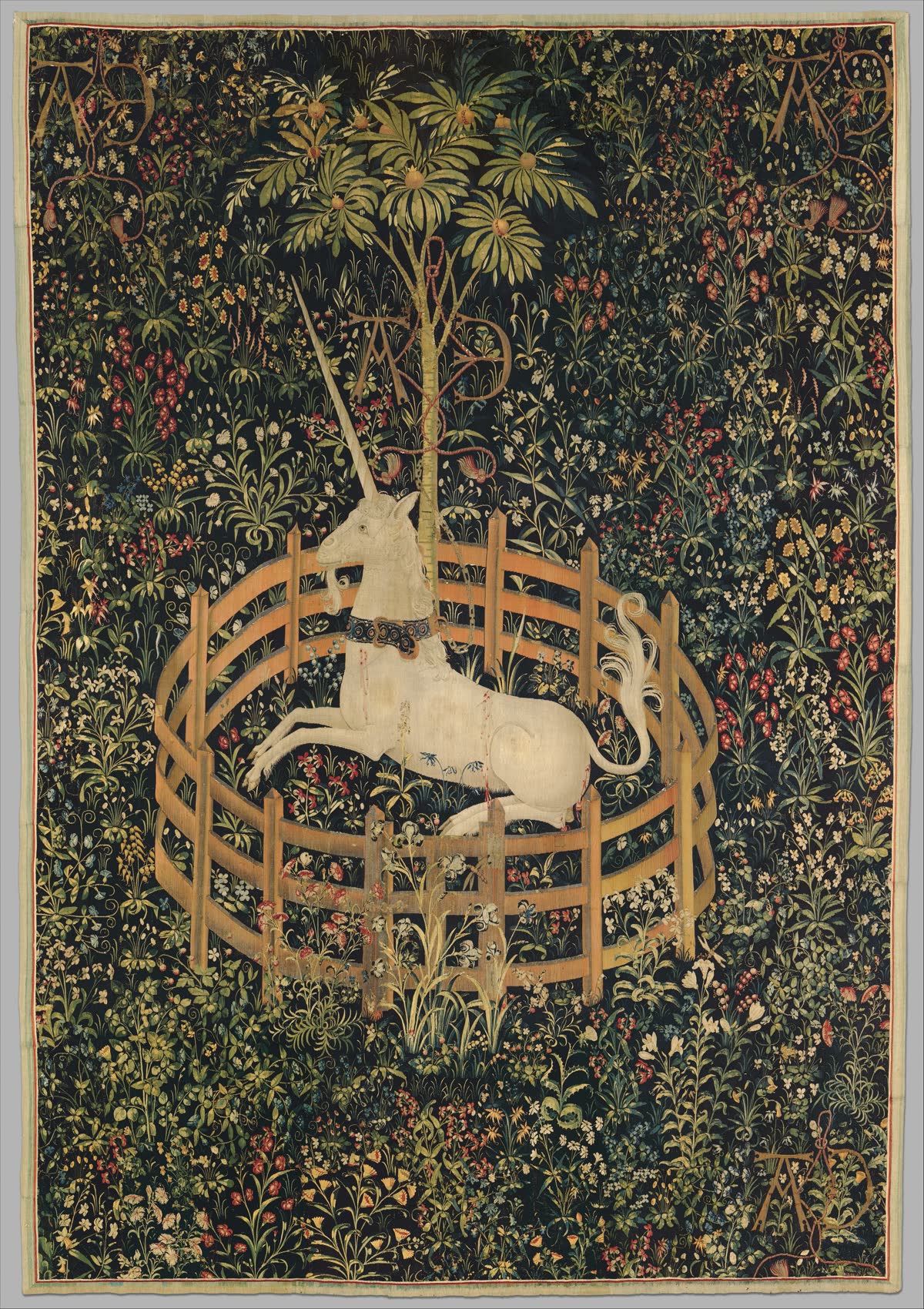
The strangest thing about The Unicorn Rests in a Garden is not that the animal is captive. It is that captivity has been made beautiful enough to hesitate over. The unicorn sits inside a low circular fence, collared and tied by a gold chain to a pomegranate tree. Yet the Met's object record stresses that the fence is low, the chain is not secure, and the animal could escape if it wished.[1] That uncertainty is the whole drama. The tapestry does not simply show a defeated creature. It stages a question: when does enclosure become devotion, and when does ornament make constraint look like peace?
This is why the work, often called The Unicorn in Captivity, remains more unsettling than a straightforward hunting finale. The larger Unicorn Tapestries show pursuit, water, dogs, spears, injury, and return. This panel slows everything down. Violence has been replaced by a garden. The animal is no longer running, fighting, or bleeding from visible wounds. He sits upright beneath fruit, alert but composed, enclosed but not visibly panicked. The scene converts capture into pose.
The tapestry was made around 1495-1505, with the cartoon associated with France and the weaving with the Southern Netherlands.[1] Its materials are luxurious: wool warp with wool, silk, silver, and gilt wefts.[1] That technical richness matters because the work's argument depends on surfaces. The unicorn is white against a dense field of leaves and flowers. The pomegranate tree is not background but structure. The chain gleams as jewelry as much as restraint. The fence reads less like prison architecture than a garden device. Nothing in the image is neutral.
Image context: the lead image is a photographic reproduction of the tapestry itself, not an illustration or diagram. The visual evidence is essential here because the essay depends on reading specific features the Met identifies in the object record: the loose chain, the low fence, the pomegranates, and the symbolically charged plants around the unicorn.[1]
The fence is low on purpose
A prison usually proves itself by blocking movement. This fence does something subtler. It marks a boundary while failing, almost deliberately, to function as a serious barrier. A powerful animal could clear it. The chain is present but slack in meaning as well as form. The collar is decorative. The whole structure turns compulsion into ceremony.
That is why the tapestry resists a single explanation. The Met's audio guide lays out several interpretive routes: the unicorn can stand for Christ's resurrection, a tamed bridegroom or beloved, or simply a prized animal subdued at the end of a hunt.[1] None of those readings cancels the others. The work survives by keeping them active at once. Religious passion, courtly love, fertility, marriage, hunting prestige, and luxurious ownership all press into the same image.
The circular forms intensify that ambiguity. The fence circles the unicorn. The collar circles the neck. The pomegranate tree rises through the center like a wedding, devotional, or dynastic axis. The gold chain can be read as restraint, but the same kind of chain also belongs to love language and elite display.[1] The object makes bondage look precious, and that preciousness is not incidental. It is the mechanism.
The garden does not soften the argument
The floral field is often the first thing viewers remember: hundreds of plants, flowers, leaves, and small living signs scattered across a green ground. It would be easy to treat that abundance as decorative sweetness. The better reading is harsher. The garden is the language through which the captivity is justified.
The Met's object text identifies pomegranates as medieval symbols of fertility and marriage, and explains that the red marks on the unicorn's flank are more likely pomegranate juice than blood because the wounds visible elsewhere in the hunting sequence are absent here.[1] The audio guide expands the plant code: iris, Madonna lily, carnation, orchid, bistort, and other plants carry religious, marital, or fertility associations.[1] The garden is therefore not simply where the unicorn rests. It is the system of meanings that makes his rest intelligible.
The Met's Cloisters garden writing gives this a broader frame. In the Unicorn Tapestries, plants are arranged not only for beauty but for symbolism, with landscape treated as a way to create ambience, emotion, and meaning inside the artwork.[3] That sentence is useful because it keeps the eye from drifting into wallpaper appreciation. The tapestry is not a natural meadow copied with charming care. It is an organized symbolic environment. Every desirable thing around the unicorn helps make captivity look abundant.
Luxury makes the paradox durable
European tapestry in this period was not minor wall decor. As Thomas P. Campbell's Met essay explains, tapestry weaving placed every stitch by hand and made possible complex figurative images on an enormous scale.[2] Large tapestries insulated rooms, decorated portable elite interiors, and broadcast wealth, magnificence, celebration, and power.[2] The Unicorn panel belongs to that world. It is an image of possession made in a medium of possession.
That material fact sharpens the theme. A painting might depict a captive animal. A tapestry also behaves like movable prestige. It can be hung, transported, installed, guarded, inherited, and used to transform a room. The image of the tethered unicorn would have lived as part of an aristocratic environment in which ownership was already being performed by the textile itself.
This does not reduce the work to propaganda or status display. It makes the work more interesting. The tapestry understands seduction too well to be only a boast. The animal is not shown crushed. He is shown surrounded. The eye has to decide whether the surrounding is care, possession, paradise, marriage, trophy, or trap. The answer keeps changing because the image has built no clean exit from its own beauty.
The unicorn is calm, not simple
The unicorn's posture is crucial. He does not collapse into victimhood. He sits with ceremonial control, almost heraldic in profile, his horn rising cleanly through the upper field. The body is available to the viewer, but not submissive in a modern sentimental way. This calm is what makes the image hard to master. A visibly suffering animal would simplify the moral terms. A visibly triumphant captor would do the same. Instead, the tapestry gives us a captive who appears composed enough to make captivity look partly chosen.
That is also why the title matters. The Unicorn Rests in a Garden sounds serene; The Unicorn in Captivity sounds coercive. Both are accurate, and the difference between them is the work's pressure. The animal rests because he is captive. He is captive in a garden arranged to look like rest. The picture never lets one phrase defeat the other.
Barbara Drake Boehm's Met publication A Blessing of Unicorns places the Cloisters tapestries in conversation with the Paris unicorn hangings, emphasizing how these works continue to invite layered readings across devotion, desire, material splendor, and medieval imagination.[4] That layeredness is not academic excess imposed from outside. It is built into the object. The tapestry was made to hold incompatible meanings without flattening them.
The result is a late medieval image that feels sharply modern in one respect: it knows how easily beautiful systems can aestheticize constraint. The low fence, loose chain, flowers, fruit, and gilt thread do not hide captivity. They make captivity attractive enough to become ambiguous. That ambiguity is the work's real force. The unicorn could leave, perhaps. He does not. The viewer is left inside the same circle, looking at a garden that has learned how to make a boundary bloom.
Sources
- The Metropolitan Museum of Art, "The Unicorn Rests in a Garden (from the Unicorn Tapestries)" - official object page with date, medium, dimensions, image source, interpretive note, and audio transcript on the chain, fence, pomegranates, and plant symbolism.
- Thomas P. Campbell, "European Tapestry Production and Patronage, 1400-1600," The Metropolitan Museum of Art, Heilbrunn Timeline of Art History, 2002 - context on tapestry scale, hand weaving, portability, patronage, and Netherlandish production.
- Corey Eilhardt, "Landscape Design in the Middle Ages," The Medieval Garden Enclosed, The Metropolitan Museum of Art, 2010 - discussion of the Unicorn Tapestries as hunting-park imagery and of plants as symbolic landscape rather than mere backdrop.
- Barbara Drake Boehm, A Blessing of Unicorns: The Paris and Cloisters Tapestries, The Metropolitan Museum of Art Bulletin, 2020 - Met publication on the Paris and Cloisters unicorn tapestries and their layered devotional, courtly, and material meanings.