Meret Oppenheim's Object is small enough to sit on a table, but it behaves like a trap laid for the whole idea of civilized touch. A cup, saucer, and spoon promise one of the most ordinary social rituals in European domestic life: hold the handle, raise the cup, sip, set it down, stir, repeat. Oppenheim keeps that grammar visible and then makes it impossible to perform without a shiver. The work does not destroy tableware. It lets tableware continue looking useful while making usefulness feel almost obscene.[1][2]
That is why the piece is stronger than its famous origin story. The Paris cafe anecdote matters: Oppenheim was in her early twenties, moving through the Surrealist circle, making jewelry and accessories, and wearing a fur-covered bracelet when the idea of covering a cup with fur entered the conversation.[2][4] But the finished work is not a clever punchline to something Picasso said. It is a precise material decision. Porcelain and metal normally promise coolness, smoothness, hygiene, and service. Fur brings warmth, animal surface, bristle, molt, and bodily nearness. The object works because neither side disappears.[2][3]
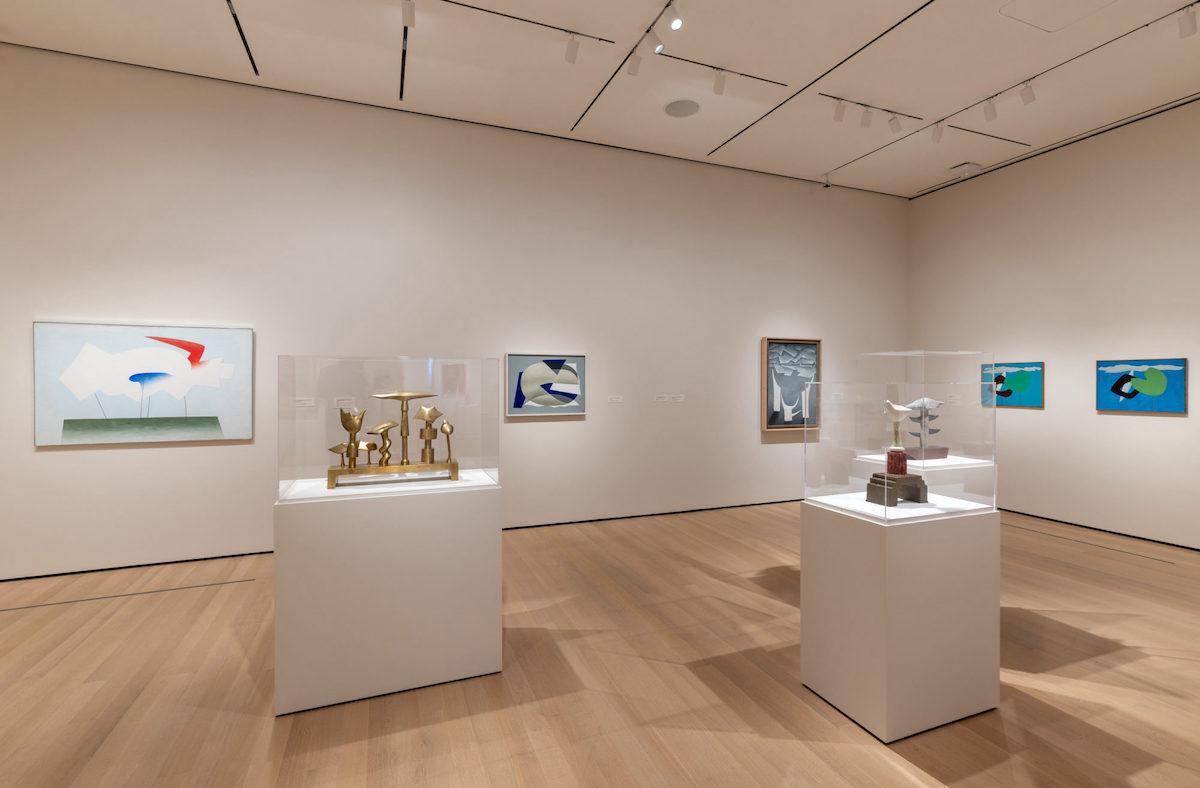
Image context: the lead image is a documentary gallery view rather than a diagram or a decorative Surrealist collage. The article still turns on the exact recognizability of the fur-covered cup, saucer, and spoon, but the image places that close reading inside the retrospective context that keeps Oppenheim from being flattened into a single Surrealist icon.[1][2][5][6]
The cup still knows what it is
MoMA's object record gives the basic facts with useful plainness: Object is a fur-covered cup, saucer, and spoon made in Paris in 1936, with the cup just over four inches in diameter, the saucer a little over nine inches, and the spoon eight inches long.[1] Those modest dimensions matter. This is not a monumental sculpture asking for public awe. It is a table object scaled to the hand and mouth. Its drama begins at domestic distance.
Oppenheim does not ask the viewer to solve a hidden code before reacting. The cup is legible. The saucer is legible. The spoon is legible. Even the handle remains available to sight as a handle. That continued legibility is the first source of pressure. The mind starts using the object before the body agrees to it. We know what to do with these shapes; the fur interrupts us only after that knowledge has already begun.
The spoon is especially nasty in this quiet way. A spoon usually mediates between container and mouth. It is the polite instrument that makes liquid, sugar, cream, or medicine manageable. Oppenheim covers it in the same pelt as the cup and saucer, turning mediation into contamination. The spoon can no longer promise cleanliness. It now looks like the part most likely to betray the mouth.
Fur changes the work from image to sensation
Many Surrealist objects depend on improbable juxtaposition, but Object is not only a visual joke about mismatched materials. Its force is sensory. Smarthistory's account is useful here because it stresses how the work makes viewers imagine the feel of fur against lips, fingers, and tongue.[2] You do not have to touch the object for touch to become the problem. The thought of touch is enough.
That is the difference between a surprising image and a genuinely hostile object. A painted furry cup could be amusing, maybe even witty. Oppenheim's actual furry cup recruits bodily memory. Most people know the comfort of fur against skin; most people also know the revulsion of hair in the mouth. The work fuses those memories and gives neither one time to win. The surface looks soft and wrong at the same time.
This is why Object cannot be reduced to a one-line Surrealist formula. The usual phrase "ordinary object made strange" is correct but too weak. Oppenheim does something harsher: she makes ordinary use turn against itself. The cup is not useless because it has been broken. It is useless because its usefulness has become imaginable in too much detail. The viewer can picture the sip, the damp fur, the bristles, the warmth, and the involuntary recoil. Function has not vanished; it has become intolerable.[2][4]
Breton's title narrowed what the object could be
The work's title history is part of its afterlife. Oppenheim's direct title, Object, is almost aggressively noncommittal. Andre Breton's title, Le Dejeuner en fourrure or Luncheon in Fur, pulled the piece toward Manet, Sacher-Masoch, erotic association, and a more overtly literary Surrealist reading.[2][4] That title helped make the work memorable, but it also risked making the object too easy to file under someone else's theory.
The tension matters because Oppenheim's sculpture is most alive before interpretation settles. Yes, the fur can carry erotic charge. Yes, the cup and spoon can invite psychoanalytic readings. Yes, the work belongs to the Surrealist moment when found and altered objects were treated as carriers of desire, dream, and psychic displacement.[2][5] But the object does not need any single symbolic decoding to function. Its primary intelligence is more direct: it alters the contract between a familiar form and the body that expects to use it.
MoMA's audio material catches this well by placing the piece between humor and discomfort. The cafe story preserves play, but the same object also feels sinister because a domestic utensil seems to have acquired animal agency.[3] The strongest reading keeps both registers. Oppenheim's work is funny because the premise is absurdly simple. It is disturbing because the simplicity does not let the viewer escape.
A success that threatened to flatten the artist
The object became famous almost immediately. It traveled to MoMA's landmark Fantastic Art, Dada, Surrealism exhibition in 1936, where it helped establish the museum's early Surrealist narrative and helped make Oppenheim a name in modern art.[5][6] MoMA's exhibition introduction describes the work as producing quick admiration among Surrealist painters, poets, and sculptors, then causing a sensation in New York later that year.[6] For the object, this was a triumph. For Oppenheim, it was more complicated.
MoMA's 2022-23 retrospective materials make the correction explicit: Oppenheim did not stop with the fur-covered cup. The exhibition gathered nearly 200 works across painting, sculpture, assemblage, relief, jewelry design, works on paper, and collage, emphasizing a six-decade practice far broader than the single icon by which she was often known.[5] The press text makes the same point by describing her later work as varied, original, and concerned with dreams, gender binaries, stereotypes, and the boundary between ordinary objects and art.[6]
That broader frame should change how Object is read. The piece is not the isolated miracle of a young woman who accidentally supplied Surrealism with a mascot. It is an early proof of Oppenheim's larger method: ordinary things could be made to misbehave without losing their identity. A cup could become animal without becoming sculpture in the heroic sense. A joke could become a serious instrument. A domestic object associated with feminine service could turn aggressive without making a speech about aggression.[2][5][6]
The refusal is the meaning
What lasts in Object is not shock alone. Shock fades quickly when it depends only on novelty. Oppenheim's object lasts because it keeps regenerating a practical contradiction every time someone looks at it: this is for drinking, and this cannot be drunk from. The contradiction stays fresh because it is lodged in bodily knowledge, not in a puzzle.
The work therefore changes the viewer's role. We are not only spectators reading a Surrealist proposition from a safe distance. We become potential users who have to decline use. The refusal is not moral, intellectual, or institutional at first. It is tactile. The hand hesitates. The mouth refuses. The polite tea service becomes a machine for making the body say no.
That refusal is also why the plain title Object feels so exact. The work does not need to announce its dream content. It places one altered thing before us and lets the altered thing do the work. Oppenheim's cup, saucer, and spoon do not illustrate the Surrealist breakdown of ordinary reality. They enact it at the scale of a sip.[1][2][3]
Sources
- The Museum of Modern Art, "Meret Oppenheim. Object. Paris, 1936" - official object page for the fur-covered cup, saucer, and spoon, including date, medium, dimensions, acquisition, image, and provenance note.
- Josh R. Rose, Steven Zucker, and Beth Harris, "Meret Oppenheim, Object (Fur-covered cup, saucer, and spoon)." Smarthistory, 2022 - art-historical discussion of the cafe story, Surrealist object context, tactile response, title history, and later reception.
- The Museum of Modern Art, "Meret Oppenheim. Object. Paris, 1936" audio transcript - Glenn Lowry, Jenny Holzer, and Anne Umland on the object's humor, menace, domestic setting, fur surface, and title.
- Sarah Hotchkiss, "'Luncheon In Fur': The Surrealist Teacup that Stirred the Art World." KQED, 2016 - contextual account of Oppenheim's cafe anecdote, Schiaparelli-related accessory work, Breton's title, and public reactions.
- The Museum of Modern Art, "Meret Oppenheim: My Exhibition" - retrospective page describing the 2022-23 exhibition, its nearly 200 works, institutional partners, and the breadth of Oppenheim's practice beyond the fur-lined teacup.
- The Museum of Modern Art, "Meret Oppenheim: My Exhibition" introduction PDF, 2022 - press/exhibition text on Object in 1936, its inclusion in Fantastic Art, Dada, Surrealism, and Oppenheim's later range and self-representation.