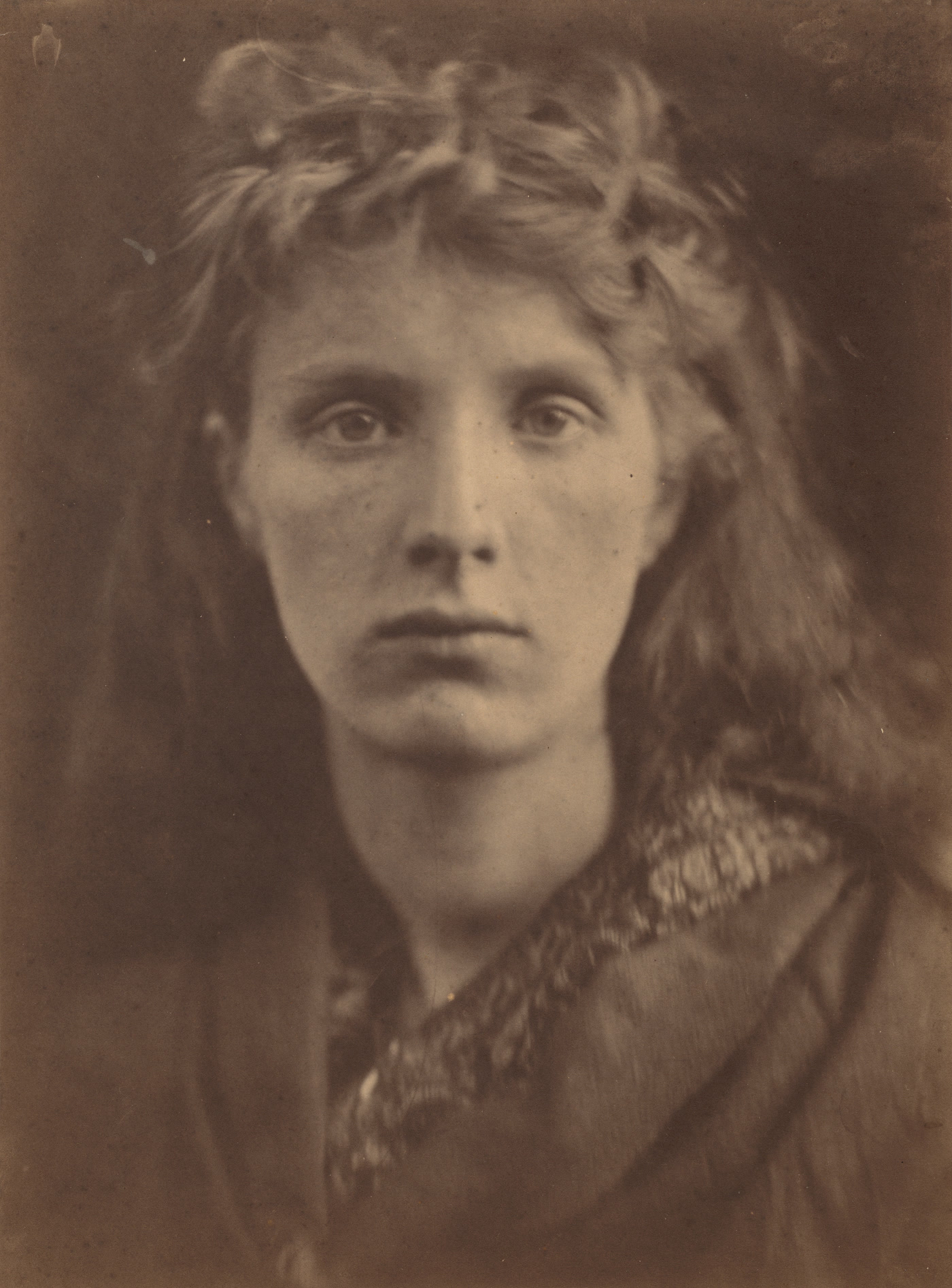
Julia Margaret Cameron's The Mountain Nymph, Sweet Liberty looks, at first, like a portrait that has slipped partly out of ordinary portraiture. A young woman fills the frame from head to shoulders. Her hair is loose, her face is close, and the background withdraws into darkness. The National Gallery of Art identifies the work as an albumen silver print from June 1866, made by Cameron and held in Washington under the title taken from Milton.[1] Those facts are spare, but the photograph is not. It presses the sitter forward until she feels less like a person recorded in a studio than a presence arriving through the paper.
That pressure is why the picture needs to be read through its so-called flaws. Cameron's soft focus was not a technical accident to excuse after the fact. It was one of the ways she broke with conventional mid-Victorian portrait finish. The V&A's account of her working methods notes that her early portraits developed the soft focus, dramatic lighting, and close-up compositions that became her signature style, and that by 1865 she was using a large camera to make near life-size head studies.[2] The Mountain Nymph belongs to that concentrated world. The photograph's force does not come from crisp inventory. It comes from the feeling that the face is being held at the edge between person, myth, and apparition.[1][2]
Image context: this article uses the artwork itself, not a later illustration or a portrait of Cameron. The photograph is a real nineteenth-century albumen print from a collodion negative, and its material surface is part of the argument: what looks like softness is the method through which Cameron makes nearness feel unstable.[1][6]
The face is too near to behave politely
Most studio portraiture of Cameron's moment offered social information: clothing, posture, furniture, rank, propriety, and enough sharpness to make likeness feel disciplined. Cameron strips that frame down. The National Gallery's visual description emphasizes the head-and-shoulders closeness, the sepia tonality, the dark background, and the sitter looking directly at the viewer.[1] That direct gaze is the hinge of the photograph. The sitter does not look away into poetic reverie. She meets the camera in a way that makes the allegorical title harder, not easier, to consume.
The result is a productive imbalance. The title asks for myth: a mountain nymph, liberty, a figure from poetry rather than from the household or neighborhood. The image gives us a real face at close range. The Met's object page identifies the sitter only by the last name Keene and stresses that little else is known about her.[4] That lack of biographical anchoring matters. Cameron does not let the viewer settle either into documentary certainty or into pure fantasy. We know there was a sitter. We also know the picture has been staged to exceed ordinary likeness.
This is where the crop does real work. The face nearly fills the vertical field, leaving no comfortable space for narrative action. There is no landscape to justify the "mountain" in the title, no costume drama elaborate enough to turn the sitter into a theatrical character, no prop that explains the allegory. Instead, hair, collar, eyes, and shadow carry the whole burden. The photograph turns literary reference into facial pressure.
Soft focus becomes an argument about truth
Cameron repeatedly defended a broader idea of photographic truth than the sharp, topographic standard prized by many photographers around her. The Met's Heilbrunn essay describes her ambition to join the real and the ideal and to give photography the status of high art, while also noting that critics attacked her large, unsharp heads and irregular handling.[3] That conflict is essential to The Mountain Nymph. Its softness is not a retreat from truth. It is a claim that truth in portraiture can include inwardness, spiritual charge, and theatrical transformation.
The National Galleries of Scotland's short profile is useful on exactly this point. It says Cameron mastered the wet collodion negative and albumen print process, resisted treating technical advances as barriers between herself and the subject, and often accepted defects rather than retouching them away.[5] That combination prevents an easy reading of her as simply careless. Cameron knew the process. She chose to push against the kind of precision that would make the image behave like a commercial record.
The wet collodion process also explains why softness could become expressive rather than merely vague. Plates had to be prepared, exposed, and developed while still wet; long exposure made sitting a bodily ordeal; slight movement could register as blur or doubled vitality.[2][3] In a Cameron portrait, the sitter is not frozen by the camera so much as held under pressure by it. The image becomes a record of duration, not just a record of features.
That duration is visible in The Mountain Nymph. The face is still, but not inert. The edges seem to breathe. The dark ground makes the head feel almost sculptural, while the softened detail prevents it from becoming a clean bust. The sitter appears close enough to touch and yet not fully graspable. That is Cameron's central paradox: the less the photograph behaves like a hard proof of identity, the more insistently it behaves like presence.
Milton gives the photograph a second pulse
The title comes from Milton's L'Allegro, where "Sweet Liberty" belongs to a pastoral imagination of pleasure, movement, and release.[4] Cameron's use of that phrase does not simply caption the sitter as a character. It charges the close-up with a contradiction. Liberty is named, but the sitter is held still. Movement is invoked, but the photograph depends on prolonged immobility. The "nymph" is imagined as free, yet the image is built from studio discipline, chemical timing, and an almost confrontational pose.
That contradiction keeps the photograph from becoming a decorative literary exercise. The Met's object discussion notes that Sir John Herschel responded to the image by sensing its extraordinary presence and psychological connection with the viewer.[4] His reaction is revealing because he was not only a friend but one of the key scientific minds in Cameron's circle. The picture did not impress him by mimicking academic painting or by delivering perfect focus. It impressed him because it seemed to push a living head out of the photographic surface.[4]
The National Gallery's version helps underline that surface. Its object data records the work as an albumen silver print, 36.1 by 26.7 centimeters overall.[1] That size matters. This is not a tiny calling-card likeness. It is a large head study that asks the viewer to meet the face nearly at human scale. The print is intimate, but not modest. Cameron uses photographic enlargement by proximity rather than by mechanical blowing-up: the sitter sits close, the camera attends closely, and the viewer receives a face that feels too immediate for the conventions of polite distance.[1][2]
Imperfection is doing the work
Cameron's critics often treated her marks of process as evidence against her. The Met's essay preserves that contemporary resistance: some reviewers saw unsharpness, deep shadow, and rough backgrounds as bungled photographic practice, while artists and sympathetic viewers recognized a different pictorial value.[3] The Mountain Nymph shows why the second group had a point. The photograph would be weaker if it were perfectly polished. A hard commercial sharpness would reduce the sitter to legible surfaces. Cameron wants something stranger: a face that feels summoned into visibility and still half unstable within it.
That instability is not sentimental haze. It is tightly organized. The dark background removes distraction. The vertical format holds the head in a narrow field. The direct gaze prevents the image from dissolving into mood. The loose hair breaks social finish without becoming disorder for its own sake. The soft focus equalizes details so that the whole face arrives as one charged event rather than as a checklist of features.[1][2][4]
The photograph's title could have made it airy. The image makes it severe. Liberty here does not mean open landscape or effortless motion. It means a figure who refuses to remain merely classified: not only model, not only Victorian woman, not only literary nymph, not only photographic experiment. Cameron's strongest move is to keep those identities unresolved. The sitter is close enough to be seen and blurred enough to resist possession.
That is why The Mountain Nymph, Sweet Liberty still feels alive. Cameron turned an unstable medium into a way of thinking about unstable identity. She accepted softness, duration, theatrical naming, and process marks not as failures of photography but as routes toward a more demanding kind of likeness. The picture does not ask whether a photograph can copy the world accurately. It asks whether a photograph can make a person feel present beyond the facts available about her. In this case, the answer arrives through a face that seems to come forward from the paper, then hold its distance exactly there.[1][3][4]
Sources
- National Gallery of Art, "The Mountain Nymph, Sweet Liberty" - official object page for Cameron's June 1866 albumen silver print, with visual description, dimensions, accession data, and image source.
- Victoria and Albert Museum, "Julia Margaret Cameron's working methods" - institutional essay on Cameron's early camera practice, soft focus, large glass negatives, close-up heads, dramatic lighting, and process difficulties.
- Malcolm Daniel, "Julia Margaret Cameron (1815-1879)," The Metropolitan Museum of Art, Heilbrunn Timeline of Art History - overview of Cameron's career, artistic ambitions, wet-collodion practice, reception, and high-art claims for photography.
- The Metropolitan Museum of Art, "The Mountain Nymph Sweet Liberty" - object page identifying the sitter as Miss Keene, explaining the Milton title, and summarizing Herschel's response to the photograph's presence.
- National Galleries of Scotland, "Julia Margaret Cameron" - artist profile on Cameron's mastery of wet collodion and albumen printing, soft-focus technique, dramatic lighting, and refusal to retouch defects.
- Wikimedia Commons, "File: Julia Margaret Cameron, The Mountain Nymph, Sweet Liberty, June 1866, NGA 102578.jpg" - source page for the public-domain National Gallery of Art image used as the article cover.