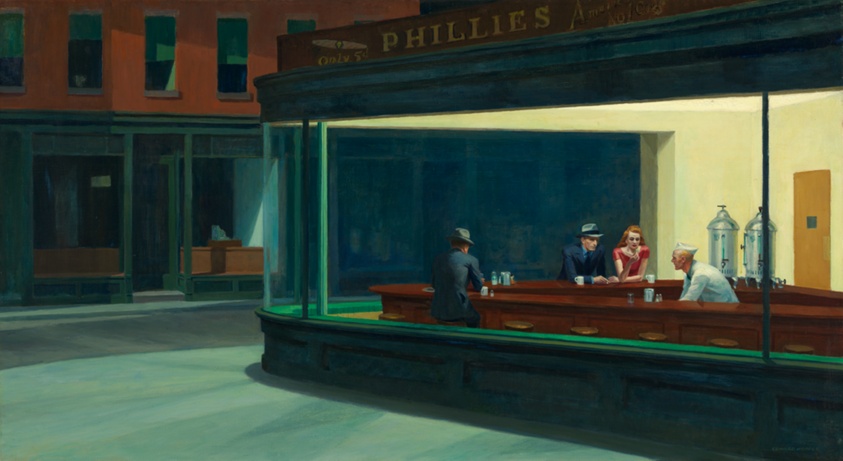
Edward Hopper’s Nighthawks (1942) survives because it does more than picture loneliness. It invents a specific kind of modern room: a brightly lit public interior that promises company without intimacy, safety without welcome, and visibility without access. That combination still feels current in 2026. We know the sensation even if the architecture has changed. A convenience store at 1 a.m., a late-night airport café, a ramen counter under white light, a phone screen full of active people while the street outside is nearly empty: all belong to the same emotional design problem.
Hopper solved that problem with extraordinary economy. One wedge-shaped diner, four figures, no visible entrance, almost no street debris, and a hard band of electric light are enough to make the city feel both inhabited and sealed.[1] The painting remains famous because it does not merely show urban solitude; it stages the fantasy that somewhere in the city there is still one illuminated room holding against the dark.
Image context: the hero image reproduces Hopper’s Nighthawks itself, because the article’s argument depends on the painting’s exact structure—glass wraparound, fluorescent spill, and the missing doorway all do analytical work.
1) The room matters more than the story
The Art Institute of Chicago’s object record gives the basics plainly: Nighthawks is an oil on canvas from 1942, measuring 84.1 × 152.4 cm.[1] But the work’s real force is not biographical trivia or narrative guessing. It is architectural.
The diner forms a long, angled glass container set against an empty nocturnal street. Its counter runs like a stage edge. The figures are close enough to imply shared space, yet detached enough that no stable group dynamic settles into place. Most important, the viewer cannot find a door. The Art Institute notes the same compositional fact directly: the scene is tightly organized and spare, and “there is no entrance to the establishment.”[1] That missing entrance is not a decorative oddity. It is the painting’s governing decision.
Because of it, the diner reads as public but not available. We can see in, but we cannot join. The city’s last lit room is visible to everyone and open to no one. That is the first reason the painting became durable: Hopper turned ordinary urban glass into a device for producing distance.
2) Wartime darkness sharpened the meaning of the light
A second reason Nighthawks lasts is that its electric glow carries historical pressure. Sarah Kelly Oehler’s Art Institute essay places the picture in the months after Pearl Harbor, when New York lived with blackout drills and dimmed public light.[2] Read through that wartime atmosphere, the diner’s brightness stops feeling like mere commercial illumination. It becomes a counter-image to a city darkened by fear.
That does not cancel the loneliness reading. It complicates it. Oehler argues that the painting can also be understood as a beacon—an image of people gathering, however tenuously, inside one bright place while the world outside feels unsafe.[2] This is persuasive because Hopper did not paint a solitary room. He painted four figures held inside one pool of light.
The Whitney’s Study for Nighthawks sharpens this point from the angle of process. In the museum’s audio transcript, curator Carter Foster notes how Hopper worked through “harsh fluorescent light” against the “rich darkness” of the street, using white chalk to test the glow spilling outward.[3] That contrast is the emotional engine of the final canvas. The painting does not ask us to choose between alienation and shelter. It gives us shelter in the form urban alienation can actually take: impersonal, provisional, bright enough to keep going.
3) Hopper’s deeper subject was the unstable wall between public and private
Seen in that light, Nighthawks is not an isolated miracle. It intensifies a problem Hopper had been working on for years: how modern city life makes people visible to one another without making them known.
The Whitney’s interpretation of New York Interior traces this earlier grammar clearly. Hopper’s urban windows often come from glimpsed views—moments seen from the El train, framed by cut-off edges that make looking feel both intimate and invasive.[4] Even when a figure is indoors, the room is never fully private. Someone might be watching, or passing, or imagining a life from the outside.
Kim Conaty, discussing Edward Hopper’s New York, describes this as a convergence of public and private space within the city’s changing architecture.[5] That language helps explain why Nighthawks still reads so precisely. The diner is not home, yet it feels almost domestic in its enclosure. It is not a street, yet the street pours against it on all sides. It is a commercial room, but the drama inside is emotional rather than transactional. Hopper made a public interior that behaves like a temporary shelter for private states.
That hybrid form is now everywhere. Modern urban life keeps building places where people gather without forming a group: cafés designed for laptop solitude, transit lounges, food halls, waiting rooms, co-working kitchens. Nighthawks remains legible because it recognized the type before the type became routine.
4) Why the image keeps getting parodied, quoted, and reused
Some famous paintings survive because they are revered. Nighthawks survives because it is reusable.
Oehler notes the multitude of parodies, cartoons, and photoshopped versions that have tried to make the picture “speak” across decades of political and social change.[2] Conaty likewise recalls the flood of Hopper memes during the pandemic years, when many people felt uncannily converted into Hopper figures indoors, looking out from isolation at a city still present but partially inaccessible.[5]
The image’s formal design makes this reuse easy:
- the wedge-shaped counter gives an instantly recognizable frame,
- the glass wall keeps figures readable as silhouettes and types,
- the narrative remains open enough to accept new emotional scripts.
That combination is rare. A painting too specific resists reuse; a painting too generic becomes forgettable. Nighthawks sits in the sweet spot. It offers a rigid stage and a missing story. Every generation can project new circumstances into it—war, loneliness, insomnia, pandemic distance, urban endurance—without breaking the composition.
5) Why it still matters in 2026
The strongest reason Nighthawks still lands is that late-modern life has not solved the condition it pictured. We have more connectivity, more delivery systems, more continuous entertainment, and more ways to remain accompanied by signals. Yet we also move through cities full of threshold spaces where presence is partial and social contact stays thin.
Hopper’s diner remains powerful because it does not sentimentalize these rooms. The figures are together, but not healed. The light is warm enough to attract, but too stark to become cozy. The city has not disappeared; it has simply withdrawn into darkness around one available-looking enclosure.
That is why the painting keeps working better than the cliché built around it. Nighthawks is not simply “a picture of loneliness.” It is a picture of urban co-presence reduced to its minimum viable form: one bright room, a few strangers, no door we can see, and the stubborn possibility that staying in the light for another hour might be enough.
60-second gallery drill (to test the thesis yourself)
If you revisit the image quickly, run this three-step check:
- Trace access first: look for the entrance before you read any faces; notice how the missing doorway changes your emotional position from participant to observer.
- Read the light as infrastructure: track where the fluorescent band spills and where darkness hard-stops; the painting’s shelter logic sits in that boundary, not in facial expression alone.
- Count social distance, not body count: there are four figures, but no stable group behavior; the room offers co-presence while withholding intimacy.
Sources
- The Art Institute of Chicago, Nighthawks (object record)
- Sarah Kelly Oehler, The Art Institute of Chicago, Nighthawks as a Symbol of Hope
- Whitney Museum of American Art, Study for Nighthawks (audio transcript and work page)
- Whitney Museum of American Art, New York Interior (collection interpretation)
- Yale University Press, David Ebony interview with Kim Conaty, Edward Hopper’s Public and Private New York
- The Art Institute of Chicago API, artwork record 111628 (image metadata and alt-text context)