Constructivism still feels contemporary because it treated art less as a picture and more as infrastructure.
Instead of asking, “What should a painting look like?”, many Constructivists asked a harder, operational question: what visual forms can reorganize collective life under industrial conditions? That shift changed not only style, but where art happened—moving from studio walls into workshops, publishing, exhibition design, street graphics, clothing, and education systems.
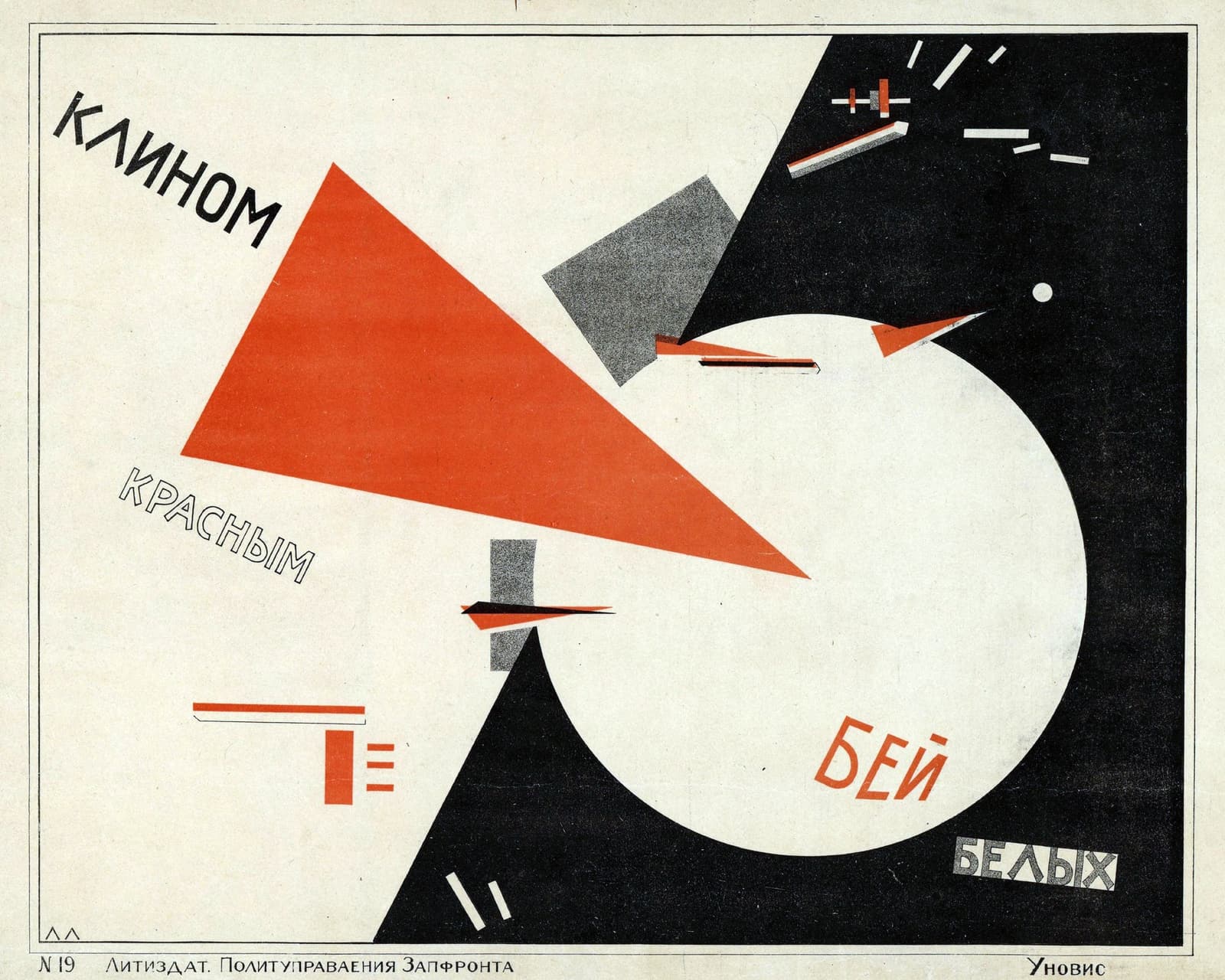
Image context: the cover image is El Lissitzky’s 1919 poster “Beat the Whites with the Red Wedge.” It is used here because its red-wedge geometry makes Constructivism’s mass-communication logic immediately legible.
The break: from composition to construction
The movement emerged in the turbulent years around and after 1915, with figures such as Vladimir Tatlin and Alexander Rodchenko pushing away from illusionistic easel conventions toward material structure, engineering logic, and spatial assembly.[1][2]
Tate’s definition captures the core attitude succinctly: Constructivism was austere, abstract, and openly aligned with the modern industrial world rather than with private decorative taste.[1] In practice, this meant artists privileging line tension, geometry, and material properties over narrative scene-making.
A key distinction in period debates was the difference between composition and construction:
- composition implied arranging visual parts into a finished image;
- construction implied building an object/system with a function, process logic, and material constraints.
This was not only a formal argument. It was a claim about labor and social usefulness.
Revolution, institutions, and the Productivist turn
After 1917, the political horizon made those arguments more concrete and more urgent. Avant-garde groups were suddenly negotiating with institutions that wanted new visual languages for a new state, mass literacy campaigns, and industrial modernization.
Within this context, debates inside circles such as INKhUK and related artist collectives accelerated a Productivist turn: instead of autonomous gallery objects, artists should contribute to practical production—posters, typography, textiles, architecture, furniture, display systems, and communication tools.[3][4]
Vkhutemas (founded 1920 in Moscow) became one of the key sites where this logic was tested in pedagogy: students moved between formal experimentation and applied design disciplines, often treating art, craft, and industrial design as one continuous field rather than separate professions.[5]
Seen from today’s perspective, this was an early prototype of interdisciplinary design education: material studies + systems thinking + public-facing output.
The movement’s visual grammar: geometry as a public language
Constructivism’s recognizable look—diagonals, wedges, grids, sans-serif lettering, photomontage, strong contrast fields—was not a style package chosen for novelty. It was a communication strategy optimized for speed, reproducibility, and public legibility.
Three linked moves mattered most:
- Geometric force over painterly atmosphere: forms were built to direct attention quickly in crowded visual environments.
- Text-image integration: typography became structural, not supplementary.
- Serial reproducibility: posters, journals, covers, kiosks, and displays extended a shared visual syntax across many media surfaces.
Lissitzky’s wedge logic in Beat the Whites with the Red Wedge is emblematic not because it is merely iconic, but because it compresses conflict into an instantly readable directional structure.[6][7] Rodchenko and contemporaries expanded this into photomontage and publication design, where framing, cropping, and text scale worked like editorial machinery rather than painterly ornament.[2][3]
International spread: from Soviet experiment to global design DNA
Although Constructivism was rooted in Soviet-era debates, its formal and pedagogical effects traveled widely through exhibitions, publications, migration routes, and dialogue with other modernist schools.
By the mid-20th century, parts of its vocabulary had fused into broader international design practice: editorial grid systems, exhibition graphics, poster rhetoric, architectural modularity, and education models that linked abstraction to production.
In that sense, Constructivism did not survive as a single “pure” movement. It survived as transferable methods:
- reduce visual noise,
- expose structural relations,
- make form do public work.
This is why it still appears, sometimes uncredited, in contemporary civic campaigns, interface layouts, social graphics, and cultural branding.
The political boundary: expansion, then closure
Any serious movement-context reading also has to mark the historical ceiling.
The same state environment that enabled rapid early experimentation later narrowed acceptable aesthetics. By the early 1930s, independent avant-garde formations were increasingly constrained as official doctrine shifted toward Socialist Realism and centralized cultural control.[3][8]
So Constructivism’s high-intensity window was relatively short. But short duration does not equal minor legacy. The movement’s strongest contribution was to redefine what counts as artistic practice: not only producing objects, but designing social information flow.
Why this matters now
Constructivism remains useful because it asks a question many current art-and-design ecosystems still avoid: Is visual work only expressive, or is it also operational?
In an era of feeds, dashboards, urban screens, and policy communication overload, that question is newly practical. Constructivists were not just “geometric modernists.” They were early architects of public-facing visual systems under pressure.
Their achievement was not perfection—many projects were partial, contested, and historically bound. Their achievement was opening a durable lane between art and organized social function.
Sources
- Tate, “Constructivism” (movement overview and core definition)
- The Art Story, “Constructivism Art Movement” (artists, chronology, and formal characteristics)
- Wikipedia, “Constructivism (art)” (movement timeline, debates, and institutional context)
- Wikipedia, “First Working Group of Constructivists” (programmatic shift toward construction/productive logic)
- Wikipedia, “Vkhutemas” (design education and workshop-based pedagogy in 1920s Moscow)
- Wikipedia, “Beat the Whites with the Red Wedge” (work context and political-print role)
- Wikimedia Commons, file page for “Klinom Krasnym Bej Belych” (image provenance)
- Wikipedia, “Socialist realism” (official doctrine shift and constraints on avant-garde practice)
- Khan Academy, “Constructivism and Russian avant-garde art” (formal language and historical teaching context)
- Khan Academy, “Vladimir Tatlin, Monument to the Third International” (material/structural ambition and movement framing)