Jean Tinguely's Homage to New York is best approached as a machine whose most important product was not motion but loss. On March 17, 1960, MoMA presented the work in its sculpture garden as A Self-Constructing and Self-Destroying Work of Art Conceived and Built by Jean Tinguely.[2] The title sounds like a stunt until the surviving record starts to clarify the stakes. Tinguely was not adding movement to sculpture as a decorative upgrade. He was making a sculpture whose life span, noise, combustion, disorder, and partial failure were inseparable from its form.
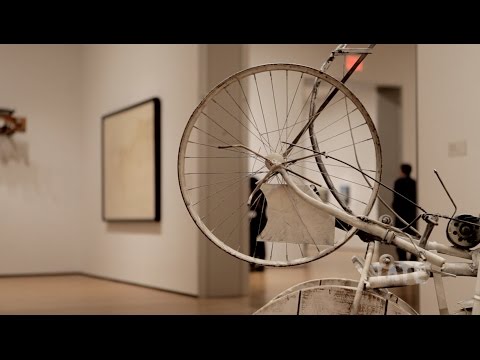
Tate's short film, produced for the Gallery of Lost Art project and later made available on YouTube, is useful because it treats the event as a vanished artwork rather than as a neat kinetic-art milestone.[1][6] It notes the setting, the ambition, and the afterlife: the machine was engineered to erupt, burn, and disintegrate before an audience, yet not all of it disappeared. A surviving Fragment from Homage to New York, owned by MoMA, is documented as painted metal, fabric, tape, wood, and rubber tires, over six feet tall.[3] The fragment is not a relic outside the work. It is part of the work's logic: self-destruction left evidence.
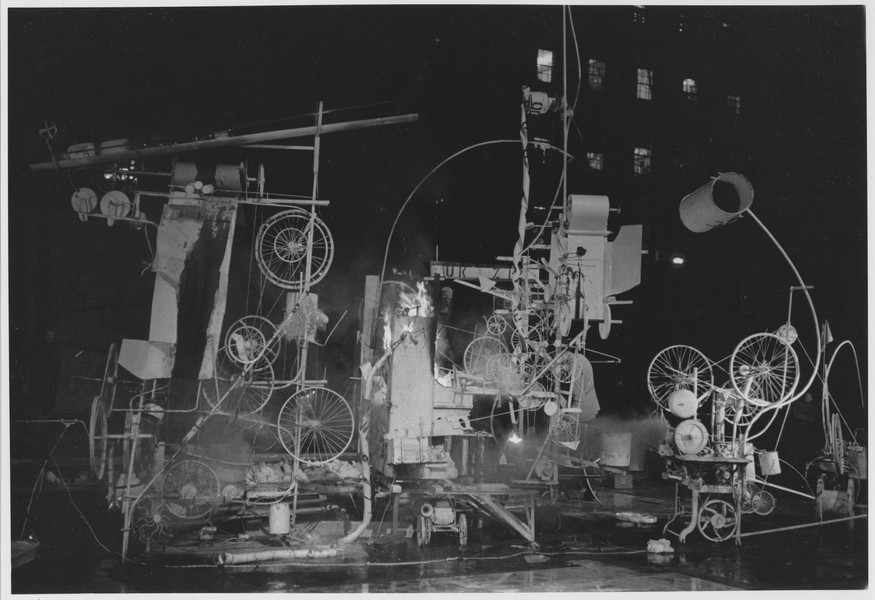
The first thing to notice is the film's refusal to smooth the machine into a heroic object. Its archival imagery and narration keep returning to assemblage: wheels, tubing, scrap, supports, small motors, and combustible elements arranged in a temporary body. Museum Tinguely's biography is more specific about the materials Tinguely gathered in New Jersey scrapyards and junk shops: motors, a weather balloon, steel tubes, bicycle parts, a piano, a radio, and more.[5] That list matters because the machine was not disguised industrial design. It was modern urban debris made theatrical.
Around the film's opening movement, the sculpture reads almost like a night skyline that has been rebuilt from leftovers. The white-painted structure stands in the garden as an anti-monument: vertical, busy, precarious, and unable to promise permanence. MoMA's original two-page publication preserves the event's time and place, and frames it as a work in which time, movement, gesture, and self-transformation are demonstrated rather than merely represented.[2] That language can sound grand, but the video shows the practical meaning. The work does not depict instability. It undergoes it.
The second thing to watch is how strongly the audience is implicated. In a conventional sculpture gallery, viewers circle a stable object. Here they gather for a timed event, waiting for the machine to begin losing itself. The artwork converts looking into witnessing. The point is not just that the machine moves, burns, and breaks. The point is that viewers see a museum object refuse the museum's ordinary promise: preservation, repeatability, and calm inspection.
That is why the partial failure of Homage to New York strengthens rather than weakens the piece. Museum Tinguely says almost nothing went according to plan, and adds that this did not seem to trouble Tinguely.[5] A machine built to vanish but unable to choreograph its own disappearance perfectly becomes sharper, not softer. Its breakdown exposes the fantasy of total control. It asks whether a self-destroying artwork can ever succeed cleanly, or whether its best truth lies in the messy remainder: smoke, malfunction, scrap, memory, and fragments gathered back into institutional care.
The surviving fragment makes that contradiction visible. The UNT Digital Library record identifies the owner as the Museum of Modern Art and describes what remains with exact material and dimensional language: painted metal, fabric, tape, wood, rubber tires, and a large physical scale.[3] The remnant is stabilized and identified, while the original work was designed around disappearance. This is not hypocrisy. It is the afterlife of a performance that forced the museum to keep what the event left behind. Conservation enters after anti-conservation has done its work.
The cover photograph deepens the same paradox. The archival installation image is a March 17, 1960 photograph by David Gahr from MoMA's Photographic Archive.[4] In still form, the machine looks held, almost legible. Yet the image's calm is borrowed from the camera. The sculpture itself was built against stillness. The photograph, the Tate film, the surviving fragment, and the original publication now work together as four incomplete ways of encountering something that was never meant to be fully recoverable.
This is the value of watching the Tate video now. It compresses the event into a few minutes, but it also reopens a larger question about modern art's relation to machines. Tinguely did not treat the machine as a symbol of efficient progress. He made it excessive, comic, noisy, unstable, and mortal. The work's failure to disappear completely is exactly what lets it keep speaking. It survives as footage, archive, fragment, description, and rumor: an artwork that made its own breakdown part of its medium, then left the museum to decide what could still be held.
Sources
- Tate, "Jean Tinguely's Fire at MoMA | Lost Art" (YouTube video, 2:28), on Homage to New York as an auto-destructive artwork presented at MoMA in March 1960.
- The Museum of Modern Art, Homage to New York: a self-contructing and self-destroying work of art, 1960 publication PDF - primary event text with title, date, venue, and framing of time, movement, gesture, and self-transformation.
- UNT Digital Library, "Fragment from Homage to New York" - metadata record for the surviving fragment, including physical description, creation date, artist, and MoMA ownership.
- The Museum of Modern Art, direct archival installation image for Homage to New York, March 17, 1960, Photographic Archive, photograph by David Gahr - source for the article image.
- Museum Tinguely Basel, "Jean Tinguely: life and work (1925-1991)" - biography section on Homage to New York, its materials, audience, collaborators, and partial disorder.
- Art Explora Academy, "Jean Tinguely's Fire at MoMA" - Tate-produced Lost Art page identifying the video, length, subject, and March 1960 MoMA context.