Christo and Jeanne-Claude's Running Fence is often remembered as an astonishing line: white fabric passing over northern California hills and falling into the Pacific. That memory is accurate, but it can make the work look too effortless. The fence's beauty came from the fact that it had to pass through so many things before it could become visible: ranch gates, county hearings, private property, environmental review, steel hardware, wind, workers, and the final limit of the sea.[1][2][3]
The finished work stood only for two weeks in September 1976.[1][2] It was 18 feet high and 24.5 miles long, crossing Sonoma and Marin counties before entering the Pacific Ocean.[1][2] Smithsonian American Art Museum's exhibition page describes the archive behind the project with unusual material precision: heavy woven white nylon, 90 miles of steel cable, 2,050 steel poles, hundreds of thousands of hooks, and 13,000 earth anchors.[1] Those numbers matter because they pull the work back from postcard lyricism. Running Fence was not a drawing imposed on a landscape. It was a temporary civil engineering system that turned the right to pass through land into the subject of art.
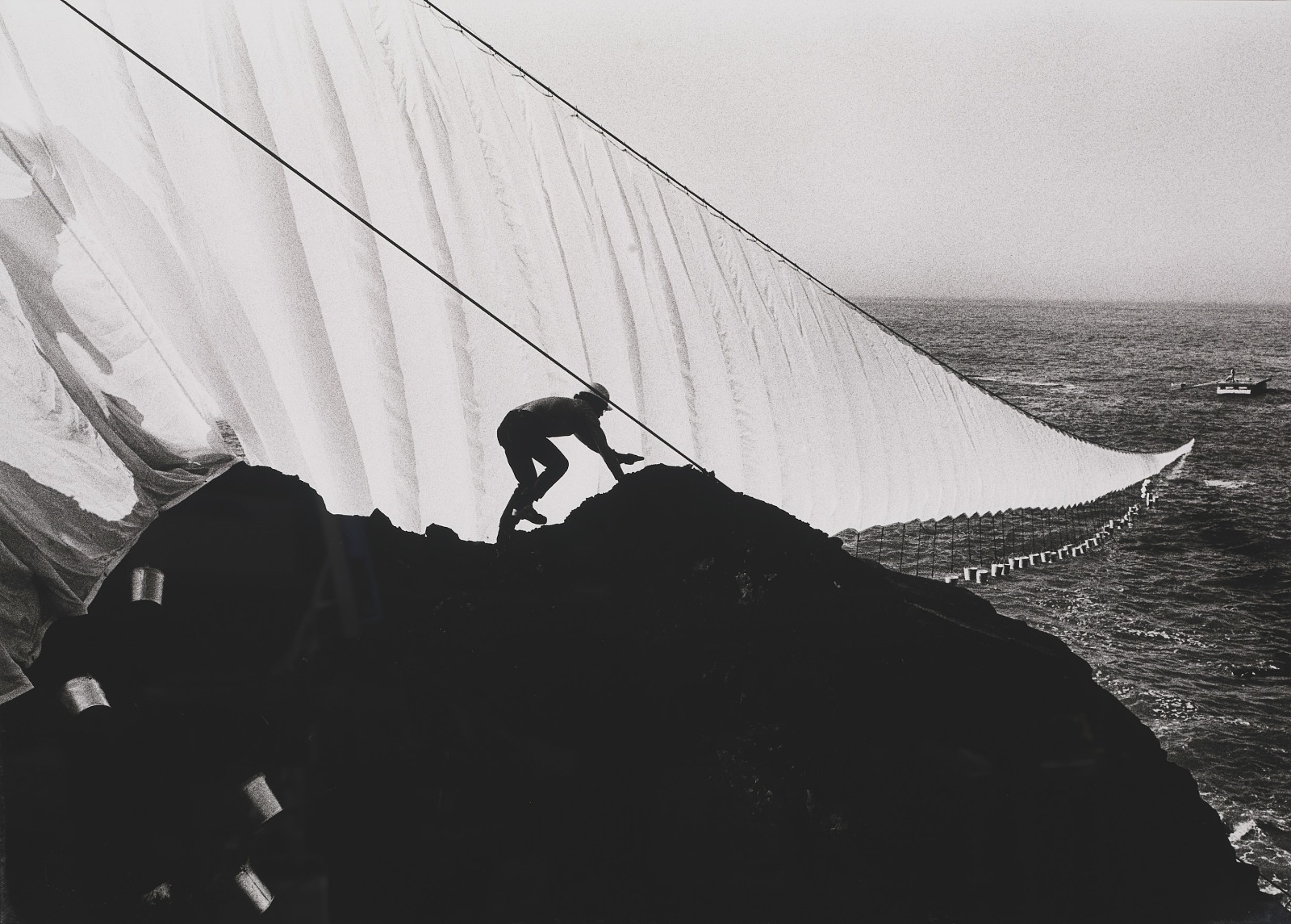
Image context: the cover uses a real 1976 archival photograph by Wolfgang Volz from the Smithsonian American Art Museum collection. It shows the ocean panel being unfurled with buckets, which makes the work's final gesture less abstract: a line of fabric reaches the sea only because bodies, cables, weights, and weather hold it there for a short time.[4]
Permission was one of the materials
The first material in Running Fence was permission. Christo later described the project as something learned through ranchers, politicians, hearings, publications, workers, and installation, and he emphasized that without rancher support the government permission would not have arrived.[3] That is more than a biographical anecdote. It changes what the artwork is. The line in the hills was beautiful because it had already moved through social resistance.
This is why the fence should be read as a public artwork whose publicness begins before the public sees it. The Smithsonian's 2010 exhibition framed the museum's archive as a record of the work from genesis to realization, not just a collection of handsome photographs after completion.[1][5] That distinction is crucial. Preparatory drawings, fabric samples, legal documents, photographs, scale models, and engineering materials are not secondary leftovers. They are the evidence of a work whose form depended on negotiation.
Christo and Jeanne-Claude's refusal of patronage also belongs inside that form. The project was paid for by selling preparatory works rather than by taking public funding or sponsorship.[1][2] In the ordinary story of large public art, finance and administration sit offstage. Here they become legible. The artists had to invent a structure by which a temporary artwork could pay for its own passage through land. The fence was therefore not only nylon and steel; it was an agreement machine.
The fence drew by borrowing scale from human structures
At 18 feet high, Running Fence was large enough to interrupt vision but not large enough to become a wall in the military or border sense.[1][2][3] Christo's Smithsonian interview is useful here because he ties the scale to barns, garages, roads, ranches, subdivisions, and the ways people already mark property and movement in California.[3] The work borrowed its legibility from the built and worked landscape around it.
That borrowing gives the piece its strange balance. From a distance, the white fabric reads like a continuous ribbon of light, a line that lets the hills become newly legible.[2][3] Up close, the same line becomes hardware, anchors, poles, hooks, seams, and labor. The work never fully chooses between drawing and construction. It stays suspended between the two. It is a line, but one that has weight. It is a temporary apparition, but one held up by industrial parts.
The official Christo and Jeanne-Claude project page lists 14 roads crossed, 2,050 fabric panels, 144 kilometers of steel cable, and 2,080 steel poles.[2] Those details keep the work from dissolving into scenery. Every mile required attachment. Every passage required ground contact. Every view depended on components that had to be carried, set, tensioned, and later removed. The artwork's grace came from an infrastructure that refused to disappear until the work itself disappeared.
Wind turned fabric into an instrument
Fabric was the most visible material, but wind was the most active one. Christo said that extra fabric allowed the panels to move, and that the fabric showed what wind was doing because wind itself could not be seen directly.[3] That observation opens the work. Running Fence did not simply sit on the land. It translated an invisible force into a visible and audible event.
This is where the ocean-panel photograph becomes especially strong.[4] The image shows the fabric descending toward the Pacific in a hard diagonal, with a worker crouched against the dark shoreline and the sea stretching beyond. The fence is not a pure white abstract form. It is a sheet under stress. The cable line cuts across the frame; the buckets and the worker's body tell us that the cloth has to be managed. The photograph makes visible what a distant hill view can hide: the installation was always negotiating with gravity, water, and air.
That negotiation is the work's deepest beauty. Land art can sometimes imply mastery over territory, as if scale alone were enough to make a claim. Running Fence is more delicate than that. Its scale is immense, yet its material is responsive. It catches light, moves in gusts, and depends on the same weather that can unsettle it. The fence becomes powerful by admitting that it is temporary and vulnerable.
The sea was an ending, not a backdrop
The Pacific Ocean mattered because it gave the line a final condition. A fence usually separates one side from another, but Running Fence ends by meeting a body of water that cannot be fenced in the same way.[1][2][4] That ending changes the meaning of the whole line. The work crosses roads, ranches, and hills, then reaches a place where the idea of enclosure breaks open.
This is why the title matters. Christo recalled that an earlier title, Divide, felt wrong because the work was not finally about division. It became Running Fence because the image was movement.[3] That change is not cosmetic. The word "running" keeps the object from hardening into a barrier. The fence is still a fence, but its visual grammar is kinetic: it passes, bends, descends, catches, and ends.
The work's two-week duration also belongs to that grammar.[1][2][5] Permanence would have changed the piece. A permanent 24.5-mile fabric fence would quickly become infrastructure, nuisance, jurisdictional object, or monument. As a two-week event, it remained an encounter. People had to see it within a narrow window, and then the land returned to ordinary visibility. Removal was not cleanup after the artwork. Removal was part of the artwork's tense.
What remains after a temporary work
The paradox of Running Fence is that a work committed to disappearance produced a huge archive.[1][4][5] Smithsonian American Art Museum acquired the definitive record in 2008 and later exhibited hundreds of objects tied to the project.[1][5] The archive does not betray the temporary artwork. It shows what temporariness costs. If the finished fence lasts only two weeks, the drawings, permissions, photographs, models, and fragments carry the burden of making the event thinkable afterward.
The archive also prevents the work from becoming pure legend. A distant photograph can make Running Fence look like a miracle line, but the record returns it to labor, argument, money, fabric, and removal.[1][3][4][5] That return is not demystifying in a flat sense. It makes the beauty more exact. The fence was luminous because it had passed through all that friction and still looked light.
That is why Running Fence remains one of Christo and Jeanne-Claude's clearest statements about freedom in art. Freedom here does not mean escaping rules into empty space. It means making an unnecessary object so carefully, and through so many binding relationships, that everyone can briefly see the shape of permission, weather, property, labor, and public attention. The white cloth did not erase the land. It revealed how much had to be agreed, built, held, and released before a line could run.
Sources
- Smithsonian American Art Museum, "Christo and Jeanne-Claude: Remembering the Running Fence" - exhibition page describing the 2008 archive acquisition, 42 months of collaborative effort, materials, scale, financing, and two-week duration.
- Christo and Jeanne-Claude Foundation, "Running Fence" - official project page with dimensions, route, roads crossed, panels, cable, poles, materials, and 14-day duration.
- Smithsonian American Art Museum, "Christo and Jeanne-Claude: On the Making of the Running Fence" - interview/transcript material on the project's title, rancher support, permits, scale, wind, and Jeanne-Claude's role.
- Smithsonian American Art Museum, "Running Fence, Sonoma and Marin Counties, California, 1972-76, Unfurling the ocean panel with buckets" - Wolfgang Volz black-and-white photograph used as this article's cover image.
- Smithsonian American Art Museum, Christo and Jeanne-Claude: Remembering the Running Fence - publication page summarizing the 1972-1976 project, four-year planning horizon, Marin and Sonoma route, and exhibition record.