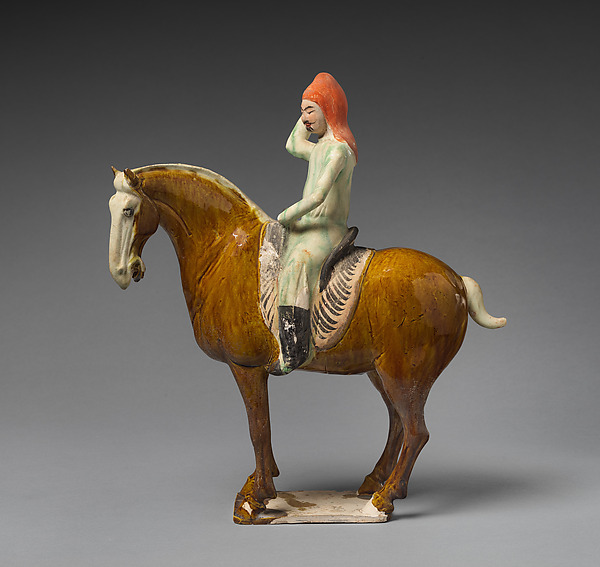
Tang sancai ceramics are often introduced as "three-color" wares, but the name can make the technique sound tidier than it is. The best pieces do not behave like neat color charts. They look as if liquid weather has passed over clay: amber gathers along a flank, green slides around a saddle, cream opens a quiet ground, and occasional blue or dark accents snap the eye back to detail. What makes the medium exciting is not only the palette. It is the potter's controlled surrender to a glaze that wants to move.
The Met's early eighth-century Horse and rider is a compact demonstration of that logic. Its object record gives the plain facts: Tang dynasty China, earthenware with three-color glaze and pigment, about 15 inches high, now classified as tomb pottery.[1] The figure is not large enough to overwhelm by scale, yet the surface keeps expanding the event. Glaze clarifies the saddle, tunic, horse, and rider while also refusing hard-edged obedience. The object is sculpture, ceramic chemistry, and funerary image at once.
Image context: the lead image is a real museum photograph of the Met object, not a diagram, chart, generated visual, or abstract placeholder. It belongs here because this article is about what sancai glaze does physically. The visible runs, pools, and color zones are evidence, not decoration.[1]
The Technique Begins With A White Stage
Sancai depends on a useful tension: a pale clay body gives color a luminous base, while lead-based glaze lowers the firing threshold enough for mineral colors to melt into a glossy, mobile skin. The University of Michigan Museum of Art's Tang tomb guardian record explains the material logic in practical terms: potters worked with clay associated with white wares, used iron and copper oxide colorants for the cream, amber, and olive-green palette, and relied on lead flux so the glazes could fuse to earthenware at relatively low kiln temperatures.[2] Those ingredients explain why the surface reads so differently from painted terracotta or high-fired porcelain. The color is not merely sitting on the object. It has fused into a translucent layer that can catch light, thicken at edges, and drift under gravity.
That last word matters. Gravity is part of the medium. A potter can plan the placement of glaze, stamp or incise patterns, reserve unglazed zones, and choose where colors begin. But once the piece enters the kiln, the lead glaze has its own behavior. Britannica's larger history of Chinese pottery describes late seventh- and eighth-century northern Chinese sancai as slipped ceramics covered with low-fired lead glaze, tinted with copper or ferrous oxide, whose bright colors were allowed to mix or run naturally over robust contours.[3] The phrase "allowed" is doing real work. Sancai is not sloppy painting. It is a process in which the maker designs conditions for a partly unpredictable surface.
The result is a ceramic art that carries motion after firing. On the Met horse, the animal's body is still, the rider is fixed, and the tomb function is permanent, yet the glaze keeps moving visually. Amber and green do not stay where a drawing would keep them. They slide, pool, thin, and overlap. The eye follows the run of the kiln as much as the anatomy of the horse.
Three Colors Were Never Just Three
The term sancai literally points to three colors, and the familiar Tang trio is amber, green, and cream or white. But the category was never limited to a schoolroom count. The Met's horse and rider includes blue and black detail as part of its visual system.[1] China Online Museum's Tang ceramics overview makes the same point from the recipe side: copper produced green, iron produced amber or brownish yellow, clear glaze supplied cream, and expensive cobalt could occasionally add blue.[4] "Three-color" is therefore better read as a convention of effect than a strict inventory.
That helps explain the liveliness of the best pieces. The cream ground is not empty space; it is a control field. Green can look wetter because it moves across pale clay. Amber can look warmer because it thickens where the form turns. Blue, when present, can feel almost electric because it interrupts the expected range. The medium's drama comes from the relation among color, ground, contour, and melting point.
China Online Museum's overview also notes that three northern kilns supplied much of the lead-glazed sancai that furnished aristocratic tombs for more than a century and a half of the Tang period, and that the glaze's tendency to run slightly produced the splashed effects and mingled colors that give the wares their exuberant look.[4] That historical scale matters technically and aesthetically. Sancai was not a one-off accident. It was a repeatable craft system that made room for controlled instability.
Tomb Objects Needed Presence, Not Stillness
Sancai's most famous objects are tomb figures: horses, camels, guardians, musicians, riders, attendants, and animals. That funerary context is not incidental. These were not simply pretty ceramics for shelves. The UMMA tomb guardian record explicitly frames sancai as a ware for tomb figurines and funerary wares under Tang elite patronage.[2] Cleveland's ewer record makes the same boundary clear for vessels, noting that many sancai lead-glazed wares were intended for the tomb and often depended on metalwork prototypes.[5]
The tomb setting explains why the surface needed more than correctness. A burial object had to carry vitality into an unseen space. A horse in a tomb is not only a representation of an animal; it is an image of mobility, rank, service, and afterlife provision. Sancai's runny surface gives that image a charge that plain fired clay would not have. The horse becomes a body animated by color, light, and the memory of heat.
This is especially important because Tang visual culture made horses carry political and cultural meaning. The Met object tags the figure simply as horse and man, but the form belongs to a larger Tang world in which mounted figures, riders, and imported or elite horse imagery signaled movement, status, and empire.[1][2] Sancai did not invent that prestige. It gave it a surface that could look alive in the half-light of a tomb.
Metal Shapes, Clay Bodies, Liquid Skin
One of sancai's smartest tricks is that it can make earthenware compete with more expensive materials without pretending to become them. Cleveland's ewer record points to sancai wares' dependence on metalwork prototypes.[5] The Met tray record makes a similar observation: its shape and medallion decoration derive from metalwork models, while stamped lines helped contain glaze in intended areas.[4] That combination is revealing. Tang potters were not merely copying prestige shapes. They were translating them into a ceramic language where surface movement became the new luxury.
Metal gives a vessel crispness, reflectivity, and status. Sancai gives clay another route to brilliance. A lip can catch color. A raised edge can slow a run. A curved shoulder can turn glaze into a gradient. Instead of hammering or casting brightness into a hard surface, the potter lets chemistry and contour collaborate. The object can remember metal and still remain unapologetically ceramic.
That is why sancai is not only a color story. It is a boundary story. The technique lives between sculpture and vessel, between funerary ritual and display, between planned decoration and kiln accident, between imported luxury models and local ceramic invention. Its surfaces make those boundaries visible because they never look fully locked down.
Why The Runs Still Feel Modern
Modern viewers often respond to sancai as if it anticipates abstraction: drips, stains, pools, asymmetry, and color fields over form. That response is understandable, but it should not detach the works from Tang craft. The runs are not modernist self-expression before modernism. They are technical consequences of lead glaze, mineral colorants, firing sequence, and object contour.[2][3][4] The maker's intelligence lies in understanding how much control to keep and how much to give away.
That is the enduring lesson of the Met horse. It is easy to admire the rider, the stance, the small lifted energy of the animal. But the real medium is the meeting between modeled clay and mobile glaze. The surface does not merely decorate the horse; it gives the horse its afterlife weather. Color seems to have happened to the object, yet happened under rules.
Sancai's beauty comes from that disciplined instability. First the clay body is formed. Then glaze is placed. Then heat loosens the plan. Then cooling fixes the accident into permanence. A good sancai object therefore contains a sequence, not just an image: hand, mineral, fire, gravity, burial, museum light. It asks us to look at ceramics as events that have become solid.
That is why "three-color ware" is too small a phrase for the best Tang examples. Sancai is color, but it is also timing. It is glaze made visible as behavior. It lets an afterlife horse stand still while its surface keeps running.
Sources
- The Metropolitan Museum of Art Collection API, "Horse and rider" - object record for the early eighth-century Tang dynasty ceramic figure used as the cover image, including medium, dimensions, public-domain image link, tomb pottery classification, and object URL.
- University of Michigan Museum of Art, "Tomb Guardian" - Tang sancai object record explaining white-ware clay, iron and copper oxide colorants, lead flux, low-temperature glaze fusion, and tomb use.
- Encyclopaedia Britannica, "Chinese pottery: The Sui and Tang dynasties" - historical overview of northern Chinese sancai in the late seventh and eighth centuries, low-fired lead glaze, copper and ferrous oxide colors, and naturally running colors over robust contours.
- China Online Museum, "Tang Dynasty Ceramics" - overview of Tang sancai tomb wares, northern kilns, copper, iron, clear and cobalt glazes, glaze running, Silk Road circulation, and later ceramic influence.
- Cleveland Museum of Art, "Ewer" - Tang sancai object record noting lead-glazed three-color ware, dependence on metalwork prototypes, and tomb use.