Tehching Hsieh's One Year Performance 1980-1981, often called Time Clock Piece, begins with a machine that normally belongs to labor discipline. A time clock is supposed to make work legible to an employer. It converts presence into proof, proof into payroll, and payroll into the ordinary bargain of industrial time. Hsieh kept the machine and emptied that bargain out. From April 11, 1980 to April 11, 1981, he punched a time clock every hour, on the hour, in his New York studio, and photographed himself with the clock each time.[1][2]
The result is not a performance about efficiency. It is almost the opposite. Hsieh made a year of life answer to a machine without letting the machine produce anything except evidence of passing time. Frieze's account gives the useful arithmetic: the plan implied 8,760 possible hourly punches, and Hsieh completed 8,666, missing 94.[2] Those missed hours matter as much as the completed ones. They keep the piece from becoming a fantasy of perfect control. The work is rigorous because it lets fatigue, electricity, sleep, and error remain inside the record.[2]
The Clock Is Sealed, But The Year Leaks
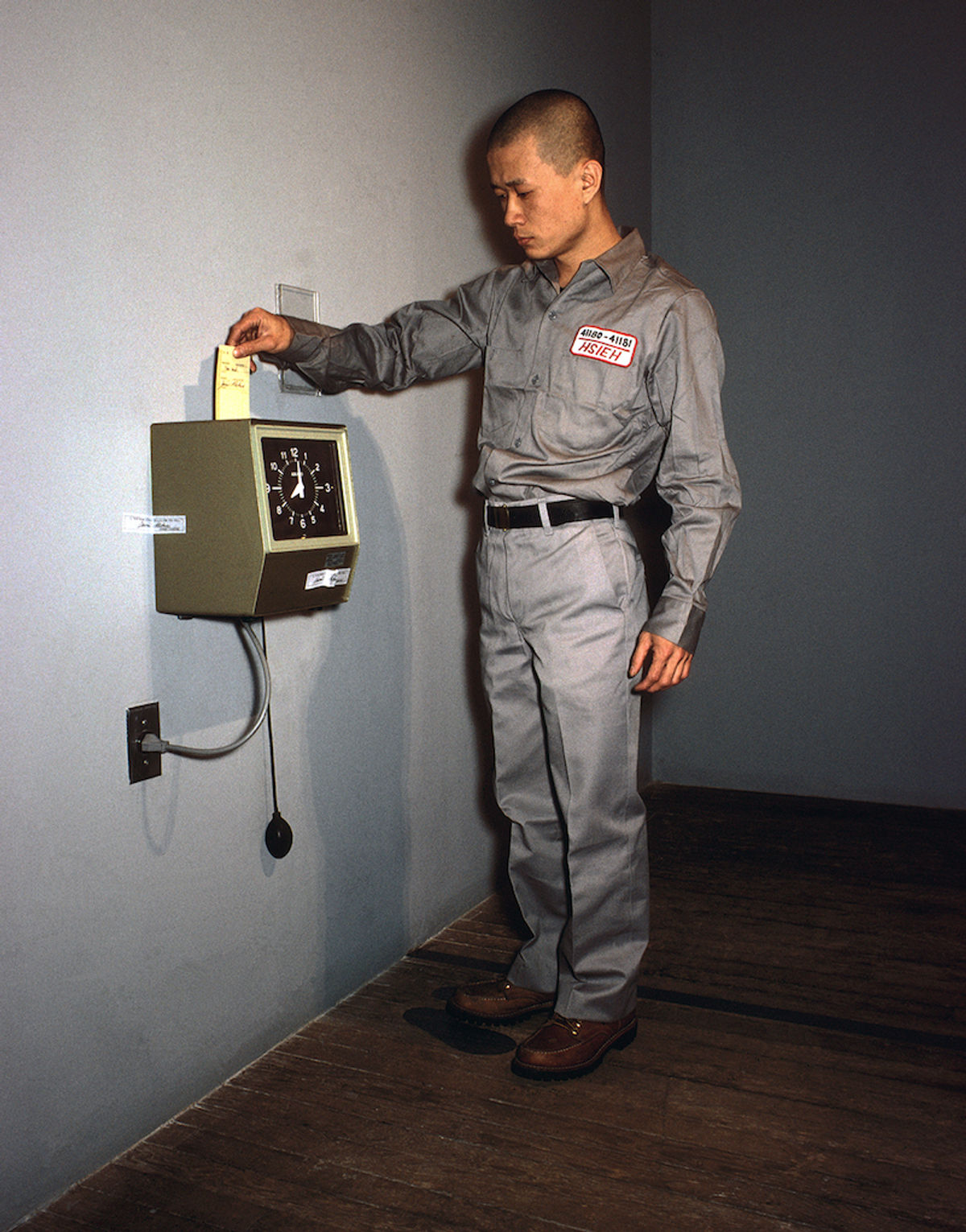
The photograph can make the piece look deceptively simple. Hsieh stands beside a wall-mounted time clock in a gray work uniform, hand raised toward the apparatus. Nothing theatrical happens. That plainness is the work's first trap. The pose looks like employment, but the system no longer points outward to a boss, wage, shift, or factory floor. It points inward to a rule that consumes the artist's entire year.
Hsieh's official page preserves the documentary materials as part of the work: statement, explanation, witness documents, missed-punch records, time cards, the "life image" photograph, and related installation material.[1] This is not supplementary paperwork after a vanished action. It is the form through which the action survives. The performance exists as a rule lived in real time and as a record that lets later viewers test the rule's pressure.
That record is harsh because the clock is both exact and stupid. It does not know whether the artist is hungry, ill, lonely, bored, frightened, or briefly asleep. It knows only the top of the hour. The sealed clock, the card, the camera frame, and the growing hair all measure duration at different speeds.[1][2] The punch says: this hour arrived. The photograph says: this body arrived with it. The hair says: this has been happening for months. The missed punches say: the body is not a machine.
Documentation Does Not Make The Work Easy
Performance art often faces a preservation problem: if the event has ended, what exactly remains for a museum or reader to encounter? Hsieh's answer was not to solve the problem by over-documenting everything. It was to build the documentation into the work while leaving most of the year inaccessible.
Frieze describes the components clearly: artist and witness statements, hourly stamped timecards, film stills, a six-minute film, and monthly public viewings during the year.[2] That sounds exhaustive until one notices the scale of what is still missing. Each hourly image captures a tiny threshold. It does not show the fifty-nine minutes before the next alarm. It does not show how sleep was negotiated, how errands became nearly impossible, how a studio became a site of recurrence, or how the mind adapted to a future broken into one-hour units.
This is why Time Clock Piece is stronger than a stunt. A stunt collapses into the fact that someone did something difficult. Hsieh's work keeps difficulty formal. The archive proves obedience to the rule, but the archive also marks the limits of proof. The viewer can see that the artist returned again and again. The viewer cannot fully enter the duration that made each return costly.
Industrial Time Turns Into Life Time
The time clock normally separates working time from nonworking time. Hsieh's performance destroys that boundary by making every hour accountable. There is no clean off-shift. Even sleep becomes a timed risk. Even leaving the studio must be calculated against return.
That is why the work should not be reduced to endurance alone. Endurance names the pain of continuing, but the sharper artistic move is conversion. Hsieh converts an industrial device from a tool of productivity into a tool of bare duration. The machine still records presence, but presence no longer promises useful output. It becomes the artwork's substance.
MoMA's 2009 exhibition page helps place this performance inside Hsieh's larger practice. Between 1978 and 1986, he made five one-year performances: a year in a cage, a year punching a time clock, a year completely outdoors, a year tied to another person, and a year abstaining from art activity; the later Thirteen Year Plan ended in 1999.[3] That sequence matters because Time Clock Piece is not an isolated feat. It belongs to a larger investigation of how a rule can turn life into form without turning life into illustration.
The rule is severe, but it is also strangely modest. Hsieh does not ask the clock to symbolize capitalism, immigration, alienation, or discipline in one neat key. Those readings are available, and the artist's life as an undocumented immigrant in New York gives the work real social pressure.[2][5] But the performance remains more durable because it is not only a statement about one condition. It is a mechanism for making time visible as obligation.
The Body Becomes The Second Clock
The official image shows Hsieh with a shaved head and work uniform.[1] The shaved head is not costume decoration. It turns the body into a slow clock beside the mechanical one. Across the year, the hair grows. The face changes. The same gesture returns under different bodily evidence.
That second clock softens nothing. It makes the work more exact. Mechanical time treats each hour as equivalent. Bodily time refuses equivalence. A punch at 3:00 p.m. after rest is not the same as a punch at 3:00 a.m. after weeks of broken sleep, even if the machine registers both in the same grammar. The artwork lives in that mismatch.
The Neue Nationalgalerie's exhibition text for the work emphasizes the hourly photograph and the transformation of the performance into film and photo installation.[4] That installation form is crucial because it lets viewers meet the year as accumulation. One image is almost nothing. Thousands of images become a field of bodily recurrence. The body keeps showing up until showing up becomes the event.
The Missed Punches Keep The Piece Human
The most tempting misreading is to admire the work as pure discipline. Hsieh was disciplined, obviously. But a perfect year would have been less interesting. The 94 missed punches make the piece legible as lived time rather than as a machine fantasy.[2]
Frieze notes one revealing episode: on January 19, 1981, Hsieh punched at 7:05 p.m. because the building's electricity dropped out for five minutes, and he had to readjust his wristwatch alarm because the time clock itself was sealed under the work's rules.[2] That small delay is almost comic in its precision, but it opens the whole structure. The performance depends on clocks, cameras, power, paper, sleep, body, and building. A year is never only a concept. It is also infrastructure.
Those failures do not weaken the work. They keep it from lying. A performance about time that erased interruption would be theatrical in the wrong way. Hsieh's record lets interruption remain visible as part of the contract. The piece is not about becoming superhuman. It is about exposing the difference between a rule that can be stated cleanly and a life that must drag itself through the rule hour by hour.
Why It Still Feels Current
The work feels newly sharp in an age of productivity dashboards, attention metrics, biometric logs, and self-tracking apps. Hsieh's time clock is older hardware, but its logic is familiar: prove that you were there, prove that the moment happened, let a record stand in for life. The difference is that Hsieh refuses the usual reward structure. He does not optimize the record. He endures it until the record becomes strange.
The New Yorker's 2025 account of Hsieh's Dia Beacon retrospective describes a career built from a small number of radical time-based works, with the final rooms returning viewers to the passage of time itself.[5] That recent institutional attention helps explain why Time Clock Piece has not settled into historical curiosity. It now looks less like an extreme corner of performance art and more like one of the clearest artworks about what happens when life is made accountable to periodic proof.
In the end, the time clock fails at its old job. It does not produce productivity. It produces a year made visible through repetition, loss, sleep debt, mechanical regularity, and bodily change. Hsieh's achievement was to take the most ordinary instrument of work-time discipline and make it tell a different truth: being present is not the same as being useful, and time becomes most visible when a rule is just strict enough to reveal that no life can be reduced to a clean sequence of punches.
Sources
- Tehching Hsieh, official page for One Year Performance 1980-1981 - artwork documentation including statement, explanation, witness records, missed punches, and the Michael Shen life image used as the article photograph.
- Vivian L. Huang, "The Rigour of Tehching Hsieh's One Year Performance," Frieze, 2023 - interpretive essay on the hourly punches, 8,666 completed clock-ins, missed punches, documentation, immigration context, and art-time/life-time framing.
- The Museum of Modern Art, "Performance 1: Tehching Hsieh" - 2009 exhibition page summarizing Hsieh's five one-year performances and the later Thirteen Year Plan.
- Neue Nationalgalerie / Staatliche Museen zu Berlin, "Tehching Hsieh" - exhibition page on One Year Performance 1980-1981 (Time Clock Piece) as film and photo installation.
- Tobi Haslett, "Tehching Hsieh Turned Every Second Into Art," The New Yorker, 2025 - recent account of Hsieh's durational works and Dia Beacon retrospective context.