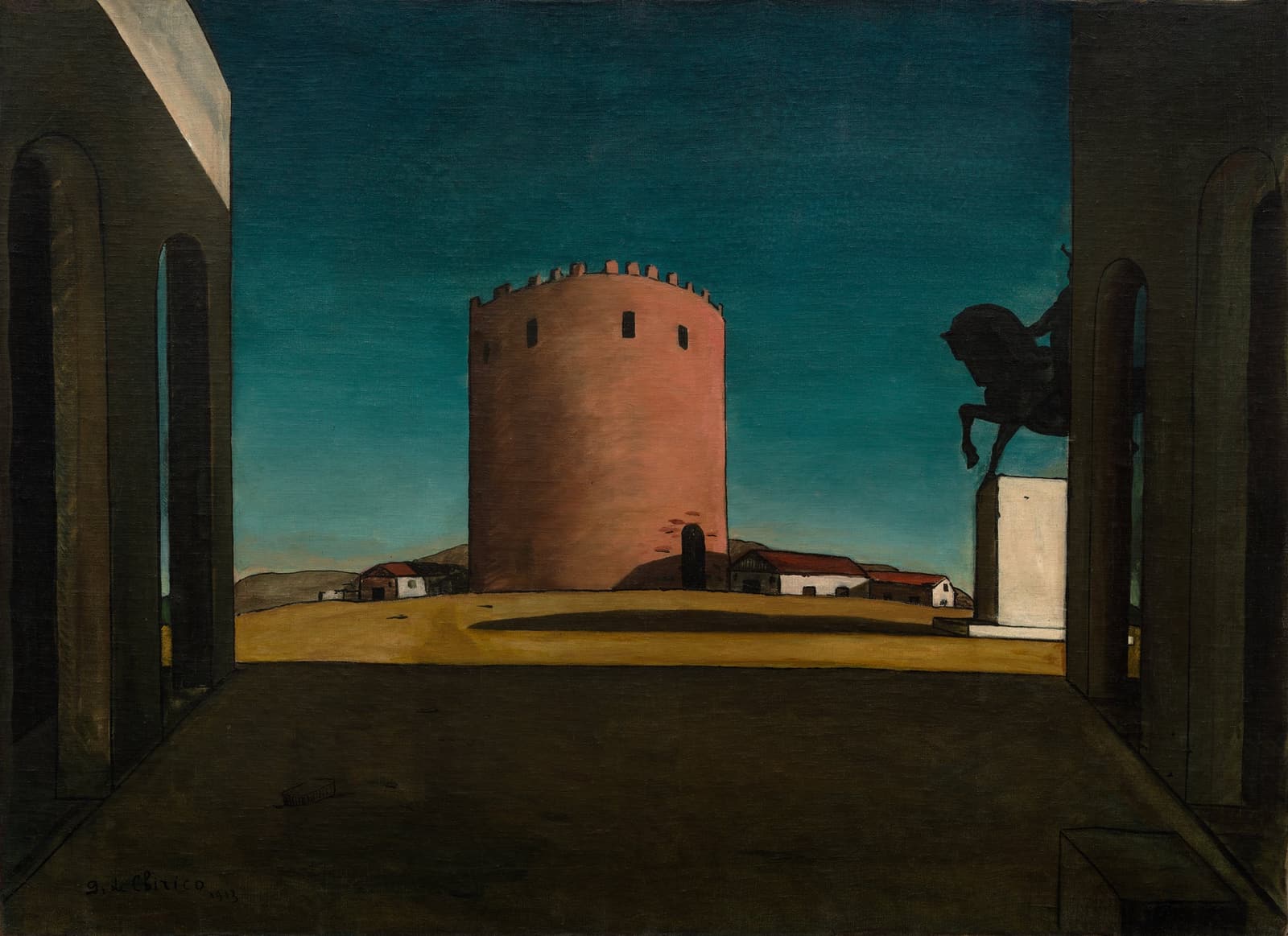
Metaphysical painting is easy to misfile as a preface to Surrealism: a few empty squares, a statue, a train, a shadow, then the dream movement arrives and completes the job. That shortcut loses the sharper historical fact. Before Surrealism made the unconscious a public program, Giorgio de Chirico and Carlo Carra had already built a pictorial language in which ordinary urban space behaved as if meaning had been delayed, withheld, or moved just out of sight.[1]
The movement's force lies in how little it needs. No melting clocks, no crowded fantasy, no spectacular monster. A plaza is almost empty. A tower stands too still. An arcade casts a shadow that seems longer than the hour requires. A train passes in the distance. Classical fragments sit beside modern objects without explaining why they have met. The result is not a dream copied into paint. It is a waking scene made unstable by exactness.
Tate defines Metaphysical Art as the English term for Pittura Metafisica, the Italian movement associated with de Chirico and the former Futurist Carra.[1] That pairing matters because Metaphysical painting was not simply anti-modern nostalgia. It emerged from the same early twentieth-century pressure field as Futurism, Cubism, and Dada, but chose a different tempo. Where Futurism celebrated impact, velocity, machinery, and rupture, Metaphysical painting slowed modernity until its spaces began to sound hollow.
The Piazza As A Machine For Unease
De Chirico's The Red Tower gives the movement its cleanest architectural syntax. The Peggy Guggenheim Collection dates the painting to 1913 and describes the dreamlike effect as a product of irrational perspective, inconsistent light, elongated shadows, and a hallucinatory focus on objects.[2] The painting is not complicated in a narrative sense. A tower rises behind a wall, arcades frame the square, a shadow cuts across the ground, and an equestrian monument is partly concealed. Yet the scene refuses to become simple.
That refusal is the point. The piazza looks public but uninhabited, classical but modern, stable but psychologically wrong. It does not show an event. It makes the absence of event feel active. The viewer is pushed into a peculiar kind of waiting: something has happened, or is about to happen, but the painting withholds the sequence that would let the eye settle into story.[2]
This is why the empty plaza is not a backdrop. It is the operating system. Metaphysical painting turns space into a trap for interpretation. Arcades imply passage, but no one passes. Statues imply memory, but their meanings are displaced. Towers imply civic orientation, but they become watchful rather than helpful. The long shadow is not only an effect of sunlight; it is the visual sign that the scene's ordinary measurements are unreliable.
Objects That Refuse Their Jobs
If The Red Tower makes architecture strange, de Chirico's The Song of Love makes the still-life object stranger. The Art Story's movement overview treats the 1914 painting as one of Metaphysical painting's key works and stresses its startling combination of a red surgical glove, a green ball, the sculpted head of Apollo, architecture, and a low-horizon train.[3] The objects are legible one by one. Their grouping is the problem.
That is where Metaphysical painting differs from ordinary symbolism. A symbol usually asks to be decoded. These objects resist that satisfaction. The glove implies a hand but is not a hand. The plaster head implies antiquity but is pinned into a modern, almost theatrical arrangement. The train suggests industrial movement, yet it remains in the background, more like a signal than a transportation system. The green ball is not absurd because it is impossible. It is absurd because it is too plainly present.
The Art Story links this object logic to the movement's larger ambition: realistic settings and recognizable motifs are made unfamiliar by being placed in contexts that suspend ordinary interpretation.[3] The paintings do not abolish appearances. They over-clarify them until appearance itself becomes suspicious. The glove is glove-like, the head is statue-like, the plaza is plaza-like. Their very clarity creates doubt.
Classical Memory Without Comfort
Metaphysical painting keeps returning to classical forms, but it does not use antiquity as reassurance. The Art Story's account of the Italian-piazza works emphasizes statues, emptied squares, stage-set architecture, and a sense of haunted isolation; the Estorick Collection's learning guide likewise frames de Chirico's Metaphysical world around deserted city squares, strange object groupings, and classical statues.[3][4] The classical body is therefore not a stable inheritance. It is a memory object stranded inside modern loneliness.
That stranded quality is central to the movement's style. Classical statues, arcades, towers, and Italian squares look as if they should organize time. Instead, they make time feel broken. Antiquity appears as a fragment, not a foundation. A statue cannot restore civic wholeness. A myth cannot restore narrative confidence. The old forms remain powerful precisely because they no longer know what world they belong to.
This is one reason Metaphysical painting feels cooler and more severe than later Surrealist fantasy. It rarely erupts. It arranges. The emotional charge comes from spacing, silence, angle, and displacement. The picture does not shout that the world is irrational. It makes rational-looking space behave as if it has lost its reason.
From Munich To Turin To Paris To Ferrara
The movement's geography helps explain its odd mixture of philosophy, architecture, and stagecraft. The Musee de l'Orangerie's exhibition account traces de Chirico's formation from Greece and Munich through Turin, Paris, and Ferrara, noting his classical culture, late German Romantic influences, and exposure to Nietzsche, Schopenhauer, Bocklin, and Klinger.[5] Those references matter because Metaphysical painting is not only a style of eerie plazas. It is a theory of how objects can reveal a second pressure behind ordinary perception.
Turin gave de Chirico arcades, squares, statues, and the urban theatricality of long perspectives. Paris gave him avant-garde visibility and literary attention, including Apollinaire and later Surrealist admirers.[3][5] Ferrara, where de Chirico and Carra overlapped during World War I, sharpened the movement's interiors and mannequin-like stillness.[1][5] The result was a style that could make a city square feel philosophical without turning painting into illustration of philosophy.
The war context should not be flattened into a single cause, but it changes the temperature of the work. The Art Story notes the movement's isolation amid Europe's difficult recovery from World War I, while the Orangerie account places de Chirico's vocabulary inside a route that culminated in Ferrara during the wartime years.[3][5] That historical pressure is persuasive because the paintings often feel like civilization holding its breath. They are not battlefield pictures. They are pictures of cultural time after confidence has cracked.
Why Surrealism Needed This Silence
Surrealism would later make dreams, automatic writing, and psychic collision central to modern art. Metaphysical painting prepared one of its crucial permissions: unrelated things could meet in a scene and produce meaning without being explained by normal narrative. The Guggenheim account notes the importance of de Chirico's 1911-17 works for Surrealist painters, and The Art Story similarly treats Metaphysical painting as a primary influence on the emerging Surrealist movement.[2][3]
But the movement should not be valued only as a source for something else. Its independent invention was silence. Surrealism often accelerates association. Metaphysical painting suspends it. A viewer can stare at The Red Tower or Ariadne for a long time without receiving the release of plot. The paintings create a mental room where symbols do not resolve, and that unresolved condition becomes the subject.[2][4]
That is why the style still feels contemporary. Modern life is full of spaces that appear functional while withholding emotional orientation: stations, plazas, office districts, transit edges, institutional corridors, empty civic architecture after hours. De Chirico and Carra did not invent alienation, but they gave it a precise visual architecture. The empty piazza became a way of painting the mind when the world remains legible but no longer feels intelligible.
Metaphysical painting's lasting lesson is therefore not "dreams are strange." It is sharper: ordinary clarity can be strange when the links between objects, memory, and purpose have been cut. A glove, a statue head, a train, a tower, and a shadow do not need to become fantasy. They only need to stand together long enough for the viewer to feel that appearances are not enough.
Sources
- Tate, "Metaphysical Art" - art-term overview identifying Pittura Metafisica, Giorgio de Chirico, Carlo Carra, and the movement's relation to later Surrealism.
- Peggy Guggenheim Collection, "Giorgio de Chirico, The Red Tower" - collection page on the 1913 painting, irrational perspective, elongated shadows, silent Italian piazzas, and Surrealist influence.
- The Art Story, "Metaphysical Painting" - movement overview on the 1910-1920 chronology, de Chirico, Carra, key motifs, The Song of Love, Italian piazzas, World War I context, and Surrealist influence.
- Estorick Collection, "Metaphysical Marvels: Giorgio de Chirico and Carlo Carra" - learning guide on de Chirico and Carra, deserted city squares, bizarre object groupings, classical statues, and Metaphysical art's mood of mystery.
- Musee de l'Orangerie, "Giorgio de Chirico. Metaphysical painting" - exhibition page tracing de Chirico's formation from Munich, Turin, Paris, and Ferrara and his philosophical and artistic influences.