The Isenheim Altarpiece is often remembered for shock: the stretched arms, the greenish wound-darkened skin, the terrible hands, the dead weight of Christ's body against the cross. But shock is too small a word for what this work is doing. Its brutality is not a flourish added to sacred subject matter. It is the altarpiece's method of meeting viewers who did not need suffering explained to them.
The work was made between 1512 and 1516 for the Antonite order's monastic complex at Isenheim, near Colmar, with Niclaus of Haguenau responsible for the sculpted section and Matthias Grünewald for the painted panels.[1] The Unterlinden Museum notes that it decorated the high altar of the monastery hospital chapel until the French Revolution.[1] That setting changes everything. This was not a private collector's taste for the macabre. It was an image built for a place where patients came with diseased skin, pain, fear, and hope already in the room.
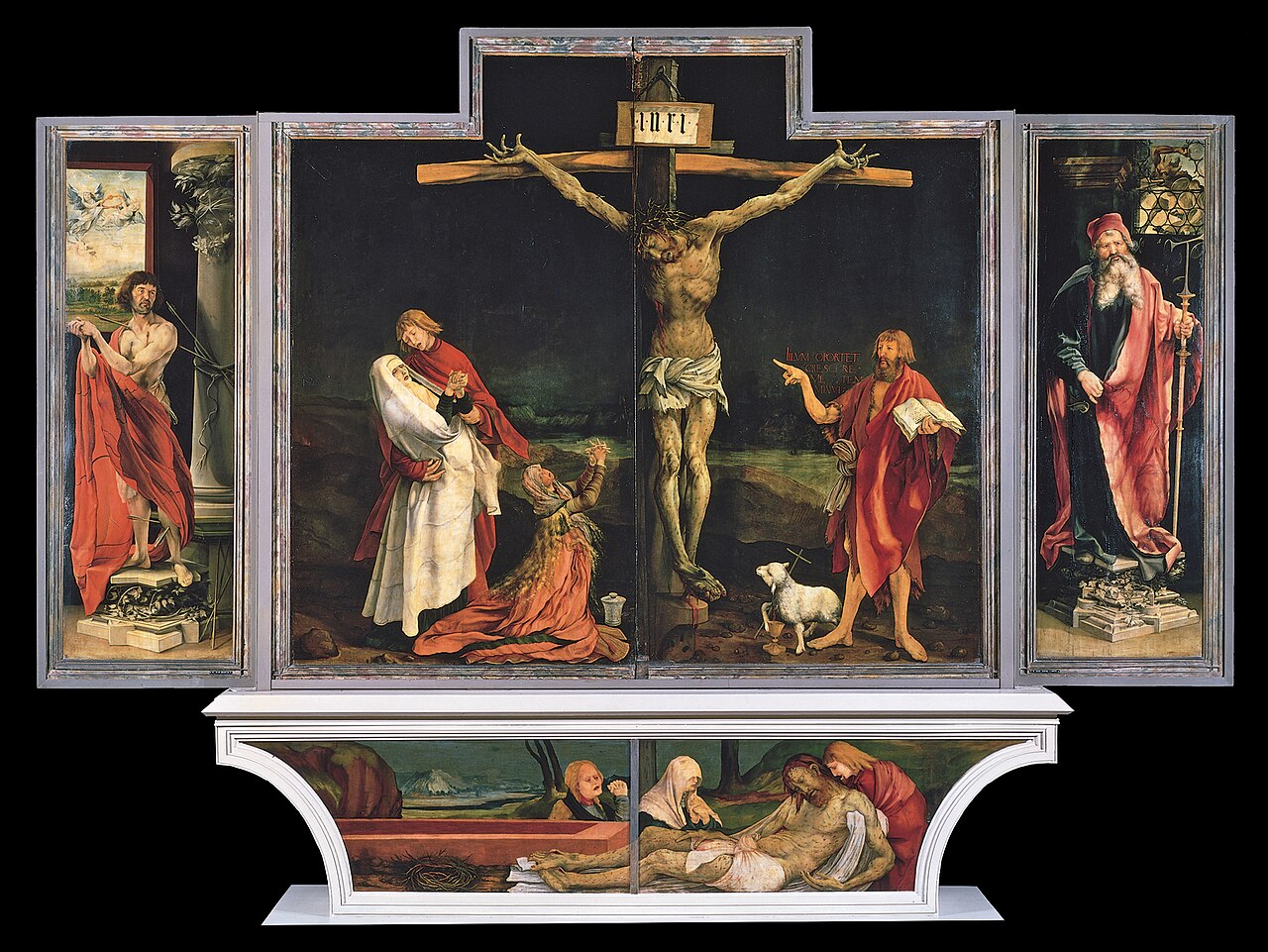
A Hospital Image, Not A Horror Image
The closed state is the key. With the wings shut, the viewer faces the Crucifixion, flanked by Saint Sebastian and Saint Anthony, with the Lamentation below.[3][4] This is the face the altarpiece gave ordinary time. Feast days could open the structure into other visions, but the closed configuration made the daily argument: Christ's body is not remote from the sick body.
Smarthistory's account is useful because it keeps the hospital context in view. The Antonite monks cared for sufferers of skin disease, especially ergotism, a condition historically known as Saint Anthony's fire.[3] That knowledge makes the surface of Christ's body more than expressive exaggeration. The sores, discoloration, twisting limbs, and punctured skin become a form of recognition. The painting says, with almost unbearable directness, that sacred presence has entered the same damaged flesh patients brought to the chapel.
That is why the image should not be softened into a general meditation on pain. Grünewald makes pain specific. The fingers do not merely gesture. They strain. The feet do not merely hang. They twist under nailed pressure. The body is not classically noble in defeat. It is medically vulnerable, publicly exposed, and almost aggressively unidealized. The painting's compassion depends on that refusal of beauty as escape.
The Saints Make The Wound Useful
The side figures are not decorative witnesses. Saint Sebastian, pierced by arrows, stands on one side; Saint Anthony, patron saint of those afflicted by Saint Anthony's fire, stands on the other.[3][4] Their presence turns the central Crucifixion into a triangle of suffering, protection, and intercession. The saints do not remove pain from the image. They organize it into a devotional system.
Sebastian matters because he carries the memory of bodily assault and plague protection. Anthony matters because the institution itself was Antonite, and because his cult was tied to the very disease context the hospital served.[3] The patient looking at the altarpiece was not asked to climb out of illness into a clean symbolic world. The patient was given saints whose authority came through proximity to wounds, disease, temptation, endurance, and care.
John the Baptist on the right side of the Crucifixion sharpens the theology. He points toward Christ beside the lamb, directing the viewer's attention away from himself and toward the wounded body.[3] The gesture matters because the whole image could easily collapse into horror. John prevents that collapse. He tells the eye that the body is not an end point. It is the place where meaning must be found.
The Hinges Change The Emotional Contract
The Isenheim Altarpiece is not one picture. It is a moveable structure, essentially a box of sculptures covered by painted wings, with multiple viewing states.[4] That mobility is central to the work's intelligence. Closed, it gives the hospital its most severe face. Opened for major liturgical occasions, it shifts into scenes such as the Annunciation, the Concert of Angels and Nativity, and the Resurrection, before revealing the sculpted shrine of saints at the core.[3][4]
This alternation matters because the altarpiece does not trap the viewer in suffering. It begins with a suffering so concrete that it cannot be dismissed, then lets the object itself become a mechanism of transformation. The hinge is not only carpentry. It is pastoral pacing. The work can move from disease-marked flesh to radiant birth, from dead body to risen body, from paint to sculpture, from private anguish to institutional ritual.
That sequence also keeps the Crucifixion honest. Consolation does not arrive by pretending the first image was exaggerated. It arrives because the first image was allowed to be true. The closed Crucifixion gives pain its full weight, so the opened states can feel like more than decorative relief. Hope has to pass through the body first.
Restoration Restored The Work's Double Register
The recent restoration adds another layer to the close reading. The Unterlinden Museum says the altarpiece underwent a full restoration beginning in 2018, covering painted panels, sculptures, frames, and related components, with the project completed in June 2022.[2] The museum also notes that earlier dirt and oxidized varnish had darkened the painted panels and undermined the coherence of the whole.[2]
That last point is important. The altarpiece's force depends on extremes that still belong together: corpse and radiance, disease and gold, paint and sculpture, closed severity and opened splendor. The restoration account says the public could again see the original coherence between the painted panels and sculptures, especially in color, and that pigment analysis showed Grünewald's workshop applied color to the sculptures made by Niclaus of Haguenau.[2] In other words, the painted horror and carved sanctity were never meant to be separate aesthetic worlds. They were coordinated.
This helps explain why the closed Crucifixion remains more than an image of damage. The color is sickly, but it is composed. The saints are still, but not inert. The sky is dark, but staged. The body is broken, but placed within a structure that knows how to open. The work's brutality is disciplined by form, and its form is made credible by brutality.
Why The Painting Still Refuses Distance
Modern viewers can admire the Isenheim Altarpiece safely, as art history, as Northern Renaissance intensity, as a famous museum object. The painting resists that safety. Its first demand is still bodily: look at the wound before you translate it into style.
That demand is not anti-beautiful. It is a harder kind of beauty. The altarpiece makes beauty answer to use. In a hospital chapel, the Crucifixion had to do something more difficult than impress healthy viewers. It had to speak to people whose bodies already felt unreliable. It had to make pain legible without making pain meaningless. It had to offer consolation without insulting the sick by making suffering look elegant.
That is why the Isenheim Altarpiece makes pain part of the cure. Not because looking at pain heals by itself, and not because illness is redeemed by spectacle. The painting's claim is more exacting: the wounded body is not outside sacred attention. The patient does not have to leave the body behind to enter the image. Grünewald brings the sacred body down into disease, and the altarpiece's hinges promise that this descent is not the final state.[1][2][3][4]
Sources
- Musée Unterlinden, "The Isenheim altarpiece" - official object page on the 1512-1516 commission, Grünewald's painted panels, Niclaus of Haguenau's sculpture, Antonite monastery hospital setting, and Guy Guers.
- Musée Unterlinden, "The restoration of the Issenheim Altarpiece" - museum restoration note on the 2018-2022 project, varnish and dirt issues, public conservation work, and restored color coherence between painting and sculpture.
- Smarthistory, "Matthias Grünewald, Isenheim Altarpiece" - art-history overview of the hospital context, Saint Anthony's fire, closed and open states, saints, and sculpted interior.
- Khan Academy, "Grünewald, Isenheim Altarpiece" - article on the altarpiece as a large moveable structure made between 1512 and 1516 for a hospital context.
- Wikimedia Commons, "File:Grunewald Isenheim1.jpg" - public-domain photographic reproduction used for the article image, showing the closed view of the Isenheim Altarpiece.