Try to tell where Patroclus is looking. The nose gives a firm answer, pointing left into an expanse of brown. The eye is harder to consult. Under the ledge of the brow there is barely enough light to distinguish the eyelid. Follow the face around to the ear, though, and you could trace the ridges of individual curls with a fingertip. In William Henry Fox Talbot’s photograph of August 9, 1843, the hair is considerably easier to read than the expression. [1]
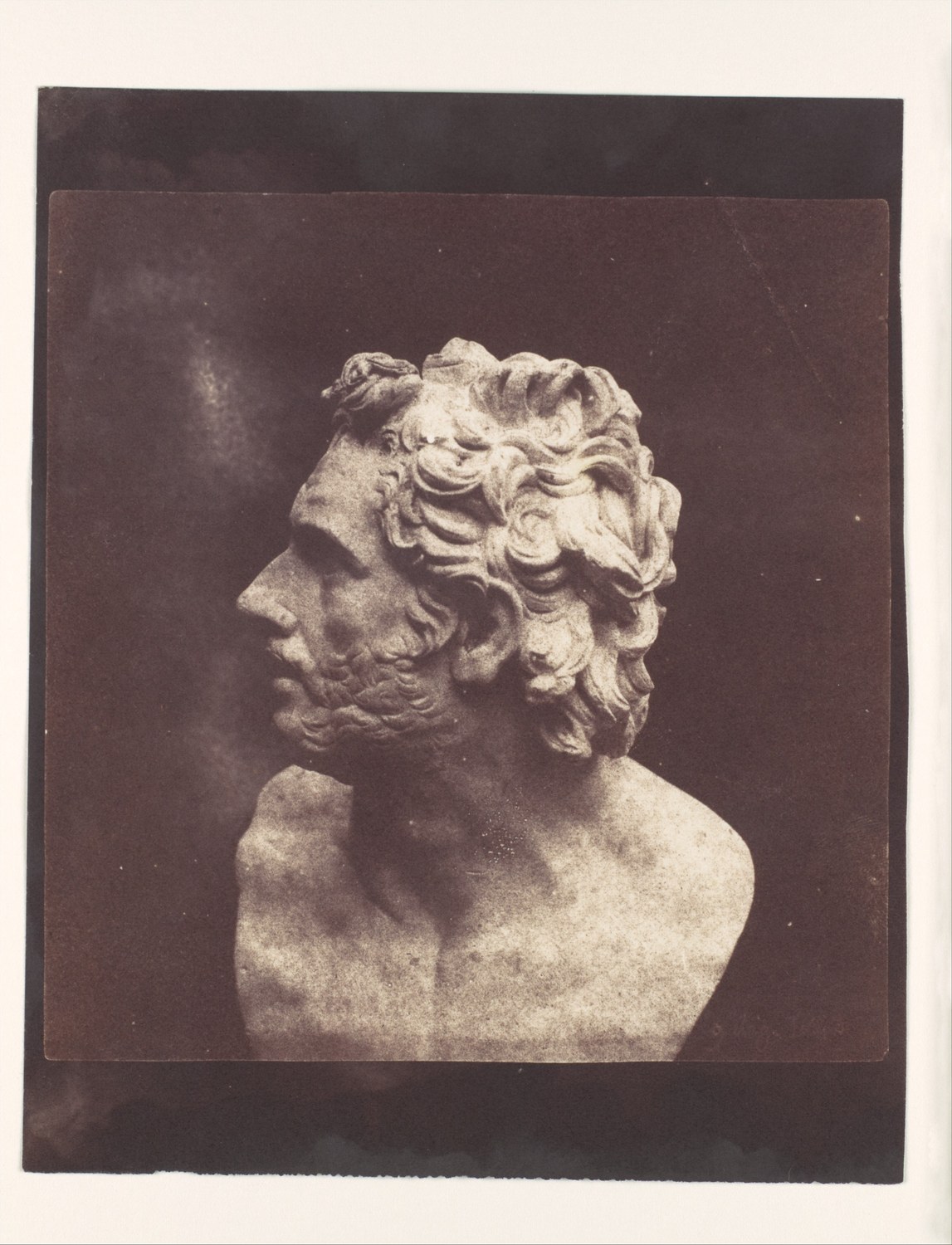
Look at the small interval between the chin and the shoulder on the left. The background gets into it, making a dark notch. On the right, the neck runs down into the shoulder in a long, unbroken slope. Taken together, those two edges give the head a little wrench, as if someone had just called to the sitter from outside the picture. Cover the shoulders with a finger and much of that sense of a sudden turn goes away. The nose still points left. What disappears is the suggestion that the body has yet to follow.
Talbot had an unusually patient sitter. He owned the plaster cast and could bring it out again when the light changed. His records document a series of views in the summer of 1840. Two later photographs of it made their way into his illustrated book The Pencil of Nature. The negative for plate V bears the date August 9, 1842. The view reproduced here, chosen for plate XVII, followed a year to the day later. A reader turning the pages could meet the same head twice. [1][2]
What a white cloth could do
In the text for plate V, Talbot gives the reader something to try. In strong sunshine, he suggests, hold a white cloth a little way off to one side of a statue. Light bouncing off the fabric will reach recesses that the sun has left dark. His wording is modest and precise about the desired effect. Only a little light need come back. Imagine doing this for the shadowed eye in the later photograph. The lid might grow easier to distinguish while the ridge above it kept its brightness. One could change the apparent alertness of a face without touching a single feature. Talbot offers the cloth as a general method. Its use for this exposure is an open question. [3]
His other suggestions involve moving things. A photographer can turn the pedestal, choose the angle at which the sun strikes the plaster, or bring the camera closer. Each decision answers a different question about the head. A close view can make a curl large enough to study. Light grazing the curl determines whether its grooves remain legible. Here the little alternating bands of light and dark above the ear have such definition that the eye keeps slipping back to them, even when one means to look the man in the face. [1][3]
When the bust reappears at plate XVII, Talbot’s prose takes a comic turn. He imagines amateurs happily giving up the pencil because the camera saves them the trouble of mastering perspective. Even an accomplished artist, he adds, could spend a day drawing the details of a Gothic building that the camera could register in moments. It is a good joke to put beside the second portrait of this particular sitter. Anyone who remembers the earlier lesson knows how much there was to do before the exposure began. [3][4]
Return to the curl just behind the temple. Its upper lip catches the light in a pale crescent. A short distance to the left, the brow has much the same overhanging shape, yet it drops the eye beneath it into obscurity. The same sunlight that lets us inspect the sculptor’s work strand by strand leaves us guessing at the direction of a glance. That small uncertainty is where a plaster cast begins to feel like company.
Sources
- The Metropolitan Museum of Art, collection record and photograph for William Henry Fox Talbot’s Bust of Patroclus, accession 1988.1159.
- J. Paul Getty Museum, Disciples of Light: Photographs in the Brewster Album, discussion of Talbot’s early studies, note 86, and catalogue entry for the August 1843 view.
- William Henry Fox Talbot, The Pencil of Nature, plate V, on positioning and lighting a bust.
- William Henry Fox Talbot, The Pencil of Nature, plate XVII, on photographing the same bust again and the appeal of drawing by camera.