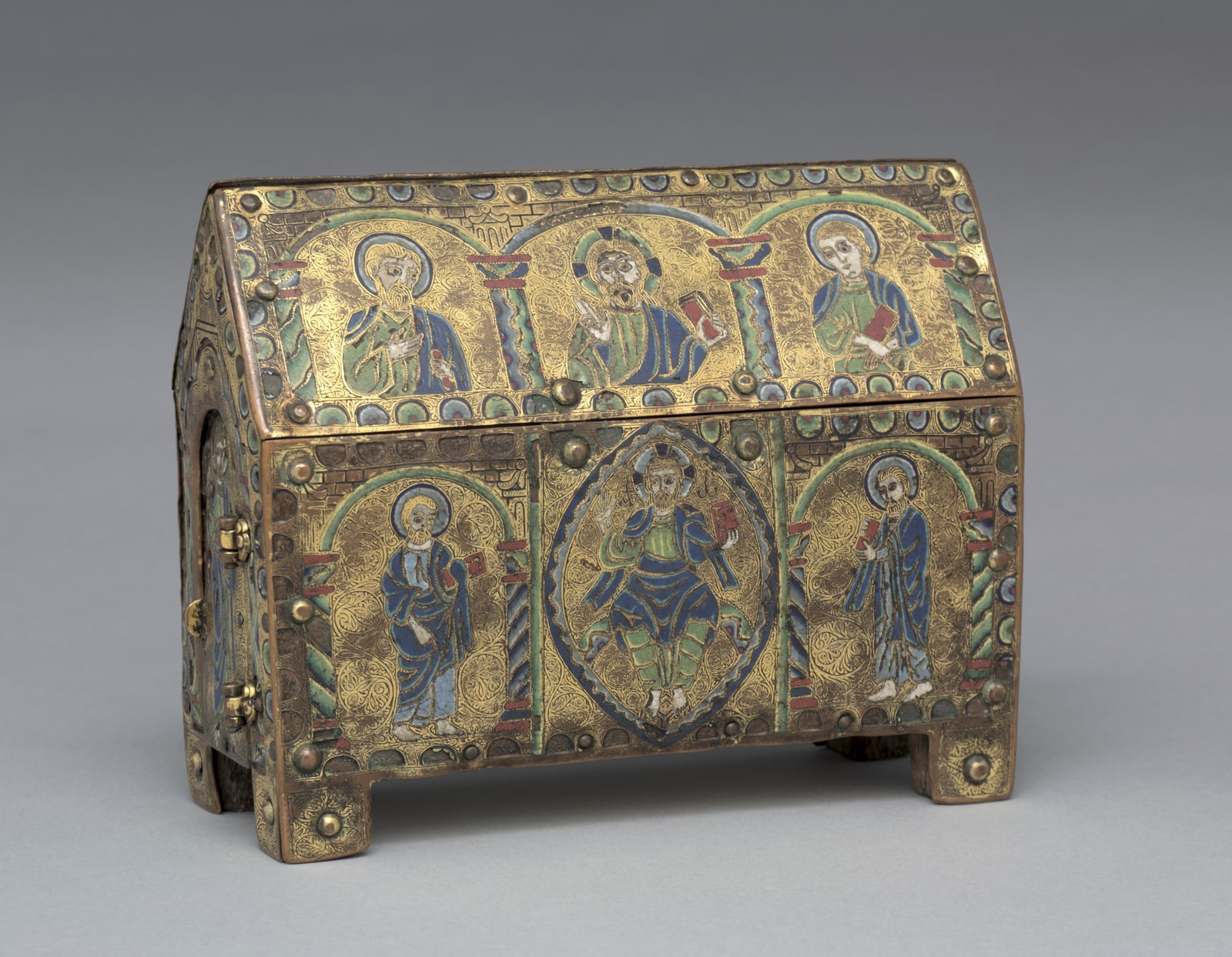
Blue gathers around the figures; gold curls through the spaces between them. The little house-shaped reliquary in the Cleveland Museum of Art looks lavishly dressed, its surface crowded with halos, arches and patterned clothing. Yet much of this richness began with subtraction. Before the colored glass could occupy the copper, someone had to make room for it.
The museum dates this Chasse to 1200–1250 and identifies its place of manufacture as Limoges, France. It is only 21.4 centimeters wide. Its materials include gilded, engraved and chased copper, champlevé enamel and a wooden core.[1] That compact inventory describes several kinds of work sharing one object. Learning to separate them makes the surface more absorbing: a line may be an edge, an engraving or the boundary of a hollow filled with glass.
Drawing with what remains
The French name champlevé means “raised field.” The useful thing to picture is the metal that stays at its original height while the maker lowers selected areas around it. In the carved-copper method, recesses receive the enamel; the surviving metal supplies divisions and can become a substantial part of the picture. The V&A notes that these boundaries and unrecessed areas were often gilded, giving the composition bright outlines and backgrounds.[2]
This differs from cloisonné, in which fine wires fixed to a metal surface establish the compartments.[2] Both methods can produce crisp divisions between colors, but the divisions have different origins. Champlevé asks the maker to think through the plate: which areas should remain metal, and which should become places for glass?
That question helps explain why the Cleveland casket's gold is so visually active. It is easy to let the blues command attention and treat everything around them as support. Try reversing that habit. Follow the curling ornament between the figures. Watch how a bright interval separates one area of color from the next. The metal has its own drawing to perform.
The distinction also prevents a misleading reading of the surface. A narrow gold line need not be a wire attached on top. Its appearance alone does not tell us how it was made; the named technique gives us a better starting point.
The first firing does not finish the color
The Met's account of medieval enameling describes ground colored glass mixed with water and placed in the prepared hollows. Heating fused it into enamel, but the powder lost volume as it melted. The cells therefore needed refilling and another firing, sometimes several. After cooling, the filled surface was polished; details could be engraved into the surrounding copper, with gilding and burnishing among the subsequent finishing operations.[3]
This makes the smooth result feel less instantaneous. The maker had to bring a loose material toward the intended level through repeated work. Color occupied a depth before it became a finished surface. Polishing then helped reconcile the filled recesses with their metal surroundings.
There was judgment in the heating, too. The V&A's explanation of its modern champlevé reconstruction stresses a historical difference: medieval practitioners used charcoal-fueled kilns and assessed the firing themselves.[4] A reconstruction can clarify the sequence without reproducing every condition of a medieval workshop. It also cannot establish the exact number of firings used for this particular Cleveland object.
The finished casket invites us to forget those pauses. Its small colored areas read together immediately, across the front and sloping roof. Knowing the process slows that first impression down. The glass had to be placed, fused, replenished and worked before it could look so settled.
A small building assembled from surfaces
The wood in the museum's materials list matters.[1] A reliquary of this kind was also a construction, with decorated metal covering a supporting body. The vivid outer skin was only one part of the object.
A related Limoges casket in the Wyvern Collection, dated about 1185, makes that assembly especially clear. Bowdoin's study describes six panels nailed onto a wooden core and five heads made separately and attached. Its fine curling ornament is called vermiculé, from the Latin for “little worm.” The same study notes differing nail conditions, evidence of repair, and a missing enamel floret exposing copper beneath.[5]
Those details belong to the Wyvern casket, not automatically to Cleveland's. They show why “champlevé enamel” cannot explain every feature of a reliquary. A maker could combine recessed glass with engraved ornament, attached relief and structural fasteners. Later repairs could join that history. The technique names a central operation within an assembled object.
Reliquaries held saints' remains or objects associated with them; Limoges workshops supplied patrons across Europe.[5] Their precious-looking exteriors gave visible attention to contents that might remain concealed. The house form supplies an enclosing architecture, while the small figures and patterned fields hold the eye at its walls.
Return to the photograph and start with a boundary between blue and gold. Follow it until it becomes a curve, a halo or a division between figures. Then look at the rows of fasteners that hold the larger form together. The casket offers both scales of making at once: the local decision to remove a little copper, and the larger decision to join decorated pieces into a shelter. Its brilliance rests on both.
Sources
- Cleveland Museum of Art, “Chasse,” accession 1954.599 — dating, Limoges attribution, materials, dimensions and museum photograph.
- Victoria and Albert Museum, “A guide to metalworking techniques,” sections on champlevé and cloisonné enamelling — recessed fields, gilded boundaries and wire partitions.
- Michael Norris, Medieval Art: A Resource for Educators, Metropolitan Museum of Art, 2005, pp. 144–145 — glass preparation, shrinkage, repeated firing, polishing and finishing; official museum PDF.
- Victoria and Albert Museum, “How was it made? Champlevé enamelling,” updated April 17, 2024 — written introduction to the process and the historical use of charcoal-fueled kilns.
- Maria McCarthy, “Vermicular Chasse with Saints and the Lamb of God,” Bowdoin College Museum of Art, New Views of the Middle Ages — Wyvern Collection 0436, its assembly, ornament, condition and devotional context.