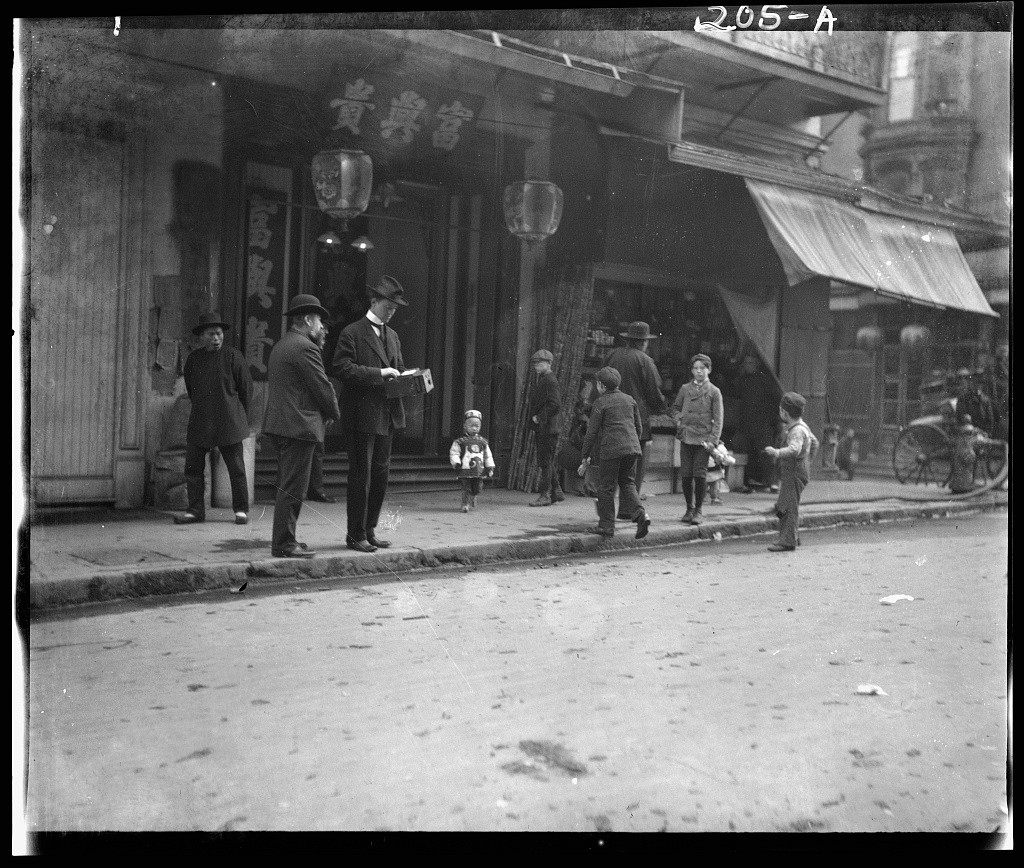
Look for the tall man studying something in his hands. That is Arnold Genthe, holding the camera he carried through San Francisco’s Chinatown. Beside him stands a man in a round-brimmed hat, close enough that the dark sleeves of their coats meet. Farther along the curb, a child has stepped into the street. There are several small centers of attention here, and remarkably little to suggest that the tall man ought to have the picture to himself. That came later, when Genthe prepared it for print. [1][2]
Genthe arrived in San Francisco from Germany in 1895 with a job tutoring a boy. In his account, photography began with a letter-writing problem. He wanted pictures of Chinatown to send home. The postcards disappointed him, and when he took out a sketchbook, people moved away. A camera small enough to pocket let him work before anyone had time to step aside. It also settled a disagreement entirely in his favor. Someone who could decline to sit for a sketch had much less say about appearing in a photograph. [3]
Consider what happened when Genthe himself appeared on the other side of the lens. The Library of Congress preserves the street negative reproduced here as well as evidence of the steps that turned it into the book illustration An Unsuspecting Victim. Cropping brought Genthe forward, but a tighter frame still left him with company. On a surviving copy negative, red dye and retouching marks show where he worked to remove the other man. An intermediate print has a blur where the man had stood. Look back at the two pairs of shoes along the curb and the delicacy of the job becomes apparent. Genthe wanted to keep the space right up to the edge of his own coat. [1][2]
He knew the value of a detail small enough to work on with a pencil. In another Chinatown photograph, of children walking away from the camera, the exposure had left limbs and braids hard to distinguish. Genthe drew on a copy negative. Light falling across its surface at a low angle still picks out the graphite. A reader could recognize the braids in the finished picture without ever knowing whose hand had made them so distinct. [2]
These choices accumulated across a book. The Museum of Chinese in America points out that children appear in roughly two-thirds of Genthe’s Chinatown pictures, although the neighborhood’s population was predominantly adult and male. Holiday clothes recur so often that a reader unfamiliar with the streets might take them for everyday wear. After the earthquake and fire of 1906, the distinction mattered even more. Genthe’s Chinatown negatives had been stored outside the city and survived. People who had never walked the old neighborhood could now get to know it through his selection of faces and clothes. [3][4]
Genthe went on to a portrait career with sitters including the dancer Isadora Duncan. For one picture he worked from a negative that also showed her manager, Paris Singer. He cut Singer out of the composition and softened Duncan’s features in the enlargement. A viewer meeting Duncan alone on the page might reasonably imagine a moment of privacy. Genthe could give a sitter that quality after the sitting was over. [2][3]
The man at the curb makes an unusually good guide to this photographer’s career precisely because so little is known about him from the picture. He might be interested in the camera. He might simply be waiting. The full negative leaves room to wonder what business has brought two people shoulder to shoulder on a San Francisco sidewalk. In the book, Genthe kept the pleasure of catching a photographer absorbed in his equipment. The other man took the question with him. [1][2]
Sources
- Library of Congress, An Unsuspecting Victim, Chinatown, San Francisco, scan from the original negative.
- Library of Congress, “The Negative and the Print,” comparisons of Genthe’s working materials and finished photographs.
- Library of Congress, “Wipe That Scowl Off Your Face,” on Genthe’s recollections, portrait clients and surviving negatives.
- Museum of Chinese in America, “Arnold Genthe,” on the people and occasions represented in his Chinatown photographs.