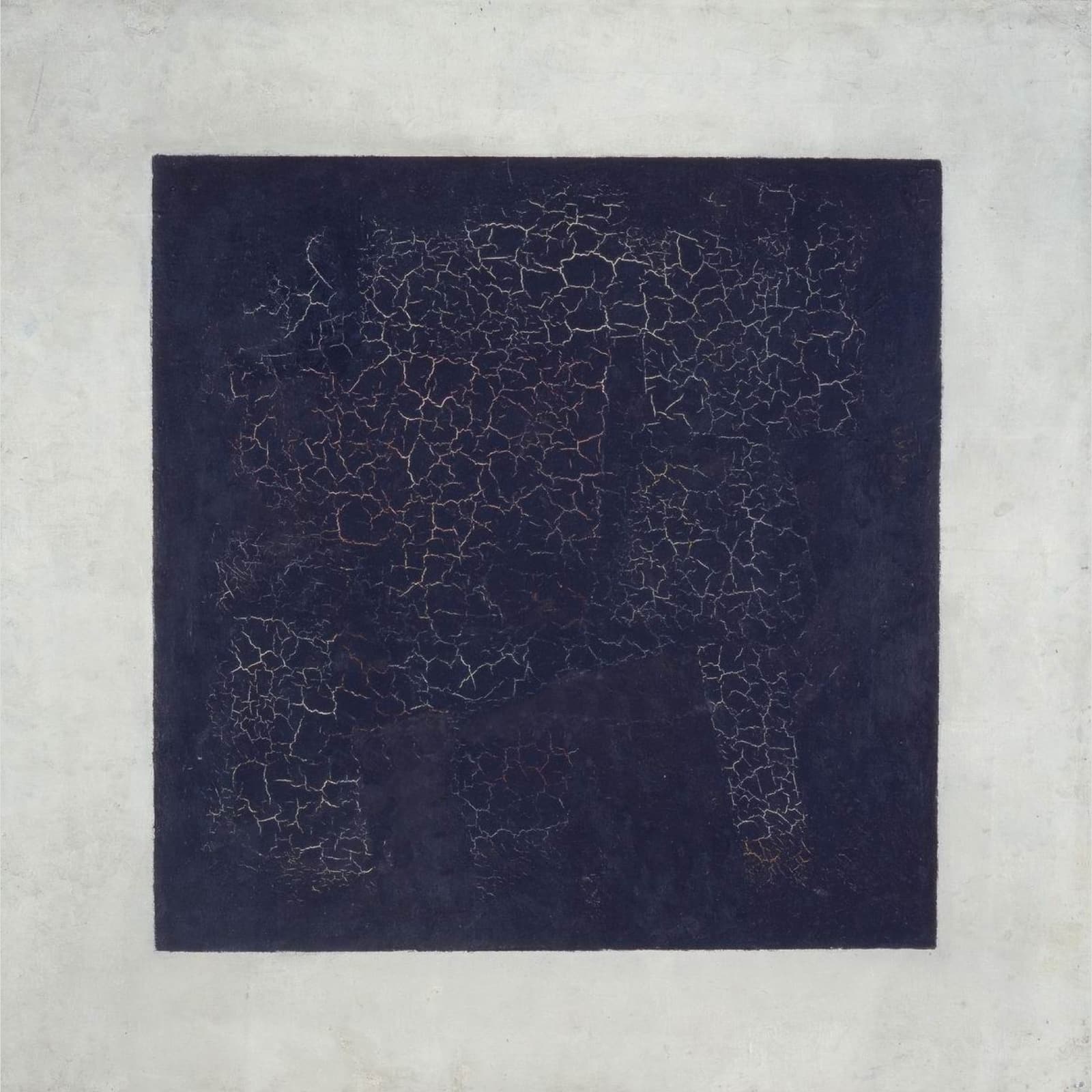
Suprematism is often reduced to one meme-level sentence: “a black square that changed modern art.” That line is directionally true and analytically weak.
The stronger reading is structural: Suprematism changed the unit of visual meaning. Instead of asking a painting to represent an object, Kazimir Malevich asked it to stage relations among elementary forms—square, circle, cross, line, color field—so perception itself became the subject.[1][2]
That shift sounds familiar today because it behaves like a design system: strict primitives, constrained grammar, expandable combinations.
1913–1916: from anti-object painting to a new exhibition protocol
Both Tate and Britannica place Suprematism’s emergence around 1913, with public inauguration at the 0.10 Exhibition in Petrograd in December 1915 (running into January 1916).[1][2][3] The historical point is not only that new paintings were shown. The display logic itself declared a new hierarchy.
At 0.10, Malevich’s Black Square (1915, oil on linen, 79.5 × 79.5 cm) was installed high in the room, in a position repeatedly discussed as icon-like within Russian domestic visual culture.[3][4] Whether one reads that as provocation, substitution, or both, the curatorial gesture turned a painting into a claim about what could count as a “primary image” in modern life.
So the movement’s real rupture was double:
- a formal rupture (non-objective geometry), and
- a display rupture (new visual authority inside the room).
Why Black Square is less “minimal image” and more “zero-point device”
Malevich later framed Suprematism through ideas of non-objective art and a break from inherited representational burden.[1][2] In practice, Black Square works less like an endpoint and more like a calibration card.
It does three things at once:
- Removes narrative obligation. No landscape, no portrait, no anecdote.
- Magnifies edge behavior. The painting’s force lives at boundaries: black/white, object/ground, icon/surface.
- Creates a generative rule. Once representation is no longer required, compositional logic can iterate as a system.
That is why Suprematism quickly moved beyond one canvas into families of rotated planes, floating bars, and tuned intervals in color and spacing.[2][4]
1917–1919: the movement completes its internal arc in White on White
Britannica and MoMA’s collection record together anchor the key transition: by 1917–1918, Malevich’s White on White phase pushed color contrast toward near-disappearance, with orientation and tonal difference doing the remaining work.[2][5]
This matters because it closes the movement’s internal argument. If Black Square proves that depiction can be suspended, White on White asks whether even stark chromatic opposition is necessary for pictorial structure. The answer is: only partly. Tilt, proportion, and pressure between planes can carry meaning on their own.
In style-history terms, this is where Suprematism stops being “radical simplification” and becomes a mature spatial syntax.
1919–1927 and after: from Russian avant-garde studio logic to transnational visual language
Influence claims are often hand-wavy; this one is unusually traceable. Tate notes El Lissitzky’s 1919 encounter with Malevich and later influence lines toward László Moholy-Nagy.[1] Britannica similarly tracks geometric abstraction pathways from Russian artists into Germany and the Bauhaus milieu in the early 1920s.[2] Stedelijk’s research essay adds a useful institutional bridge: by 1927, Malevich’s Berlin-facing material explicitly sat in dialogue with broader European non-objective programs.[6]
You can see the migration at the level of visual operations:
- axial vs diagonal tension,
- modular repetition,
- restricted palettes with high structural contrast,
- typography/image integration through geometric scaffolds.
By the time Bauhaus print and exhibition graphics hardened into recognizable public language, this Suprematist grammar had become portable—less a school style than a reusable design engine.[2][6][7]
How to read Suprematism now without flattening it
A useful contemporary reading sequence is:
- Start with installation context, not isolated JPEGs. The 0.10 room logic explains more than single-image formalism.[3][4]
- Track movement as a sequence, not a symbol. Black phase → color phase → white phase is an argument in time.[2]
- Look for grammar transfer. Ask where Suprematist operations survive outside painting: posters, editorial grids, interface-era geometry.[2][6][7]
Seen this way, Suprematism is not an austere dead-end. It is one of the earliest successful attempts to turn modern visual experience into a programmable system.
Sources
- Tate, Suprematism
- Encyclopædia Britannica, Suprematism
- Wikipedia, 0,10 Exhibition (dates, venue, exhibition context)
- Wikipedia, Suprematism (movement overview, Black Square context)
- MoMA Collection, Kazimir Malevich, Suprematist Composition: White on White (1918)
- Stedelijk Museum, Suprematism and Neoplasticism (cross-European dialogue, 1927 context)
- Bauhaus Kooperation, Poster for the 1923 Bauhaus Exhibition in Weimar (geometric design system in public graphic language)
- Wikimedia Commons file record, Kazimir Malevich, Black Suprematic Square (image record/metadata)