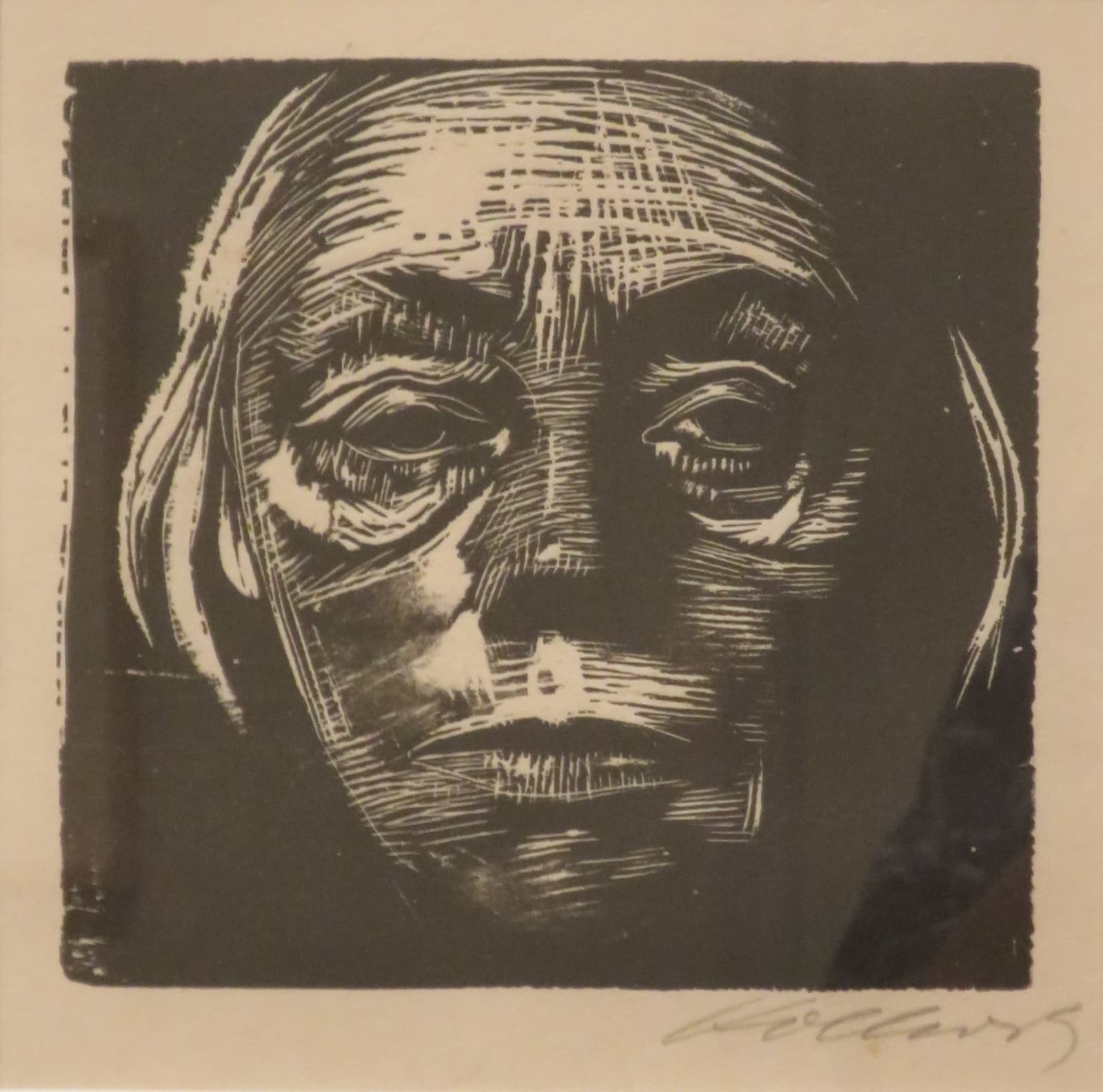
Käthe Kollwitz is often introduced as the artist of sorrow: mothers, widows, hunger, war. That is true, but it is not enough. The sharper way to read her is as a designer of public feeling—an artist who understood that if an image is to move beyond a room and into civic life, it has to survive reproduction.
That is why her medium choices matter as much as her subjects. From the 1890s forward, Kollwitz increasingly committed to etching, lithography, and woodcut, building an art that could circulate at scale while keeping emotional pressure intact.
A career built at the edge of the clinic, street, and print shop
Several timeline anchors clarify the profile:
- 1867: born in Königsberg (today Kaliningrad).
- 1891: married physician Karl Kollwitz and moved to Berlin, where his practice served working-class patients.
- Early 1890s onward: turned decisively toward printmaking as a social medium.
- 1914: her younger son Peter was killed in World War I, a rupture that deepened her anti-war work.
- 1919: appointed professor at the Prussian Academy (a historic first for a woman artist in that institution).
- 1933: forced by the Nazi regime to resign and later barred from exhibiting.
- 1945: died in Moritzburg, shortly before the war in Europe ended.
The key point is continuity. Her politics did not arrive suddenly after personal tragedy; they were already structurally present in her commitment to workers, mothers, and social violence. Personal loss intensified an existing artistic direction.
Why print, not painting, became the core language
Kollwitz studied painting, but print gave her two things painting could not combine as effectively for her goals:
- Reproducibility — one matrix, multiple impressions, wider circulation.
- Graphic force — line, pressure, abrasion, and black-white contrast that can carry urgency without decorative delay.
In her best sheets, the drama comes from compression rather than spectacle. Figures crowd the frame; blank space feels like air withdrawn from the room; hands do narrative work that faces cannot finish alone.
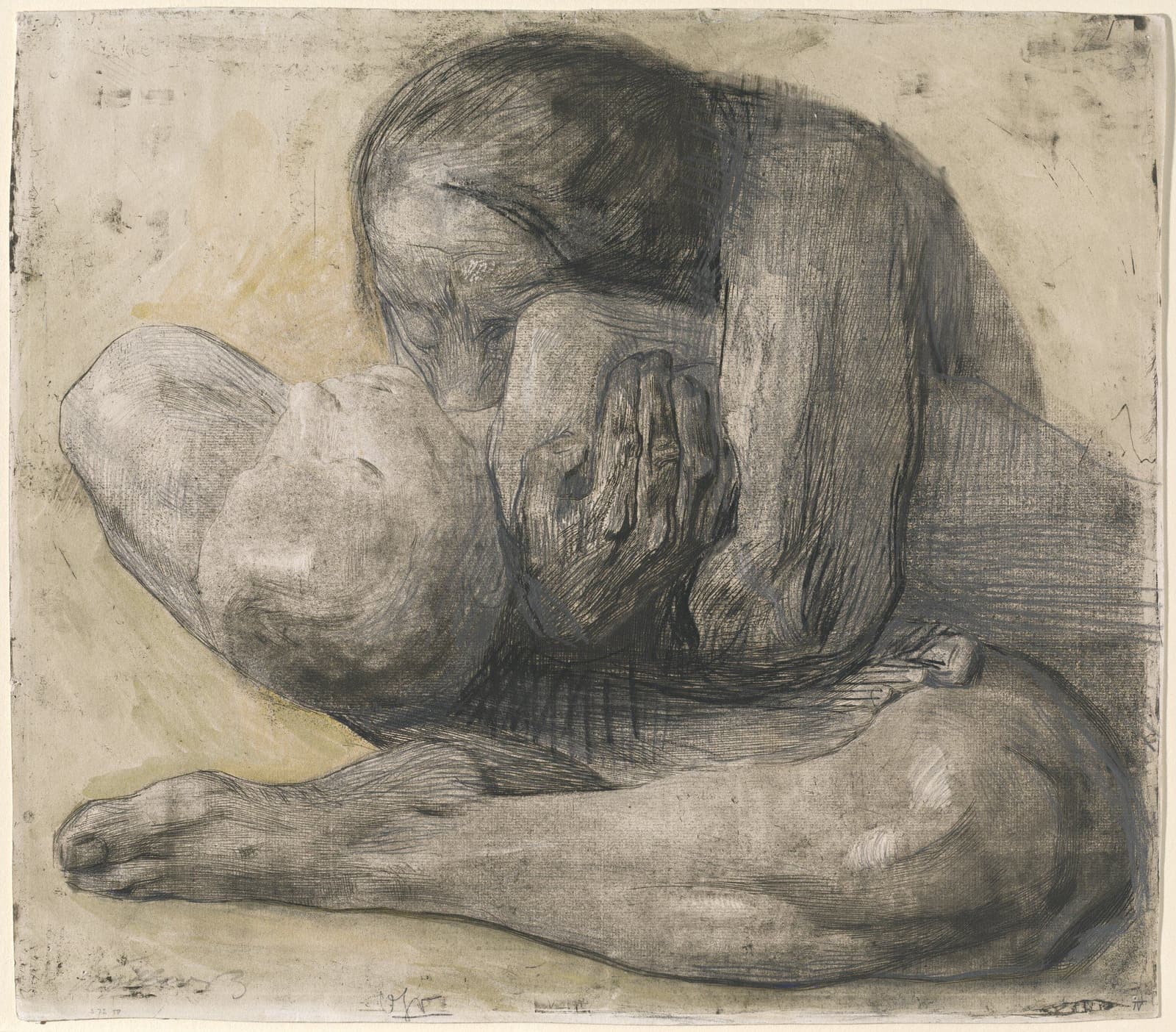
In Woman with Dead Child (1903), that pressure is almost unbearable: not theatrical lament, but muscular enclosure. The image does not offer a consoling distance. It makes the viewer inhabit contact.
From intimate pain to civic speech
Kollwitz’s anti-war poster Never Again War (1924) shows another side of her method. Instead of enclosed grief, we get an up-thrust figure and a direct slogan. The work translates feeling into declaration—an image designed for assembly, not private contemplation.
That shift helps explain why her practice still matters now. She moved fluently across scales:
- private scene → public argument,
- individual body → collective demand,
- studio craft → mass political address.
Many artists are strong in one register. Kollwitz is unusually strong in all three.
The recurring misunderstanding
A recurring misread treats Kollwitz as morally important but formally narrow—as if her relevance is ethical first and artistic second. Recent museum framing has worked against that split, showing the breadth of her self-portraiture, print cycles, posters, and sculpture across five decades.
Formally, her work is rigorous: she controls tonal economy, edge density, and spatial compression with extraordinary discipline. Historically, she also complicates easy categories. She is linked to German modernism and expressionist affect, yet she never abandons legible bodies or social referents for pure abstraction.
That refusal is a choice, not a limitation. It keeps her art answerable to lived conditions.
Why this profile matters in 2026
In a moment when images circulate faster than attention, Kollwitz offers a hard lesson: durability comes from structure, not just sentiment. Her works keep reading because they are engineered for transfer—across formats, audiences, and historical shocks.
If we read her only as an icon of suffering, we flatten her. If we read her as an artist of transmission—of how feeling becomes public form—we recover the scale of her achievement.
Sources
- Käthe Kollwitz Museum Köln, biography: Käthe Kollwitz (1867–1945)
- Käthe Kollwitz Museum Köln, work entry: Woman with dead Child, Kn 81
- Käthe Kollwitz Museum Köln, work entry: Poster “Never Again War”, Kn 205
- National Museum of Women in the Arts: Käthe Kollwitz | Artist Profile
- MoMA exhibition page: Käthe Kollwitz (Mar 31–Jul 20, 2024)
- The Art Newspaper: Two big shows in New York and Frankfurt attempt to uncover the many guises of Käthe Kollwitz
Editor’s Pick Review
This one earns today’s pick because it avoids the usual “tragic biography” shortcut and does the harder editorial job: it shows how Kollwitz engineered emotional force through medium, circulation, and form. The argument is clear, the chronology is anchored, and the profile keeps art history and social history in the same frame without flattening either.
What really lands is the transmission lens. The piece explains why printmaking mattered structurally—not as a footnote to painting, but as the mechanism that let private grief become civic language. That is exactly the kind of insight an editor pick should surface: specific enough to teach, readable enough to remember, and strong enough to reframe how you look at the work.