Gustav Klimt is often reduced to a single visual shortcut: gold equals luxury, and luxury equals poster-friendly beauty. That reading misses the point. Klimt’s key move was to turn surface into argument. Across public commissions, Secession exhibitions, and private portraits, he used ornament as a way to stage power, intimacy, and social hierarchy in plain view.[1][2][3]
If you read him this way, the famous shimmer is not the end of the story; it is the mechanism.
The break with official culture was structural, not personal drama
In Vienna, the Secession formed in 1897 as a break from academic controls, and Klimt became the movement’s best-known face.[3] This matters because it explains why his career split so sharply between state-facing work and private patronage. The rupture around the University of Vienna faculty paintings was not a minor controversy about taste; it exposed a deeper conflict over what public art was supposed to do.[4]
The commission had asked for intellectual allegories that fit institutional prestige. Klimt delivered images that foregrounded bodily vulnerability, erotic charge, and mortality, and the reaction was fierce.[3][4] In practice, this pushed him toward a different production system: fewer state projects, more collector-driven portrait and landscape work.[2][4]
That shift is usually told as biography. It is better understood as an infrastructure change: who funds the work determines what visual risk is possible.
Gold as social technology
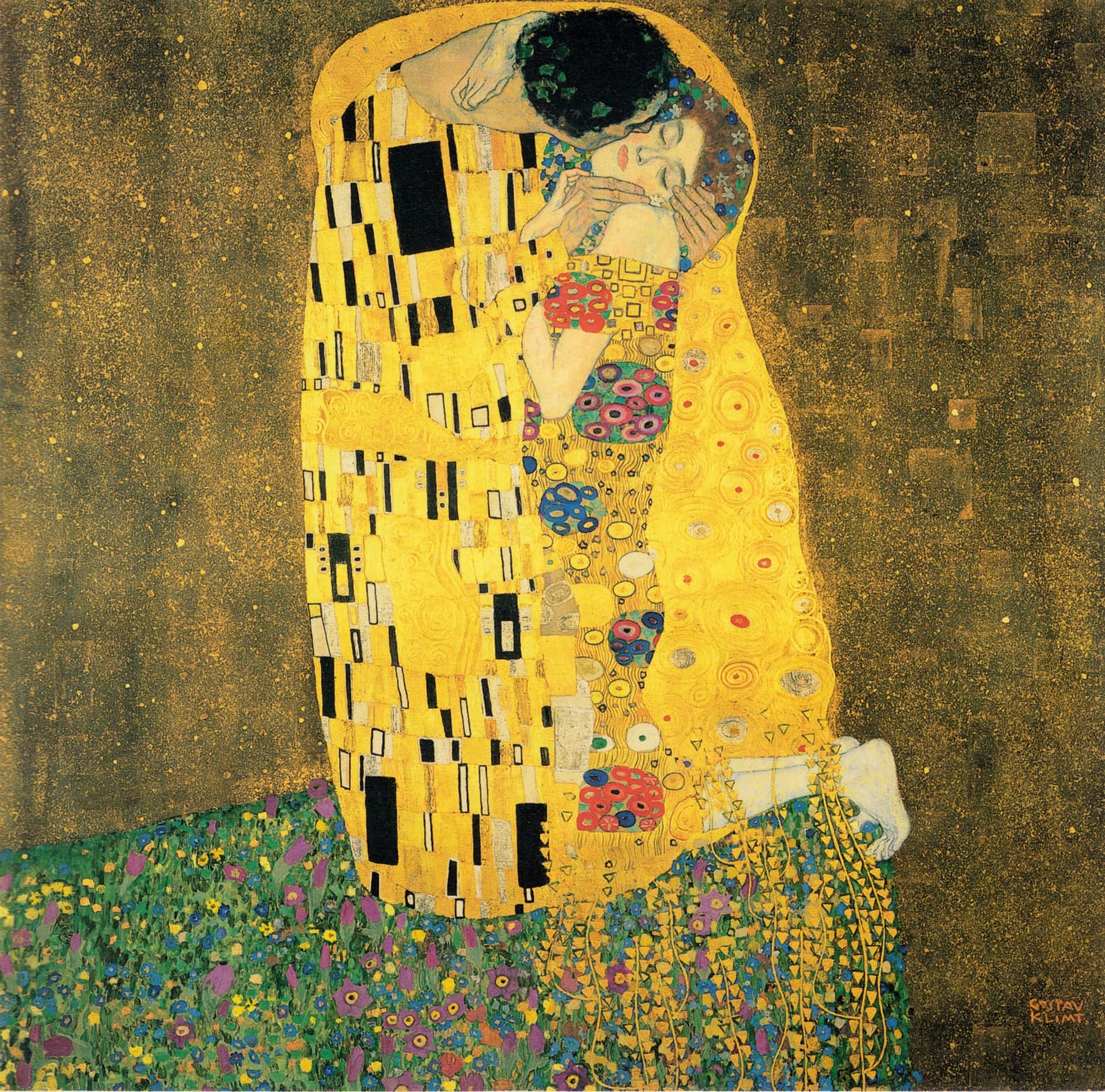
The Belvedere’s object history for The Kiss is useful here. The painting was developed around 1907, shown in 1908 under the title Lovers, and purchased from that exhibition for the Modern Gallery (today’s Belvedere), later entering the museum catalogue as The Kiss.[1] The same source highlights that Klimt used real gold leaf, silver, and platinum in the work.[1]
Those material choices are not only symbolic. They alter the viewing contract:
- gold flattens depth while intensifying frontal impact,
- pattern separates bodies even at the point of embrace,
- metal and paint together create a threshold between flesh and icon.
So the painting performs two social scripts at once: maximum intimacy and maximum stylization. The couple is touching, but never entirely available. Viewers are invited in and held back at the same time.
This is why Klimt’s “decorative” reputation is misleading. Decoration here is operational. It controls distance.
Exhibition strategy: Klimt built environments, not just canvases
Klimt’s 1902 Beethoven Frieze for the Secession’s XIVth exhibition confirms that he thought beyond standalone paintings. The frieze was made inside a deliberately integrated setting with architecture, sculpture, and painting aligned around one thematic program, and the exhibition drew nearly 60,000 visitors.[2] The later conservation and permanent installation history also shows how quickly a supposedly temporary work became institutional canon.[2]
This helps explain the through-line from frieze projects to portrait commissions: in both cases Klimt staged total visual worlds where clothing, ornament, pose, and architecture all carried meaning. He did not paint people “inside” context; he painted context as part of the subject.
Why patrons mattered: the Adele Bloch-Bauer case
The Neue Galerie’s documentation of Portrait of Adele Bloch-Bauer I (1907) is blunt about medium and social position: oil, gold, and silver on canvas, made within a close artist-patron relationship, and now read through a major restitution history.[5][6] The modern afterlife of this portrait is inseparable from legal and political frameworks around ownership, war looting, and recovery.[6]
That afterlife changes the profile of Klimt in one important way. He is not only a painter of Viennese modernism; he is now also a test case for how artworks travel through violent twentieth-century history into twenty-first-century museums.
The practical takeaway is that “style” and “provenance” cannot be separated. In Klimt’s case, surface glamour and legal history are entangled.
How to look at Klimt now (without flattening him)
A better viewing method is to ask three questions in sequence:
- What social boundary is this surface drawing? (class, gender, institutional authority, private desire)
- What material decision enforces that boundary? (metal leaf, pattern field, contour, flattening)
- Who financed and framed the image’s circulation? (state, Secession venue, private collector, museum)
This sequence keeps the work from collapsing into either pure beauty talk or pure politics talk. Klimt remains compelling because he made those domains collide on purpose.
His paintings still feel current for the same reason modern media still fights over image control: whoever controls the surface controls the story of the body beneath it.
Sources
- Belvedere Sammlung Online, The Kiss (Lovers) (object 6678)
- Vienna Secession, Beethoven Frieze (history and exhibition context)
- Encyclopaedia Britannica, Sezession (Vienna Secession overview)
- Casanova R, Science, art, society and Klimt’s University of Vienna paintings, Proc Biol Sci (2019)
- Neue Galerie New York, Gustav Klimt and Adele Bloch-Bauer: The Woman in Gold
- Library of Congress, U.S. Reports: Republic of Austria v. Altmann, 541 U.S. 677 (2004)
- Tate, Gustav Klimt: Painting, Design and Modern Life (Secession context and Gesamtkunstwerk framing)
- Wikimedia Commons file record, Klimt - Der Kuss.jpeg (image source metadata)