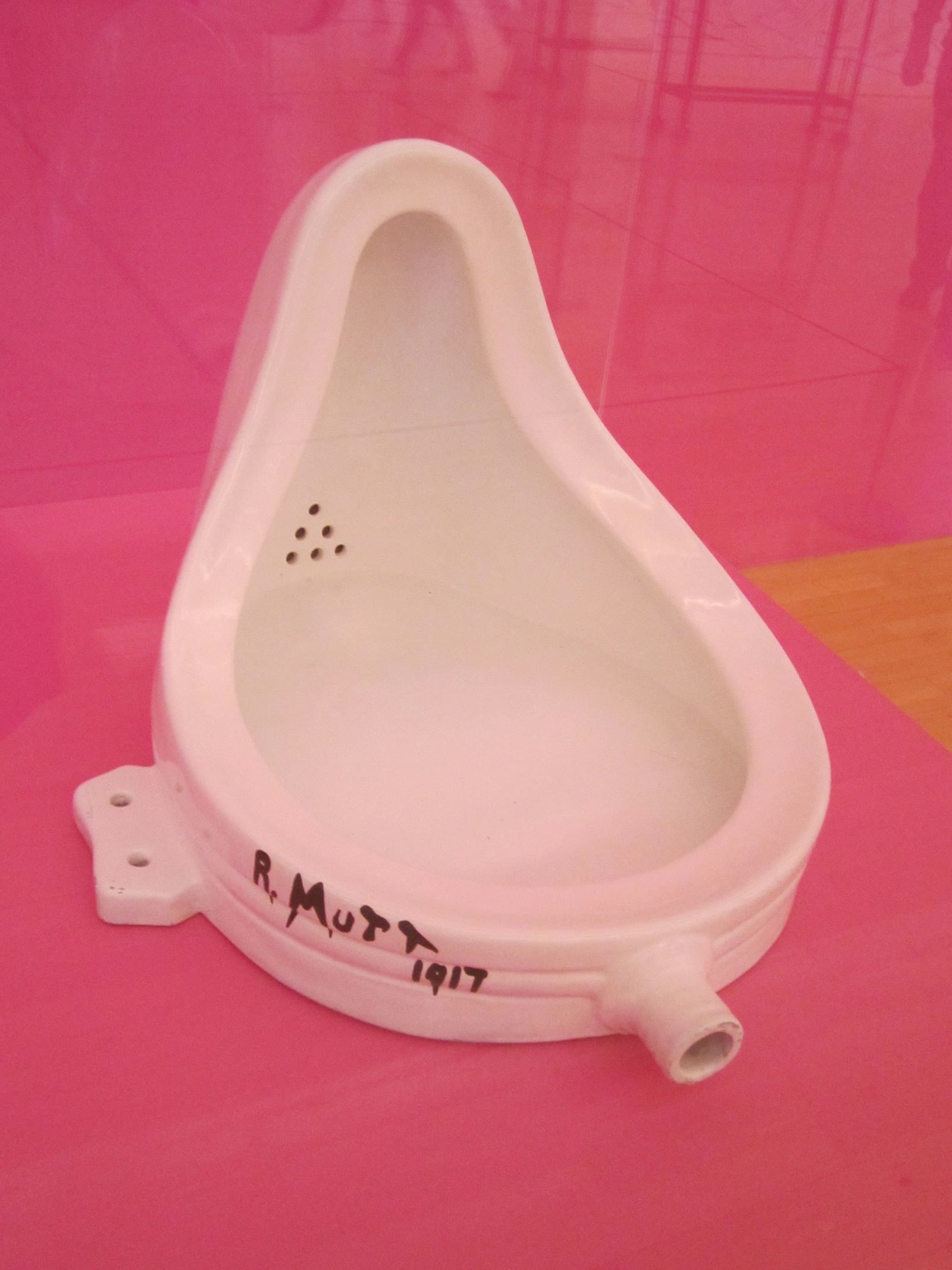
Marcel Duchamp's Fountain is usually summarized in a single blunt sentence: he put a urinal in a gallery and called it art. That sentence preserves the scandal and misses the mechanism. The work mattered not because plumbing fixture suddenly replaced skill, but because selection, signature, submission, photography, and refusal were all compressed into one event. Fountain is less a joke about taste than a machine for exposing the exhibition gate.[1][2][3][4]
That distinction matters because the object alone does not explain the work's long life. The original 1917 urinal was lost, and what most people know today comes through Alfred Stieglitz's photograph, later replicas, and institutional accounts that keep restaging the submission story.[1][2] In other words, Fountain was never just a thing on a floor. It was an entry into a system, then a rejection by that same system, then an afterlife carried by documents and replicas. The medium is not porcelain alone. The medium is the frame that decides whether porcelain can appear as art at all.
Image context: the hero image uses a photographed replica because that awkward fact belongs to the essay's core claim. You cannot discuss Fountain honestly as though the 1917 object remained stably available. Its authority has always depended on mediated survival: photographs, remakes, wall labels, and repeated institutional re-entry.[1][2]
The scandal sits inside a promise of openness
The most important context for Fountain is the Society of Independent Artists exhibition of 1917. Philadelphia's object page notes that Duchamp submitted the work under the pseudonym "R. Mutt" to an exhibition that publicly claimed any artist who paid the fee could show.[1] The crucial point is not merely that a urinal was submitted. The crucial point is that the exhibition advertised openness and then discovered a boundary it still wanted to enforce.
That is why Fountain keeps its force. A rejected object inside a conservative jury system would have been provocative but unsurprising. Fountain is sharper because it lands inside an allegedly non-juried structure. The work turns principle into stress test. If no jury really means no jury, then the urinal enters. If the urinal does not enter, then some quieter criterion is still operating under the surface. Duchamp did not invent exclusion. He made it legible.[1][2]
Tate's account of the 1964 replica keeps the argument close to the object while preserving this institutional story: Fountain is a readymade, dated 1917 though Tate's physical version was produced later, and the title remains inseparable from the submission scandal and the "R. Mutt" signature.[2] The work is therefore already doubled. There is the manufactured thing, and there is the act that reframes it. Without the act, the object returns to ordinary use. Without the object, the act loses its friction. Fountain binds them together.
Selection and signature do the real work
One reason the urinal still gets reduced to mere prank is that viewers often imagine Duchamp's claim as pure negation: no craft, no beauty, no labor, therefore anti-art. Britannica's entry on the readymade offers a more exact language. It treats the readymade as a designation Duchamp used for ordinary manufactured objects that he selected and modified only minimally, a move that shifts attention away from fabrication and toward framing.[3] That phrasing is stronger than the usual scandal shorthand because it locates the work in a shift of authorship rather than in outrage alone.
Selection is the first operation. Duchamp does not fabricate a urinal; he chooses one. The choice sounds passive until you notice what it displaces. Authorship moves from making to framing. Title, orientation, and submission become active decisions. The pseudonym "R. Mutt" intensifies that shift.[1][2] A signature usually stabilizes authorship by attaching a known person to a made object. Here the signature destabilizes it. It converts authorship into role-play, a threshold device, an alias operating at the point where object meets institution.
This is why Fountain still feels more intelligent than its cliché. The work is not saying "anything can be art" in some lazy universal sense. It is showing that the sentence "this is art" is never uttered in empty space. It arrives through naming, placement, rule systems, and the willingness of institutions to ratify or refuse those moves.[1][3][4]
Photography and replication are part of the artwork's logic
The afterlife of Fountain is not an embarrassment to be cleaned away. It is part of the point. Philadelphia's object record makes clear that the museum holds a version associated with Duchamp's later authorization, while Tate's page records its own replica as a 1964 edition after the lost 1917 original.[1][2] The work's identity therefore cannot depend on unique material continuity in the way a single untouched oil painting does. It persists by instruction, sanction, and repeatability.
That persistence was prepared early by photography. The famous Stieglitz photograph did not simply document the object after the fact. It helped establish the object as a public image once the exhibition itself blocked it.[1][4] In practical terms, Fountain entered modern art history through mediated circulation. The camera became part of the work's delivery system.
That matters because it keeps the argument from collapsing into a tired opposition between object and idea. Fountain needs both. The urinal's industrial specificness gives the claim bite; the photograph and replica network let the claim travel. If the work had remained a private anecdote about a hidden object, it would not have altered much. Its force came from becoming reproducible evidence in a dispute over artistic legitimacy.
The real theme is institutional visibility
Britannica's Duchamp biography is useful here because it places the readymades inside a larger break with conventional aesthetic standards and links Duchamp to the Dadaist challenge to inherited artistic rules.[4] That broad history matters, but Fountain sharpens it into one particularly durable theme: visibility is governed. The institution, even when it calls itself open, still decides what kind of object can cross the threshold without contaminating the category.
Seen this way, Fountain is not primarily about insult. It is about administration. Who gets to submit? Under what name? According to which rules? Who quietly overrides those rules once a troublesome object appears? The work stages those questions with remarkable economy. A porcelain urinal turned on its back becomes a test of whether openness is procedural or rhetorical.[1][2][3][4]
That is also why the piece keeps returning in every era that rediscovers platform power, moderation rules, or curatorially managed inclusion. The urinal does not predict the internet in any crude way, but it does clarify a structure modern systems share: neutrality is often advertised at the front door and renegotiated in the back room.
Why Fountain still matters
Fountain endures because it took one banal object and made the conditions of cultural admission visible. The work's real material is not only porcelain. It is the exhibition form, the pseudonymous signature, the photograph, the replica, and the institutional hesitation that keeps revealing itself across time.[1][2][3][4]
That is why the piece remains harder than its joke version. Duchamp did not merely ask whether a urinal could be art. He asked who has the power to decide when an object counts, and what happens when a supposedly open system discovers its own hidden gate. More than a century later, that question still has not gone stale.
Sources
- Philadelphia Museum of Art, Fountain - object page on the 1917 submission under "R. Mutt," the work's later museum life, and Duchamp's authorized versions.
- Tate, Fountain - collection page for the 1964 replica after the lost 1917 original.
- Encyclopaedia Britannica, "ready-made" - entry on Duchamp's term for ordinary manufactured objects selected and minimally altered to function as art.
- Encyclopaedia Britannica, "Marcel Duchamp" - biography on the readymades, Duchamp's break with conventional aesthetic standards, and his Dada context.