Stained glass feels different from painting because it is not just an image placed on a support. It is a structural skin built from colored and painted glass pieces, held together by lead, locked into stone, and completed by whatever light the day supplies.[1] In that medium, drawing, engineering, and atmosphere arrive as one problem.
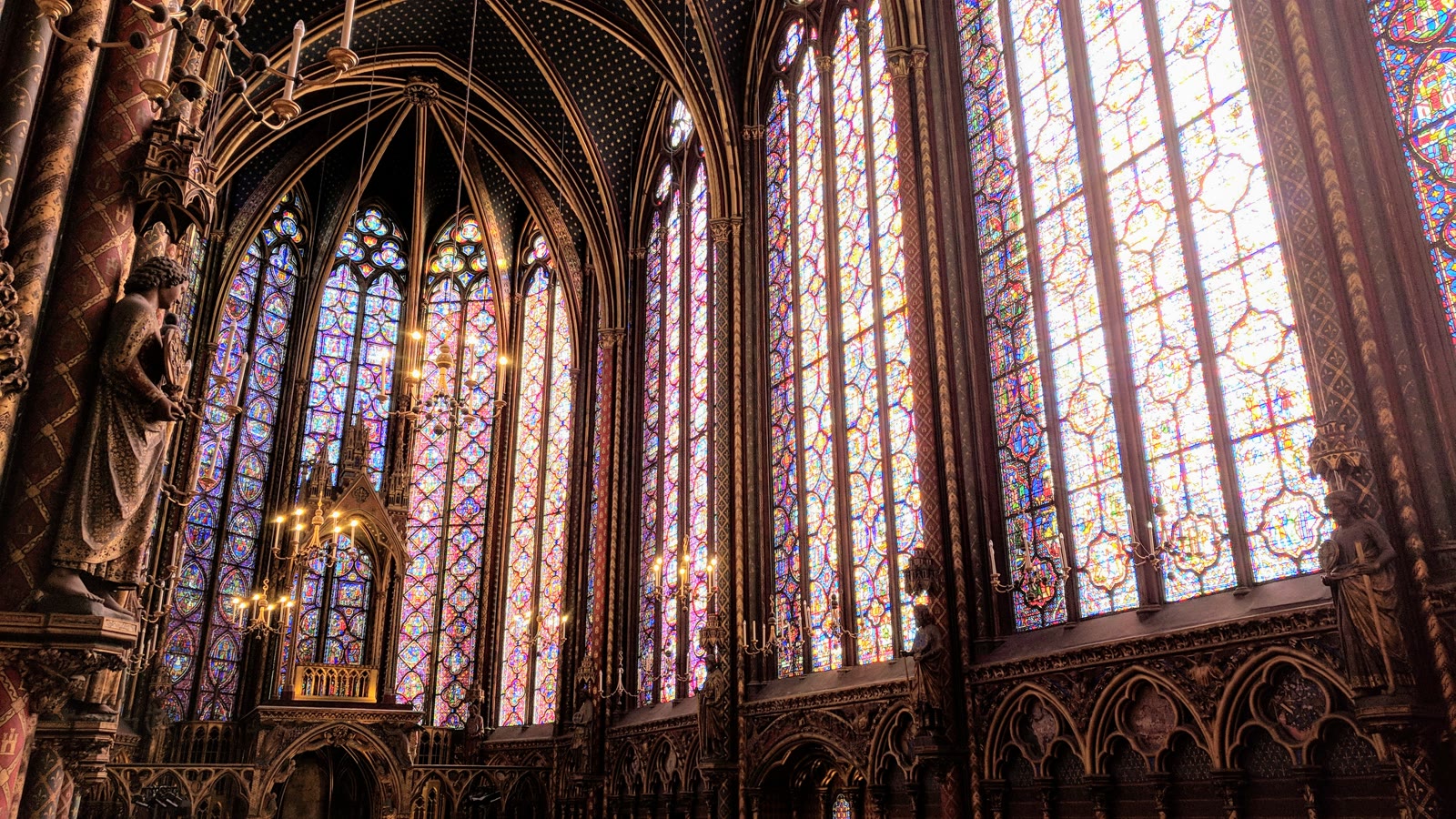
That is why stained glass often feels architectural before it feels pictorial. A panel can carry narrative scenes, saints, kings, and heraldry, but the first thing the body registers is a room whose walls have turned into filtered light. At Sainte-Chapelle, that logic reaches an extreme: the upper chapel is organized around fifteen immense bays, many of them medieval, so the building reads less like masonry punctured by windows than like a glass vessel stabilized by stone.[2][3]
The medium’s real technical achievement lives in that reversal. Stained glass does not ask how to place color on a wall. It asks how to build a wall that can remain image, illumination device, and structural object at the same time.
The hero image is a documentary photograph of Sainte-Chapelle’s upper chapel, included here as a direct visual anchor for that building-scale reading of the medium.[5]
1) The basic machine: colored glass, painted detail, lead as drawing
The V&A’s technical overview is a good starting point: stained-glass windows are assembled from colored and painted glass pieces joined by lead strips, with painted details added where contour, face, drapery, or inscription needs sharpening.[1] That description sounds simple until you notice what it implies. The black line in stained glass is rarely just painted outline. It is often the trace of assembly itself.
Lead cames are not neutral hardware hidden behind the picture. They are part of the picture’s graphic logic. They divide color fields, hold bodies together, and force designers to think in segments rather than in continuous brush movement. Even when paint refines a hand or a fold, the window’s larger legibility still depends on a network of joints that the viewer can feel across distance.[1]
The other technical limit is that glass transmits color rather than reflecting it off an opaque surface. A stained-glass red is never only a pigment choice; it is also a light-management choice. The material pushes artists toward bold chromatic blocks, decisive silhouettes, and narrative compression because the image must survive changing daylight, oblique viewing angles, and great height.[1][2]
2) Why distance matters more than detail
On paper, Sainte-Chapelle’s glazing program sounds like an overload problem: 1,113 scenes distributed across the windows, arranged as a biblical sequence that moves from Genesis toward the Apocalypse.[2][3] In practice, the chapel does not feel cluttered when you enter it. It feels coherent. The reason is medium intelligence.
The monument’s own guide makes an important distinction: stained glass here is not primarily something to decode panel by panel at first glance, but something to see as a total field of light and color.[2] That is a crucial technical point. Medieval window design had to operate in layers. From far away, you read chromatic rhythm, vertical scaffolding, medallion stacking, and the building-wide pulse of red, blue, and gold. Only afterward do individual episodes and figures start to separate.
So the medium is calibrated for nested viewing distances. At ten or fifteen meters, the window must still hold together as architecture. At closer range, it can release narrative information. If a designer solved only the iconography and not the distance problem, the work would collapse into visual static.
3) Why stained glass makes time visible
Painting can suggest time. Stained glass performs it. The image changes as weather, season, and sun angle change, because transmitted light is part of the medium, not just an external condition.[1] The same window can feel crisp in hard morning light, saturated in afternoon light, and almost atmospheric when the sky goes flat.
Sainte-Chapelle’s own presentation emphasizes how tightly the program controls that experience. The glass palette is restricted enough to preserve chromatic coherence across the chapel, even while the iconography remains dense.[2] That limit is not a weakness. It is the reason the room feels orchestrated instead of noisy.
Technical innovations changed what artists could do inside that system. The V&A notes that silver stain became an important fourteenth-century addition because it allowed yellow tones and more flexible tonal effects on otherwise pale glass.[1] But even with such refinements, stained glass never stops being a distance art. Its details matter because they serve the large luminous order, not because they replace it.
4) Conservation proves what the medium really is
The cleanest way to understand stained glass is to watch what has to be restored. The Centre des monuments nationaux notes that work resumed in January 2025 on Sainte-Chapelle’s Ezekiel bay after earlier porch phases in 2022 and 2023.[4] The reported problems are not abstract: deposits on glass and lead, breakage, and the need to protect original medieval material while also respecting the nineteenth-century restoration campaign.[4]
That list tells you what the medium actually consists of. Stained glass is not just image content trapped inside colored panes. It is glass chemistry, lead condition, workshop assembly, weather exposure, support systems, and restoration history, all in one object. When conservators intervene, they are managing a building-scale composite, not merely cleaning a picture.
This is also why stained glass can feel so physically present in person. You are not encountering a portable image translated onto a wall. You are encountering a long-lived threshold between inside and outside, story and structure, weather and devotion.
5) A five-minute viewing drill
If you want the medium’s logic to click quickly in a church or museum, use this order:
- Spend the first minute reading the window as architecture: bay divisions, vertical lift, and the balance between stone and color.
- Spend the next minute following lead lines instead of figures; notice how much of the composition is carried by assembly logic.
- Spend two minutes tracking only three colors across the window or room; this reveals the chromatic discipline that keeps narrative density legible.
- Spend the final minute moving closer and then stepping back again; the gain in detail should never destroy the larger field.
When that sequence works, stained glass stops looking like illustration trapped in a window opening. It starts reading as one of art history’s most exacting mergers of image, structure, and light.
Sources
- Victoria and Albert Museum, "Stained glass: an introduction" (updated April 17, 2024; materials, making process, silver stain, and historical context).
- Sainte-Chapelle, "A unique set of stained glass windows" (official monument guide to the glazing program, color logic, and narrative sequence).
- Sainte-Chapelle, "History of the Sainte-Chapelle" (official monument history with construction timeline, scale, and window counts).
- Centre des monuments nationaux, "The flagship projects 2025" (current restoration update on the Ezekiel bay and material condition issues).
- Wikimedia Commons, "File: La-Sainte-Chapelle-interior.jpg" (source page for the photographic image used as the article hero).