Gold-ground painting is often introduced as a stage the Renaissance had to outgrow: a flat background, a pre-perspectival habit, a decorative holdover before painters learned how to build convincing rooms.[1][2] That description misses the medium's real intelligence. Gold in these panels is not empty backdrop. It is an active surface engineered to catch light, slow the eye, and hold a holy figure in a different spatial order from ordinary architecture.[1][3]
That is why reproductions often undersell these works. On a screen, the background can collapse into one yellow plane. In person, the gold shifts with angle, burnish, tooling, and surrounding illumination. What seems static in JPEG form turns out to be materially restless.[1][4]
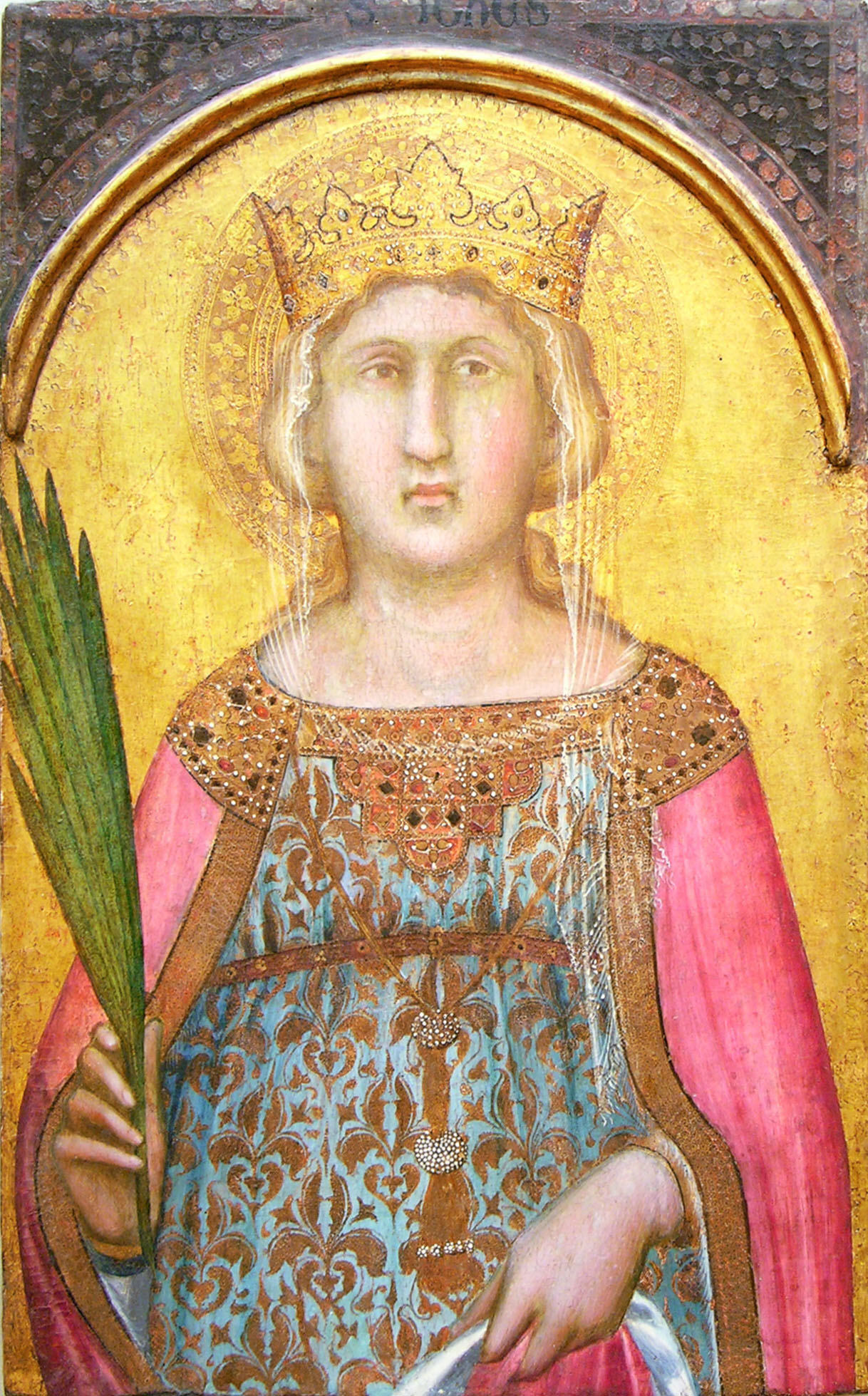
Image context: the hero image uses Pietro Lorenzetti's Saint Catherine of Alexandria because the panel shows the medium's logic in compact form. Catherine's body is legible through contour, color, and patterned cloth, while the halo and background keep returning the viewer to a worked field of gold rather than to a believable chamber behind her.[4]
1) Gold is the painting's light engine
The first mistake is to treat the gold as if it were merely color. Smarthistory's overview is useful on the basic point: medieval and early Renaissance painters built these panels so reflected light became part of the image's effect.[1] Gold leaf does not behave like yellow paint. It flashes, dulls, and brightens according to where the viewer stands and how the surface was finished. A polished passage can feel almost mirror-like; a punched or tooled area can scatter light in a finer, more particulate way.[1]
That changes the viewer's relation to the figure. In a perspectival picture, depth helps organize attention. In a gold-ground panel, light itself becomes the organizer. The saint or Madonna does not sit inside weather, furniture, or measurable air. The figure is held forward against a surface that reads as luminous presence rather than distant setting.[1][2]
This is why the usual accusation of flatness lands weakly. Flatness is present, but it is purposeful. The panel gives up one kind of spatial illusion in order to gain another kind of force: a picture that feels lit from within the plane itself.[1][3]
2) The effect depends on a layered craft sequence
Gold-ground painting looks simple only after the labor disappears. The surface is made through a sequence of preparation steps that determine how the final image will hold light.[1] A wooden support is prepared and smoothed. Gesso creates a pale absorbent ground. Areas meant for gilding are built and refined so the gold leaf can sit on a carefully prepared base rather than on raw wood.[1] Red bole under the leaf warms the surface and helps produce the softer, richer tone associated with many Italian panels.[1]
Once the gold is laid, the surface can be burnished, incised, stamped, and punched. These are not ornamental extras. They are structural decisions about how the image will breathe under changing light. Halo borders, textile patterns, and background fields can be differentiated without giving up the unity of the gold plane.[1][4]
Lorenzetti's Saint Catherine makes this tangible.[4] The saint's face is softly modeled, but her crown, halo, and the field around her retain a worked brilliance that never becomes neutral space. The panel asks the viewer to read flesh, cloth, and sanctity through one continuous material logic. Paint and gilding cooperate; neither simply fills in for the other.[1][4]
3) Gold changes what "space" means
Once the technique is understood, the spatial question looks different. Gold-ground painters were not failing to make realistic rooms. They were building a different contract between body and surface.[1][2] The point was to keep the figure emphatically available while suspending it from ordinary time and weather. The background does not describe a location so much as a condition of presence.
The Met's overview of Sienese painting helps on this historical point. In Siena, painters developed a language of elegant contour, saturated color, and precious surface that remained compelling even as other strands of Italian painting intensified volumetric realism.[2] Gold stayed valuable because it solved a problem perspective could not solve on its own: how to make painted holiness feel immediate without converting it into everyday room space.[2][3]
That is also why halos, punchwork, and patterned borders matter so much. They keep the eye moving across thresholds rather than letting it disappear into fictive depth. A gold-ground painting is less a window than a charged screen where sacred figures arrive close to the viewer while remaining formally set apart.[1][2]
4) Siena kept the language alive because it still worked
Gold-ground painting did not vanish the moment artists learned better anatomy or perspective. Getty's Shimmer of Gold materials on Giovanni di Paolo are a useful reminder that the highly decorative, gold-rich panel remained potent in fifteenth-century Siena.[3] The persistence was not inertia. It was fit. For altarpieces, predella panels, and devotional commissions, this medium could still deliver luxury, legibility, and spiritual charge at once.[2][3]
That endurance matters because it keeps art history from collapsing into a single progress story. From a modern textbook angle, gold ground can look like an old technology waiting to be displaced by atmospheric depth. From the workshop and chapel angle, it looks like a robust solution with specific strengths: it integrates painting and light, supports sacred hierarchy, and turns surface finish into meaning.[1][2][3]
Seen that way, later perspective does not cancel gold ground. It simply shifts the terms of pictorial persuasion. One system convinces by building a world the viewer could imagine entering. The other convinces by making the painted plane itself carry radiance, distance, and authority.[1][2]
5) How to look at one now
A useful museum sequence is simple:
- Start with the field, not the face. Ask how the gold changes as you move.[1]
- Then look at the worked passages: halo tooling, border patterns, crown details, and textile edges.[1][4]
- Only after that return to the figure's body and notice how little atmospheric depth the panel needs in order to feel present.[1][2]
Read in that order, gold-ground painting stops looking like unfinished realism. It becomes a medium with its own visual physics. Gesso smooths the support. Bole warms the leaf. Punchwork fractures light. The saint or Madonna emerges inside that luminous labor, and the whole panel asks for a mode of looking closer to encounter than to scenic illusion.[1][4]
Sources
- Smarthistory, "Gold-ground panel painting" — overview of panel preparation, bole, gold leaf, burnishing, and punchwork.
- The Metropolitan Museum of Art, "Sienese Painting" — historical context for Siena's gold-rich panel tradition and its devotional function.
- Getty, "Getty Presents The Shimmer of Gold: Giovanni di Paolo in Renaissance Siena" — exhibition context on fifteenth-century Sienese panel painting and extensive use of gold leaf.
- The Metropolitan Museum of Art, collection entry for Pietro Lorenzetti's Saint Catherine of Alexandria (ca. 1342).