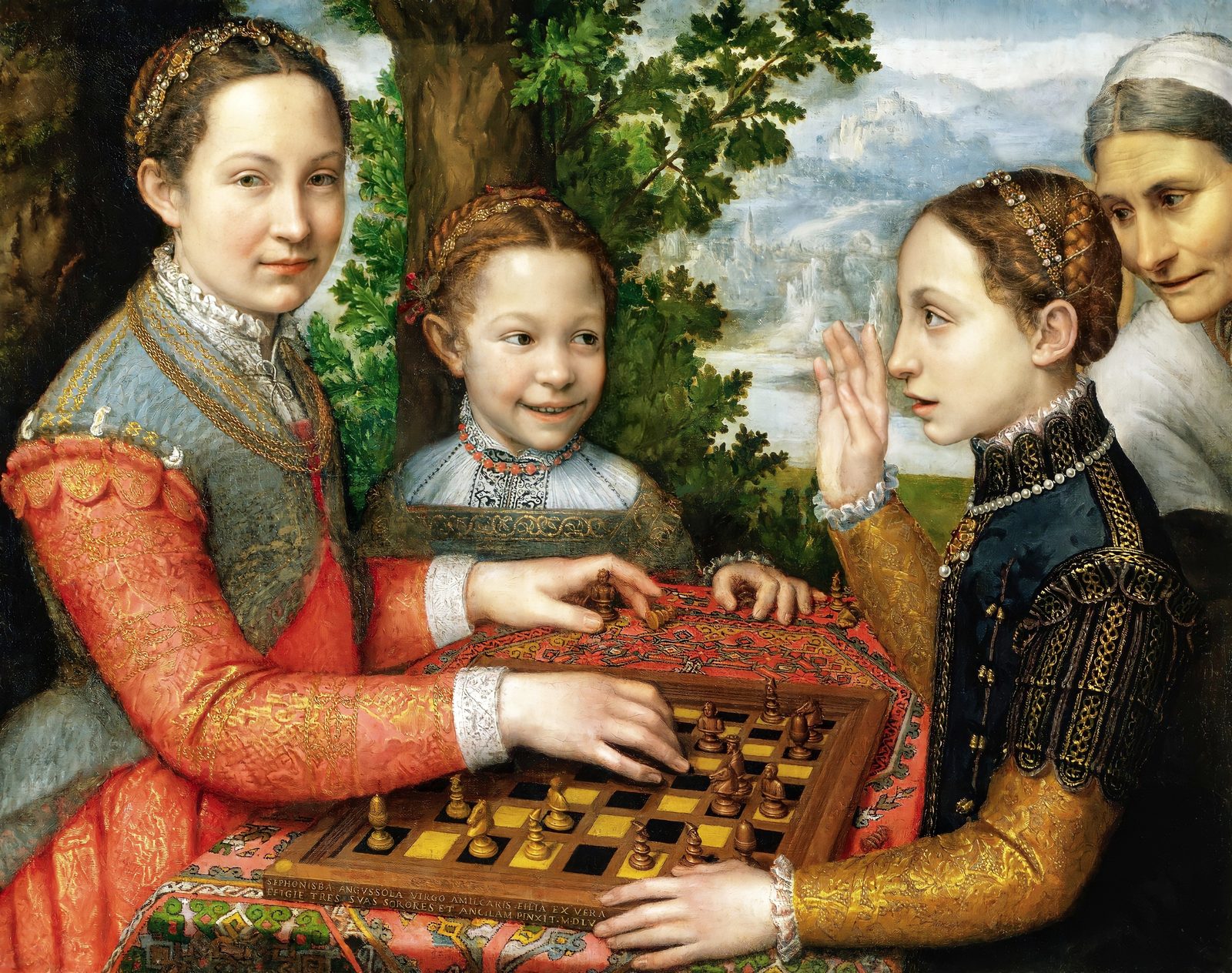
Sofonisba Anguissola is usually introduced as a first: one of the first women in early modern Europe to achieve durable international recognition as a painter. The biographical milestone is true, but it can also obscure the technical reason she mattered. Anguissola did not simply “enter” a male field; she changed portrait logic from inside it. Her best works replace static status display with observed interaction—sisters testing each other over a chessboard, faces caught in mid-thought, gestures that imply rank without freezing into emblem.
That shift became politically useful. By the time she reached the Spanish court in 1559, Anguissola had already built a visual method that could satisfy two conflicting demands at once: dynastic dignity and human credibility. Court portraiture needed hierarchy; courts also needed images that felt alive enough to circulate persuasion. Anguissola’s specialty was that overlap.
Image context: the hero image uses Anguissola’s The Game of Chess (1555), because this article’s argument depends on that specific painting’s social choreography—attention, hierarchy, and intelligence staged through ordinary action rather than allegorical theatrics.
1) Cremona as laboratory: why family portraiture became strategic training
Anguissola was born around 1532 in Cremona and received unusually sustained artistic training for a noblewoman, including study with Bernardino Campi and Bernardino Gatti.[1][2] What matters for the work is not only access but sequence: she trained in a milieu where portrait craft was practical, reputation-based, and deeply tied to social reading.
In her family pictures and self-portraits from the 1550s, she developed an observational bandwidth rare for official portraiture of the period. Instead of reducing sitters to costume and insignia, she tracked interpersonal tension—who leads, who watches, who waits to speak. In The Game of Chess, the scene performs lineage and education, yet it also records micro-psychology: rivalry, concentration, sibling play, adult supervision.[2]
This was not “private” painting in opposition to public ambition. It was the training ground for public function. Anguissola learned to make social intelligence legible on a painted surface.
2) Madrid and scale: from household observation to Habsburg image management
When Anguissola entered the orbit of Philip II’s court, she did so in a role that combined instruction, court service, and portrait production.[1][2] The common shorthand is that she became a court painter and adapted to formality. Accurate, but incomplete.
What she adapted was not only style; she adapted precision under protocol. Court portraiture had to preserve dynastic codes—costume systems, posture regimes, ceremonial hierarchy—while avoiding lifelessness. Anguissola’s contribution was to insert believable interiority without violating ceremony. The result is a distinctive kind of court image: controlled, but not inert.
The long duration of her court phase matters here. NMWA’s exhibition framing notes roughly fourteen years tied to Philip II’s environment, enough time for method consolidation rather than one-off patronage luck.[3] Once that duration is acknowledged, Anguissola looks less like an exception admitted by benevolence and more like an operator who solved a recurring institutional image problem.
3) Why small works matter: concentration, not minor scale
A useful correction to the usual “great court portraitist” narrative is to examine small-format evidence. Nationalmuseum’s 2025 acquisition of a newly identified Anguissola portrait (about 19 × 15 cm, oil on wood) shows how much authority she could generate in compressed space.[4] The work’s scale is miniature by court standards, yet its psychological directness is high: concentrated light, controlled transitions, and a sitter who seems present rather than emblematic.
This matters because it clarifies her method. Anguissola’s power was not dependent on monumentality. It came from disciplined attention control: where the eye lands first, how expression unfolds second, and how social rank remains visible without flattening personhood.
4) Self-portraiture as professional infrastructure
Anguissola’s self-portraits are often treated as isolated feats of female self-representation. They are better read as career infrastructure. In Self-portrait at an Easel (1556), she presents herself at work, with tools, task, and devotional image aligned in one controlled claim: technical competence plus moral legitimacy.[5][6]
The image does three jobs simultaneously:
- it certifies craft,
- it frames authorship as disciplined labor,
- it protects ambition within accepted social virtue language.
For a woman artist navigating patronage in the sixteenth century, that combination was not decorative self-fashioning; it was a professional survival design.
5) What changed because of her
Anguissola’s legacy is often summarized as “opening doors for women artists.” True but vague. The more precise contribution is methodological: she proved that high-status portraiture could absorb relational observation without surrendering authority. That formula expanded what elite portrait painting could communicate, and later women artists inherited not only symbolic permission but a practical visual strategy.
Her career arc also widens our map of Renaissance modernity. Innovation did not only occur through giant altarpieces, mythological spectacle, or anatomical bravura. It also occurred in calibrated acts of looking—how one face meets another, how hierarchy is staged without erasing personhood, how a portrait can function as both protocol and encounter.
Why this still matters in 2026
In contemporary image culture, institutions still need the same balancing act Anguissola solved: authority that does not feel robotic, formality that does not erase the human subject. Her paintings remain useful because they model a durable answer—credibility comes from structured attention to real social behavior, not from louder symbols.
60-second museum drill (to test the thesis)
- Start with gaze paths: map who looks at whom before reading clothing or status markers.
- Check rank vs expression: note where hierarchy is clear, then find where individuality resists flattening.
- Measure compression: in small-format works, ask how much social information is delivered within minimal space.
Sources
- Encyclopædia Britannica, Sofonisba Anguissola (biography, chronology, court context)
- Wikipedia, Sofonisba Anguissola (career timeline, works, patronage map)
- National Museum of Women in the Arts, Sofonisba Anguissola: A Renaissance Woman (exhibition scope and court-duration framing)
- Nationalmuseum (Stockholm), acquisition note on Sofonisba Anguissola portrait (object scale and attribution context)
- Wikipedia, Self-portrait at an Easel (Sofonisba Anguissola) (work metadata and dating window)
- Web Gallery of Art, Self-Portrait at the Easel commentary (iconographic reading and composition notes)
- Museo del Prado, artist collection entry for Sofonisba Anguissola (institutional catalogue anchor)