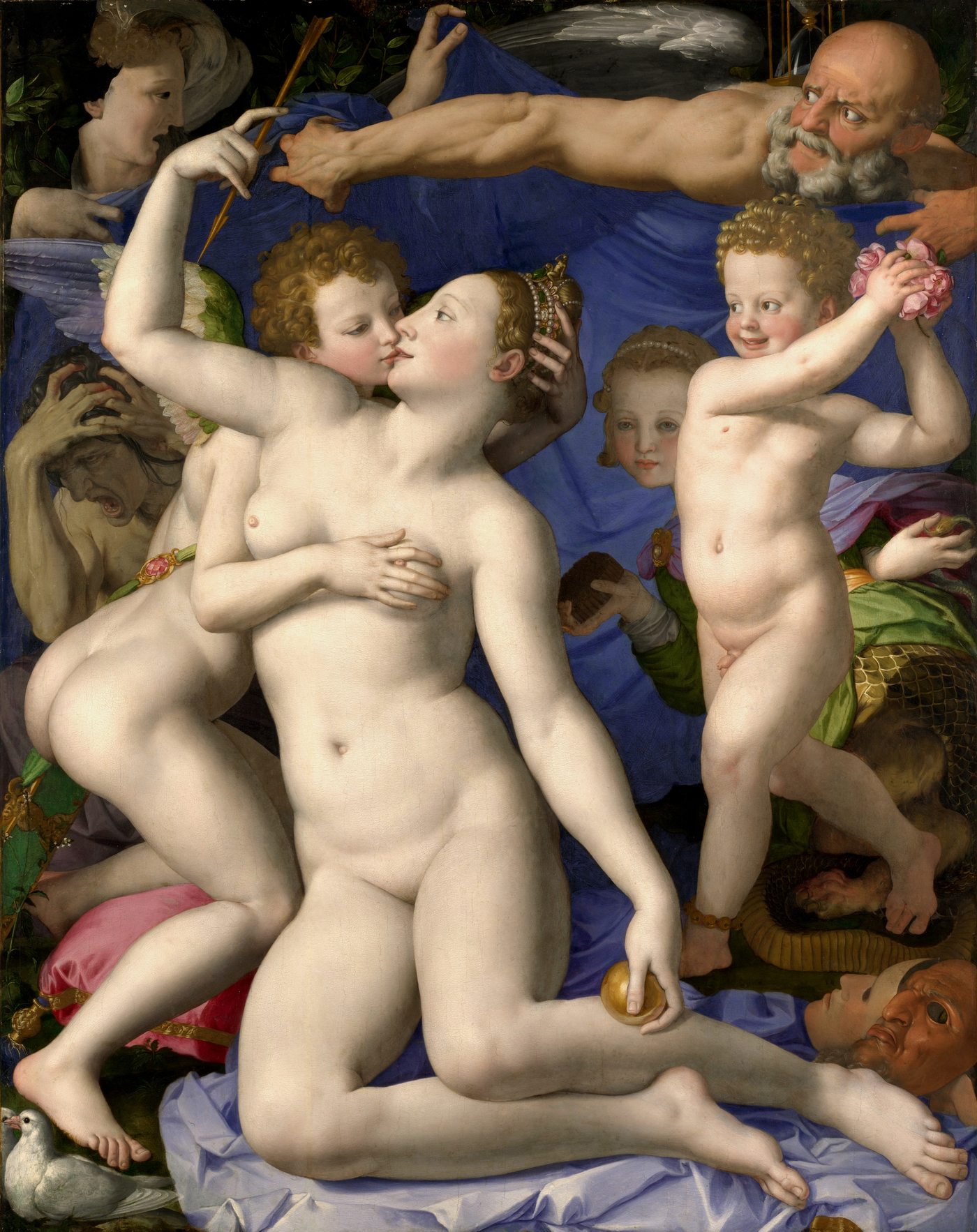
Bronzino’s An Allegory with Venus and Cupid is one of those paintings that looks hyper-controlled on first glance and increasingly unstable the longer you stand in front of it. The panel is not huge by court-display standards—146.1 × 116.2 cm—but it feels crowded, almost pressurized, because every body turns in a different logic of motion while the enamel-like finish suppresses painterly noise.[1] That formal contradiction is the point. The picture stages pleasure, but it also stages what pleasure costs in political space.
The painting is usually dated to around 1545 and likely connected to Medici gift diplomacy toward the French court of Francis I.[1][2] That context matters because this is not private confession painting. It is court rhetoric in oil: seduction as spectacle, then spectacle as warning, wrapped in elite finish.
Image relevance note: the hero image is the painting itself, used as direct evidence for this close reading of gesture, symbol placement, and surface logic.
1) The central knot: why the kiss is designed to be unreadable at one speed
At center, Venus and Cupid kiss mouth-to-mouth while hands do contradictory work: Cupid fondles Venus, Venus appears to lift an arrow from Cupid’s quiver, and both figures spiral in polished, sculpture-like poses.[1][2] The immediate reading is erotic. The slower reading is strategic ambiguity.
Bronzino does not give you a clean moral diagram where one figure equals one message. He gives you competing vectors: touch, theft, display, and interruption. The choreography matters more than a single iconographic key. If this were only a warning against lust, the composition could be simpler. Instead, it is obsessively elegant, almost complicit in the pleasure it critiques.
That friction is a classic Mannerist move: balance is replaced by tension, and clarity by intellectual pressure.[4] The painting makes viewers participate in interpretation the way courtiers had to participate in decoding social signals.
2) The side figures: a court grammar of delayed consequences
The National Gallery’s record identifies common readings of surrounding figures—Folly scattering roses while stepping on thorns, a hybrid Fraud/Deceit figure, Time pulling drapery, and an anguished figure often linked to Jealousy or disease.[1] What is useful here is not pretending there is final scholarly closure; there is not. What is useful is seeing how Bronzino arranges consequence.
Pleasure is foregrounded and luminous. Cost is displaced to the edges and upper register. The eye lands first on polished bodies, then gets pulled outward into discomfort: thorn, claw, twist, howl, exposure.[1][2] In other words, consequence is spatially delayed.
That delay mirrors court life. Immediate gains—favor, intimacy, access—can look smooth. Damage appears later, often in indirect forms: rumor, rivalry, reputation collapse, political retaliation. Read this way, the painting is less a static allegory than a timing diagram.
3) Surface as argument: why the painting feels cold on purpose
Bronzino’s reputation as a leading mid-16th-century Florentine Mannerist rests partly on a style of refined artificiality: high polish, precise contour, controlled flesh, and a near-metallic emotional temperature.[3] In this painting, that finish is not decorative excess; it is conceptual.
The smoother the surfaces, the less room for sentimental identification. The bodies are desirable but remote. You can read them, but you cannot enter them. That emotional distance is crucial if the work is to operate as elite instruction instead of devotional empathy.
The lesson is not “desire is absent.” Desire is everywhere. The lesson is that desire inside power structures is always mediated—by protocol, performance, and surveillance. Bronzino paints that mediation into the skin itself.
4) Why this image traveled: diplomatic portability of ambiguity
If the painting was indeed produced within Medici-to-French gift politics, its ambiguity was an asset, not a defect.[1][2] A straightforward moral image can be consumed once. A difficult image can be revisited by different viewers for different purposes: erotic wit, Neoplatonic play, courtly warning, anti-vice allegory, even sheer display of Florentine painterly sophistication.
That re-readability is what made such works politically portable. One object could perform multiple scripts across audiences without openly contradicting itself. In a diplomatic environment where explicit messaging could backfire, layered allegory provided plausible deniability with high cultural prestige.
5) What contemporary viewers can still learn from it
In 2026, the painting still feels contemporary because it understands attention economics: immediate reward in the center, deferred cost at the margin, and interpretation outsourced to the viewer. We live inside similar mechanics on digital platforms where attraction is optimized and consequences are temporally displaced.
Bronzino’s panel does not offer moral purity. It offers structural intelligence: desire is rarely independent of system design, and systems hide cost by staging sequence. If you read the painting as a map of that sequence, it stops being a Renaissance puzzle and starts becoming a practical literacy exercise.
60-second museum drill for this painting
- Center first (10s): identify the main pleasure signal (kiss, touch, polished skin).
- Edges second (20s): locate each discomfort marker (thorn, claw, scream, conceal/reveal gesture).
- Timing third (20s): ask which consequences are delayed rather than denied.
- Context last (10s): re-read the whole image as a court object made for circulation, not private confession.
Sources
- National Gallery (London), object record for An Allegory with Venus and Cupid (date, dimensions, figure identifications, court-gift context)
- Wikipedia, Venus, Cupid, Folly and Time (attribution history, Vasari transmission, interpretive debates)
- National Gallery (London), artist page for Bronzino (Mannerist framing, Florentine court role)
- Wikipedia, Mannerism (period framing and style characteristics used for contextual boundaries)
- National Gallery glossary entry for Giorgio Vasari (source tradition context for Renaissance artist biographies)
- Wikimedia Commons file page for the painting image used in this post (asset provenance path)