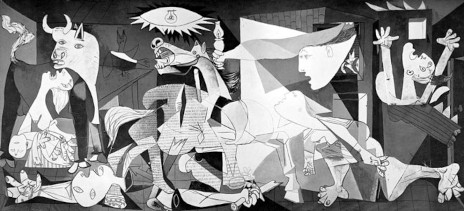
Picasso’s Guernica (1937) remains contemporary because it does not depict battle; it depicts civilian shock after the frame of ordinary life has already broken. The painting offers no horizon line to retreat toward, no heroic center to stabilize attention, and no clean sequence of before-and-after. Instead, it presses figures, animals, architecture, and scream-like diagonals into one roomless stage where panic is simultaneous. In 2026, that structure still feels accurate to how public crisis is experienced: not as a single narrative, but as overlapping signals that arrive faster than interpretation.
The work was commissioned for the Spanish Pavilion of the 1937 Paris International Exposition and created in direct response to the bombing of Guernica on 26 April 1937 during the Spanish Civil War.[1][2] Yet its long afterlife does not come only from historical significance. Guernica survives because it engineered a visual grammar for civic emergency: fracture over perspective, glare over atmosphere, witness over triumph.
Image context: the hero image reproduces Picasso’s Guernica itself because the essay’s argument depends on the exact formal logic of this specific mural—monochrome palette, angular compression, and unstable spatial reading.
1) The painting refuses heroic composition on purpose
At roughly 349.3 × 776.6 cm (about 11 ft 5 in × 25 ft 6 in), Guernica is monumental, but it does not grant monumentality to a hero.[2][3] The eye scans left to right and finds the same condition repeated: torsion, rupture, open mouths, broken limbs, and objects that read as both bodies and debris.
This is a decisive departure from traditional war painting, where scale often supports command, sacrifice, or nation-state legibility. In Guernica, scale serves another function: it removes distance. Standing in front of the canvas, viewers cannot “take in” the image at once; they must track fragments, then re-track them, which reproduces the cognitive rhythm of emergency perception.[3][4]
The result is not chaos for style’s sake. It is an anti-heroic structure with political intent. The painting withholds a central savior so the subject of the image becomes collective vulnerability.
2) Monochrome is not aesthetic restraint; it is media logic
One enduring misconception treats Guernica’s black-white-gray range as merely austere modernist taste. The stronger reading, supported by curatorial and conservation scholarship, is that monochrome links the mural to the visual field of contemporary newspaper photography and printed war reportage.[2][5]
That choice did three things at once:
- it stripped away seductive color that could romanticize violence,
- it made the work legible as public evidence rather than private fantasy,
- it synchronized painting with mass-media circulation logic in 1937.
In short, Picasso made a studio painting that behaved like a public information surface. This is one reason the mural still travels well across decades of reproduction. Even in low-fidelity reproductions, the core signal remains intact because tonal contrast, contour rupture, and directional stress carry the message without chromatic dependence.
3) The spatial collapse models civilian time under attack
In classical perspective systems, space organizes time: foreground, middle distance, and depth help us read sequence and causality. Guernica refuses that service. Floor planes tilt, wall boundaries dissolve, and figures appear both adjacent and dislocated. The painting does not tell us where we are standing, which means it also refuses to tell us when one event ends and another begins.[2][4]
That is exactly why the mural continues to function as a contemporary civic image. Civilian crisis is frequently experienced as temporal compression—sirens, rumors, alerts, official statements, personal loss, and infrastructural failure arriving in one cognitive window. Picasso’s fractured stage gives form to that compression without claiming to resolve it.
The famous overhead bulb intensifies this logic. Interpreted variously as bomb glare, electric witness, or hard modern illumination, it is less a stable symbol than a pressure point: the image’s central eye-like light sees everything and comforts nothing.[2][6]
4) Why Guernica keeps returning in protests, posters, and public argument
A work enters civic memory when it can be reactivated without losing its core structure. Guernica does that exceptionally well. Its icon set—the fallen body, the screaming mother, the dismembered fighter, the horse’s contorted mouth, the cold bulb—can be quoted in partial form while still carrying the painting’s anti-war charge.[3][6]
Importantly, the mural’s afterlife does not rely on one ideological camp. Different movements and institutions have invoked Guernica as a warning against aerial terror, state violence, civilian targeting, and the normalization of distant war. The image remains useful precisely because it does not flatten suffering into one slogan. It keeps the scene unresolved and therefore ethically active.
5) Why this still matters in 2026
The painting’s durability comes from a hard truth: modern public life repeatedly produces events where interpretation lags behind impact. In those moments, citizens do not need images that close meaning too quickly; they need images that preserve witness while resisting propaganda simplification.
Guernica remains one of the strongest examples of that balance. It is explicit about damage, disciplined about sentimentality, and structurally hostile to triumphant storytelling. That is why it still reads like a live civic alarm rather than a sealed historical artifact.
60-second gallery drill (to test the thesis)
- Start from the light source: identify how the bulb organizes attention without creating safety.
- Track one diagonal chain: follow a single vector of limbs/heads/architectural edges and note how quickly stable perspective breaks.
- Look for a hero and fail to find one: observe how the painting redistributes agency from individual triumph to collective exposure.
Sources
- Museo Reina Sofía, Guernica (catalog entry, commissioning and work context)
- Museo Reina Sofía, Repensar Guernica (research/conservation platform)
- The Museum of Modern Art (MoMA), collection/research references for Guernica and its exhibition history
- Smarthistory, Picasso, Guernica (art-historical formal reading)
- Britannica, Pablo Picasso biography entry (historical context and the Guernica section)
- Khan Academy / Smarthistory transcript resources discussing symbolism and composition stress points