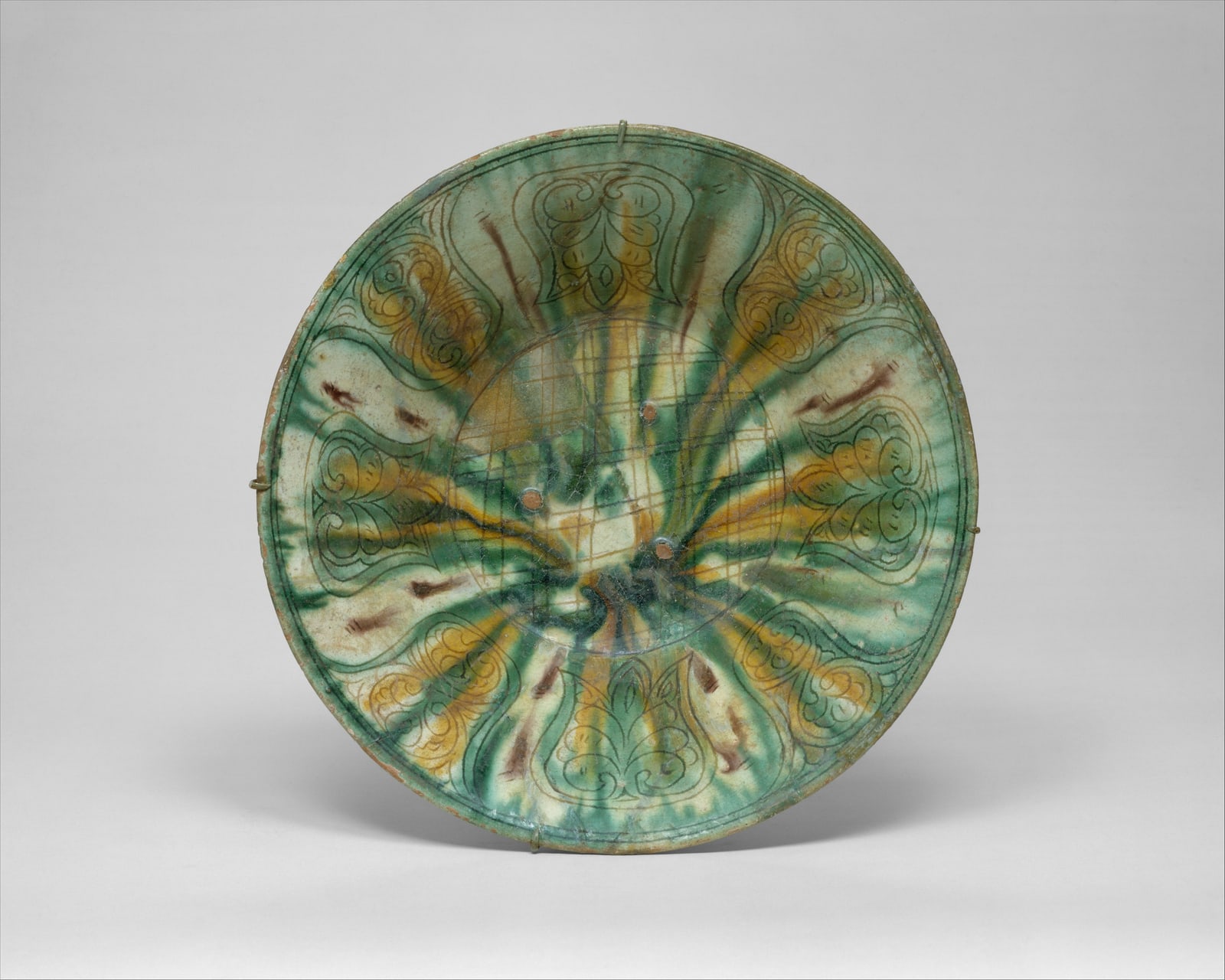
The color wanders; the drawing holds its course. On a tenth-century bowl excavated at Nishapur, Iran, green, yellow and brown splashes share the surface with curling plant forms. The Metropolitan Museum of Art identifies both the incised ornament and the colored glazes in this small earthenware vessel.[1] Looking at it means following two kinds of movement: a line with a definite edge, and color that spreads beyond it.
That distinction begins in the workshop. The drawing is made by cutting through a coating to reveal what lies underneath. This is sgraffito, a technique in which removing material supplies the visible mark.[2] The potter prepares a surface specifically so that parts of it can disappear.
A line with something underneath
Slip is clay mixed with water into a creamy liquid. Its color can differ from that of the vessel it coats. The V&A distinguishes several ways to work with it: painting and trailing add slip in patterns; combing drags a tool through wet coatings; sgraffito cuts through the coating to uncover the body below.[2]
The difference matters when reading a decorated pot. A dark line need not be dark paint. It can be the exposed clay of the object itself, made visible by a break in a lighter covering. The image draws on the vessel's material color as well as its shape. What normally serves as a support becomes part of the picture.
Contrast has to survive the kiln. Glendale Community College's ceramics teaching guide makes this practical point: the slip and body must differ enough for the design to remain visible after glazing and firing.[3] A beautifully controlled scratch cannot supply a strong color contrast if both layers finish in similar tones.
Sgraffito therefore asks the maker to think below the surface before drawing on it. The future line is already present as a material possibility. Cutting selects where it will appear.
Firm enough to hold, soft enough to work
The timing is physical. In Glendale's teaching sequence, the vessel reaches the leather-hard stage before slip is applied. It has stiffened but remains unfired. The coating is allowed to dry to the touch before carving, and the guide warns that water absorbed from the slip can soften the pot again, making it easier to distort while handling.[3]
This is drawing on an object that is still changing. The hand must manage the contour of the vessel as well as the path of the tool. A bowl offers a concave field; its surface turns away as a line approaches the rim. The design has to inhabit that curve.
The same teaching guide allows both circles made while the pot turns on the wheel and freehand carving, with light preliminary marks before fuller cutting.[3] Those options suggest how much variation fits inside a seemingly simple procedure. Repetition and improvisation can meet on one vessel. The name of the technique identifies an operation, leaving the maker considerable room to decide its rhythm.
Why the splashes do not stay inside the lines
For the Nishapur wares she studied, Met researcher Elena Basso reconstructed a more specific sequence. The white slip was incised before a first firing. Metal-oxide colors were then applied, followed by a transparent lead glaze and a second firing. The coloring components dissolved into the glaze. Her analysis established that the splashes preceded the glaze, a sequence that surface appearance alone generally cannot resolve.[4]
The account explains why it helps to look at the bowl twice. First, follow the foliate drawing as a network of edges. Then attend to the areas of color without expecting them to fill each outlined shape neatly. The two systems occupy the same curved field, but they do different visual work. The lines give the eye routes to follow; the splashes change the atmosphere around them.
Basso's reconstruction concerns the Nishapur material she investigated. It should not become a universal firing recipe for everything called sgraffito.[4] The shared principle is the cut through a contrasting layer. The materials and finishing sequence require their own evidence.
A coating changes the color story
Later English pottery makes that distinction tangible. The Florida Museum's archaeological type guide describes sgraffito slipware dated 1650–1740, probably produced in North Devon. Incisions expose a red body through a thin slip coating; the covering lead glaze gives the slip a yellow appearance. Its documented designs include birds, letters, geometric patterns and floral ornament.[5]
Here, too, the finished color belongs to the whole layered object. Seeing yellow does not by itself tell us what the slip looked like before glazing. Nor does recognizing a scratched line establish the vessel's date or place of manufacture. A technique can be recognizable while an object's history still needs investigation.
Return to the Nishapur bowl with that distinction in mind. Its drawing is both an image and a record of removal. The sharp tool has long gone, but the passages it opened through the slip remain visible beneath the glaze. Color can drift across them; the line keeps the shape of an earlier decision.
Sources
- The Metropolitan Museum of Art, “Bowl with Green, Yellow, and Brown Splashed Decoration,” accession 38.40.137 — object record, date, excavation location, materials, dimensions and photograph.
- Victoria and Albert Museum, “An A–Z of Ceramics,” section “S is for Slip,” updated April 17, 2024 — slip composition and distinctions between incision, trailing, combing and marbling.
- Glendale Community College, “Sgraffito,” ART 186 ceramics teaching guide — contrasting colors, leather-hard clay, moisture, carving and transparent glazing.
- Elena Basso, “Unravelling the Hidden Production History of Sgraffito Ware from Nishapur,” The Metropolitan Museum of Art, September 8, 2015 — scientific reconstruction of the slip, incision, color, glaze and firing sequence.
- Florida Museum of Natural History, “Slipware, Sgraffito,” Historical Archaeology Type Gallery — English examples, probable North Devon production, date range and the effect of lead glaze on slip color.