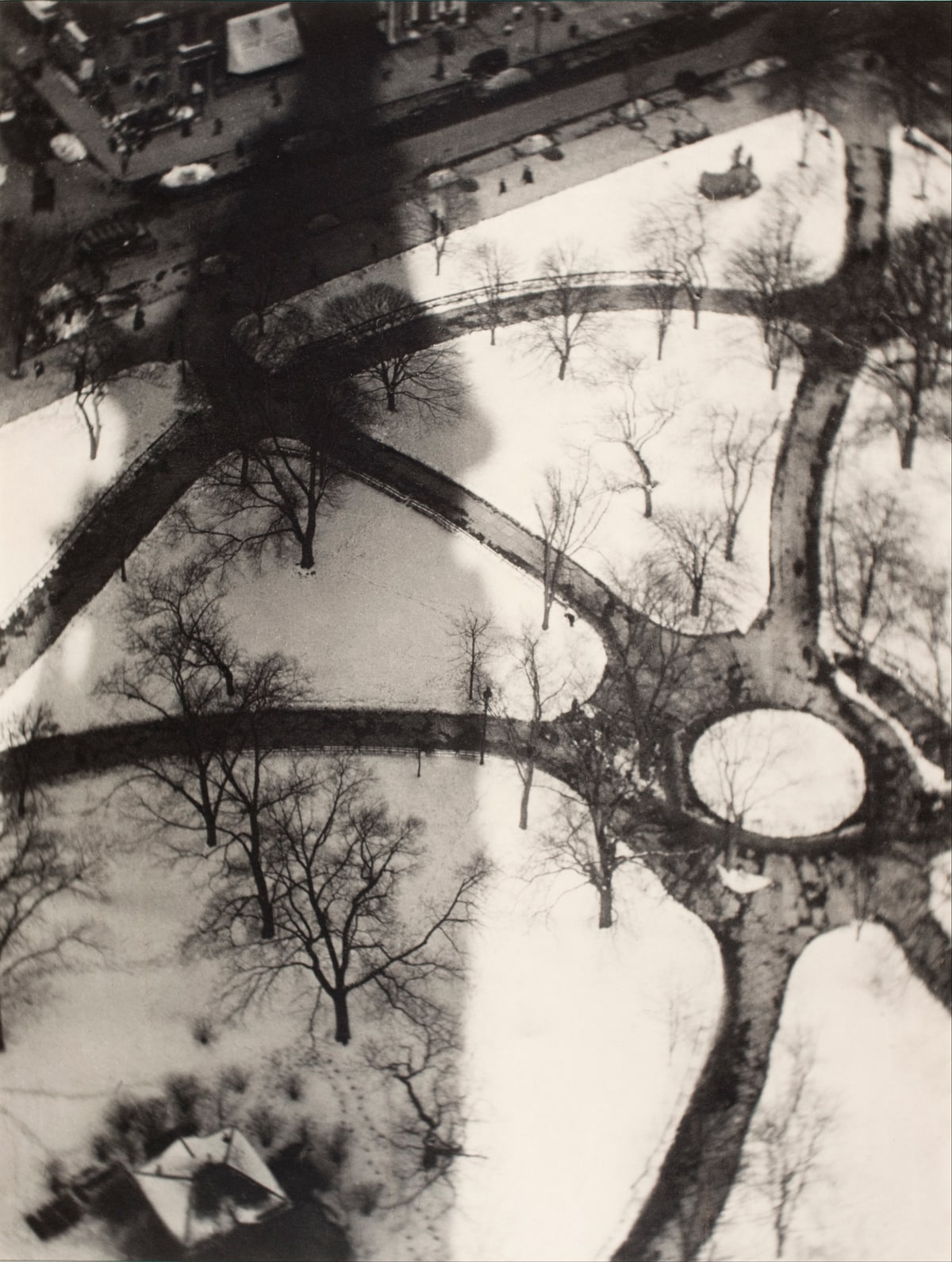
The paths are the first things to move. Dark against snow, they bend outward from a circular enclosure, thicken, divide, and disappear beyond the frame. The title supplies a creature, and suddenly the park seems capable of reaching for something.
Alvin Langdon Coburn's The Octopus looks down on New York's Madison Square Park from the Metropolitan Tower. The George Eastman Museum dates its platinum print to 1909; the photograph reproduced here comes from that museum's collection.[1][2][5] Its subject is an ordinary piece of public ground made unfamiliar by an extraordinary place to stand.
A path becomes a line
On the ground, a park path offers a practical invitation: follow it. Here, the eye can take in several routes at once. Their destinations become less compelling than the shapes they make together. The circular fountain enclosure gathers the composition without quite settling it; the paths keep pulling attention away toward the edges.
Snow helps this transformation. It separates the dark routes from their surroundings, giving the curves a clarity they would lose amid the competing colors and textures of another season. The bare trees offer a different kind of drawing. Their fine, irregular branches complicate the broad bands of pavement without overwhelming them. The picture has both a bold structure and a delicate surface.
Try following one path with your eye, then look across the whole photograph again. The shift is small but consequential. A route through a particular place becomes part of a pattern that can be enjoyed without knowing where it leads. Recognition remains available; it no longer controls the experience.
Look, too, at the small dark figures along the pavement near the top. Their size makes the distance tangible. The photograph's sweeping curves occupy ground that people are crossing a few steps at a time. That difference in scale keeps the pattern from becoming weightless: a walker following one route and a viewer surveying several routes have different relationships to the same place.
The Metropolitan Museum, which holds another platinum print, emphasizes the photograph's combination of soft focus and flowing, Art Nouveau-like lines with a startlingly elevated viewpoint.[3] That combination matters. The softness does not make the composition indecisive. It lets a sharply organized view retain something of the atmosphere of a winter day.
The building outside the picture
The most consequential structure is absent from the view. Coburn needed the tower to see this way, but he did not need to photograph its façade. Its height becomes a condition of the picture.
Its shadow also enters the park. Art historian Margaret J. Schmitz identifies the dark projection as the Metropolitan Tower's shadow and notes that Coburn made several versions with different shadow positions and framing.[2] In this view, the broad dark shape crossing the upper left interrupts the pale ground and the park's wandering lines.
I read that interruption as the photograph's reminder of where we are. The curves tempt us to treat the park as a design spread on a flat surface. The shadow points back toward a solid object outside the frame, standing in the same sunlight as the trees. A photograph that seems to lift us out of ordinary space quietly supplies evidence of its own position within it.
That gives the image a peculiar intimacy with the skyscraper. A conventional architectural portrait might let us admire a tower from across the street. Coburn lets us borrow its height. We experience what the building makes possible before we see what it looks like.
The title adds another change of scale. It encourages the paths to behave, imaginatively, like limbs belonging to one body. Nothing in the photograph has to cease being a park for that creature to appear. The pleasure lies in holding both readings together: familiar civic ground and a shape that suddenly seems alive.
A photograph with more than one date
The image's history requires a different kind of close attention. Readers will encounter both 1909 and 1912 attached to The Octopus. The Eastman Museum uses 1909, while the Met catalogues its platinum print as 1912. The Wikimedia reproduction used here also carries 1912 in its metadata.[1][3][5]
MoMA's technical record offers firmer chronological evidence. It dates the negative to 1909 and its own gelatin silver print to 1910–20. It also records publication in the June 1909 issue of Metropolitan Magazine under the title The Giant Shadow on Madison Square. The image therefore already existed before 1912.[4]
Those distinctions prevent an easy but unwarranted correction: we should not simply announce that every occurrence of 1912 must be a printing date. The Met's record does not specify that. Nor should the silver process used for MoMA's object be transferred to the platinum print illustrated here. A photographic image can circulate through separate physical objects whose records describe different things.
The earlier title also changes where attention falls. The Giant Shadow on Madison Square directs us toward the building's effect on the ground. The Octopus sends us following the paths. Both names belong to the image's documented history, but they prepare different encounters with it.[4]
Return to the photograph after reading them. First attend to the shadow, then to the circle and its branching routes. The park stays still while the picture reorganizes itself around what you notice. Coburn's high viewpoint makes that freedom possible: enough distance to discover a pattern, enough worldly detail to keep the pattern attached to a place.
Sources
- George Eastman Museum, “Alvin Langdon Coburn,” 2015 retrospective — identification of the museum's platinum print, its 1909 date, and collection credit.
- Margaret J. Schmitz, “Capturing Futurity: The Artistic Exchange of Alvin Langdon Coburn and H. G. Wells,” British Art Studies 23, August 2022 — Metropolitan Tower viewpoint, snow, shadow, variants, and dating evidence.
- The Metropolitan Museum of Art, Alvin Langdon Coburn, The Octopus, accession 1987.1100.13 — the separately held platinum print catalogued as 1912 and its stylistic context.
- Museum of Modern Art, Object:Photo, The Octopus, accession 1654.2001 — negative date, gelatin silver print date, inscriptions, and the documented June 1909 publication.
- Wikimedia Commons, “Alvin Langdon Coburn — The Octopus, New York — Google Art Project” — source reproduction of the George Eastman Museum platinum print and its retained 1912 metadata.