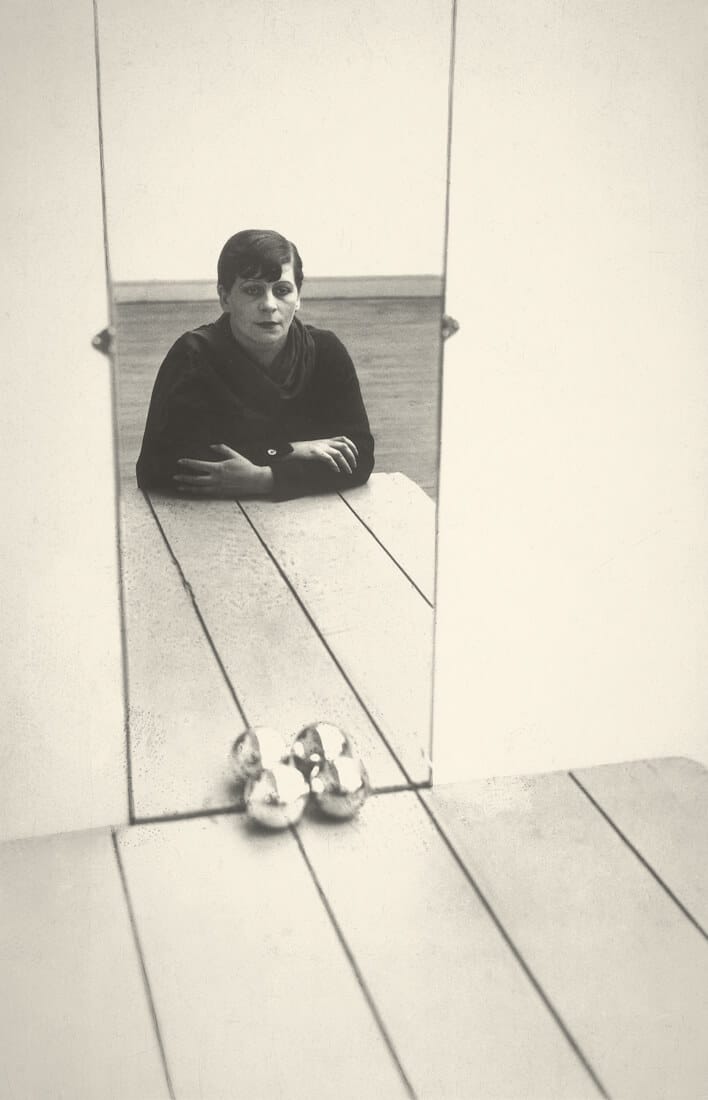
Two metal balls sit at the foot of a tall mirror. Above them, Florence Henri appears in reflection. Her face draws us in, but reaching it means looking through an arrangement that announces its edges. The person is available to view; the terms of the encounter have already been set.
Henri made this Self-Portrait in 1928. The reproduction here shows the vintage gelatin silver print in the Kunstbibliothek, Staatliche Museen zu Berlin, identified in the Jeu de Paume's exhibition documentation.[1] It is a portrait with very little anecdote. The mirror and the spheres take up room that another photographer might have given to possessions, a workplace, or an expansive gesture.
The face has company
Begin with the long sides of the mirror. They establish a narrow territory for the reflected figure while leaving a substantial surrounding field. Henri commands attention, yet she does not fill the photograph. The composition makes space for the apparatus that contains her likeness.
Now follow the diagonal seams toward the balls. Their roundness interrupts the straight lines; their polished surfaces catch light differently from the broad, quieter planes around them. The eye has somewhere to go after it reaches the face. Each return to Henri passes through a small negotiation with objects.
The tabletop continues into its reflection, carrying those seams toward her folded arms. Two balls become four rounded forms where they meet the mirror. The boundary is visible, but it also allows an apparent passage through. Henri seems both across a table from us and held inside a separate rectangle.
That movement changes the usual work of a portrait. We are accustomed to treating a face as the place where the photograph's meaning will finally collect. Here, looking at the objects can feel as consequential as studying the expression. The face supplies human interest without settling the whole picture.
Henri arrived at photography with a painter's training. She had studied in Paris with André Lhote and Fernand Léger before attending the Bauhaus in Dessau in 1927. The International Center of Photography emphasizes both her encounter with László Moholy-Nagy and her friendship with Lucia Moholy, who encouraged her camera experiments.[2] This background helps explain why the surroundings have such insistence: the space around a sitter could be composed as actively as the sitter herself.
Stillness without confession
The balls seem easy to set rolling. Here they remain fixed, giving the arrangement a faint sense of suspended possibility. Their small scale also makes the mirror feel tall. We can register all this before assigning them a symbolic meaning.
The same restraint is useful with Henri's expression. A quiet face can invite a busy story: melancholy, resolve, boredom, private worry. The image supplies too little evidence to choose among them. Its reserve is something we encounter, rather than a diagnosis we can make.
The Zentrum Paul Klee's guide describes her portraits as frequently expressionless and stresses the priority of composition over psychological anecdote. It identifies this self-portrait as an early example of her carefully arranged spatial relationships.[3] That offers a productive way to look: allow the face to remain unresolved, and attend to how it has been made visible.
This was also a moment of professional possibility. The same guide reproduces a February 1928 letter to Lou Scheper in which Henri considers pursuing photography as a profession and temporarily leaving painting.[3] The self-portrait belongs to that period of experimentation. We need not turn its expression into an illustration of the letter to recognize that the artist was testing a new medium's scope.
A mirror seems particularly apt for such a test. It gives her a likeness while giving the camera another bounded surface to organize. The resulting photograph holds together two activities that do not always coincide: showing oneself and making a picture.
Who controls the frame?
The arrangement has prompted sharply different readings. In her 1981 essay “The Photographic Conditions of Surrealism,” Rosalind Krauss challenged an earlier account that praised the photograph's balance and contemplative stillness. Comparing Henri's image with a work by Man Ray, she treated the tall frame and metal balls as sexually charged forms, and framing itself as a means of capturing a subject.[4]
Krauss explicitly allowed her interpretation to go beyond what Henri might consciously have intended. Her argument is therefore a critical reading, not documentary proof that the artist planted a particular sexual message.[4] That distinction matters. Otherwise, a challenging interpretation can harden into an unsupported claim about what an artist meant.
Marta Gili's preface for the Jeu de Paume exhibition offers another emphasis: Henri's self-staging brings formal experimentation into contact with personal subjectivity and the social expectations surrounding identity.[1] The mirror can be understood as a place where a person constructs her appearance, even as it exposes her to someone else's gaze.
My reading keeps that tension open. Henri has chosen a device that confines her reflected body, but she has also made the confinement conspicuous. We can see that a boundary is at work. The picture grants us a view without pretending that the view exhausts the person.
The folded arms reinforce that reserve. They give the reflected figure a compact lower edge, while the tabletop extends toward us. There is a route for the eye to follow, but no equivalent invitation to invent a confidence or a confession.
Look once more from the balls to the face. The arrangement is exact; the person remains difficult to read. That interval gives the photograph its staying power. We have been shown a great deal about how Henri presents herself, and left room to wonder about the self she presents.
Sources
- Jeu de Paume, “Dossier documentaire : Florence Henri,” 2015 exhibition documentation — Berlin print identification, image reproduction, and Marta Gili's account of self-staging and identity.
- Anna Linehan, “Florence Henri,” International Center of Photography — painting studies, Bauhaus attendance, Lucia Moholy's encouragement, and photographic experimentation.
- Zentrum Paul Klee, “Fokus. Florence Henri (1893–1982),” section “Mirrors, Shadows, Composition” — the self-portrait's construction and Henri's February 1928 letter to Lou Scheper.
- Rosalind Krauss, “The Photographic Conditions of Surrealism,” October 19, Winter 1981, pp. 3–7 — competing readings of Henri's self-portrait, framing, and artistic intention; PDF hosted by the University of New Mexico Art Museum.