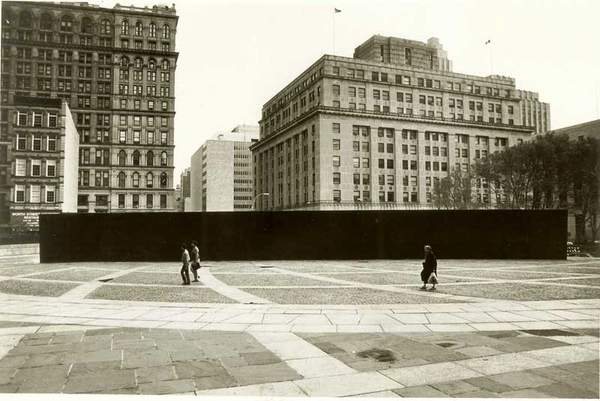
Richard Serra's Maquette for Tilted Arc looks almost too small to carry the argument that later surrounded the full public work. The Smithsonian American Art Museum lists the model as bent and incised steel, only 3 inches high, 30 inches long, and one-eighth inch thick.[1] In reproduction, it can look like a narrow rust-dark fragment on a neutral background. That modest scale is the point. The maquette compresses a plaza controversy into a strip of metal, and in doing so it makes the work's central idea easier to see.
The finished Tilted Arc was not made to be admired from a polite distance. PBS describes the installed sculpture as a raw steel wall, 120 feet long and 12 feet high, placed in Federal Plaza in lower Manhattan in 1981.[2] Britannica gives the same public outline: a government-commissioned steel work whose effect on Federal Plaza provoked intense debate.[5] The maquette keeps that pressure in miniature. It is not a decorative curve. It is a line that refuses to behave like a line. It bends, leans, and asks the viewer to imagine a body trying to pass beside it.
Image context: this article uses the Smithsonian's real photographic record of Serra's bent-steel maquette. The photograph shows the object itself, which matters because the article is a close reading of the model as an artwork and as evidence of the destroyed site's spatial argument.[1]
The curve is not graceful enough to be harmless
At first glance, the maquette's curve seems slight. It does not spiral, loop, or perform. It stays nearly horizontal, an elongated band whose bend is easier to sense than to summarize. That restraint matters. Serra's public sculpture did not need a theatrical silhouette to change the plaza. It needed just enough curvature and tilt to make straight passage unreliable.[2][4]
The model's thinness is also deceptive. On a table or museum mount, the strip has the economy of a drawing. In the plaza, the same idea became a physical interruption. PBS's account stresses that workers in surrounding buildings had to go around the steel mass as they crossed Federal Plaza.[2] The controversy often gets retold as a clash between public taste and elite art, but the maquette points to a more specific problem: the sculpture made movement conscious. It turned a habitual crossing into an encounter.
That is why the curve should not be read as elegance alone. It is a controlled misalignment. A straight wall would be easier to dismiss as a barrier. A decorative curve would be easier to absorb as plaza furniture. Serra's bend sits between those categories. It suggests passage while lengthening it, opens sight while blocking it, and makes the shortest route feel suddenly negotiated.
A model of site, not just shape
The danger in looking at a maquette is to treat it as a portable version of the finished work. Serra's case is almost the opposite. The small object clarifies that Tilted Arc depended on the site it would later disturb. The Smithsonian object page notes that the larger work was designed for the plaza of the Jacob Javits Federal Building and summarizes the dispute over traffic flow, hearings, relocation, and removal.[1] CultureNow similarly identifies the work as a GSA Art in Architecture commission and emphasizes the fight over artists' rights in site-specific public works.[4]
The maquette is therefore not simply a miniature sculpture. It is a proposal for a relation: steel against plaza, curve against commute, artist against property owner, public artwork against public administration. The object does not show pedestrians, office windows, police concerns, lunch-hour use, or the federal buildings around it. Yet its form depends on all those absences. The thin dark strip is incomplete in exactly the way a site-specific model should be incomplete. It points away from itself.
This is also what makes the object photograph valuable. The neutral studio image strips away the Federal Plaza controversy and lets the viewer inspect the physical premise. The work's stubbornness is already there. The model does not explain itself by ornament, symbolism, or commemorative text. It insists that a change in orientation can be a change in social behavior.
Ownership became part of the form
The afterlife of Tilted Arc is inseparable from law and ownership. PBS records the public hearing in March 1985, with 122 people testifying in favor of retaining the sculpture and 58 favoring removal, followed by a 4-1 vote for removal by the panel.[2] The federal appellate opinion, mirrored by Public.Resource.Org, frames the legal question around whether removing a government-owned artwork from federal property violated Serra's free-expression and due-process rights.[3]
That legal record can sound far from sculpture, but the maquette shows why it belongs inside the reading. Tilted Arc was a work about how a public place is managed, crossed, and claimed. Once the government owned the steel and the plaza users objected to how the work changed ordinary movement, ownership was no longer a backstage issue. It became part of the artwork's pressure field.[3][4]
Serra's position that relocation would destroy the work was not a romantic exaggeration. It followed from the sculpture's mechanism. If the piece makes sense by altering one plaza's movement, then moving it to a lawn, park, or museum forecourt does not merely change the address. It changes the work's grammar. The maquette helps because it preserves the grammar without pretending to replace the site. It says: this form only becomes fully active when a public route has to answer to it.
The small object keeps the argument unfinished
When Tilted Arc was removed in 1989, the full work became a memory object, a legal case, a public-art caution, and an art-history example.[2][3][5] That can make it sound settled. The maquette prevents that. Its surface is dark, scuffed, and material. Its scale is intimate. Its curve remains unresolved. It is small enough to be held in the mind, but it points toward a conflict too large for a vitrine.
The best reason to look closely at the maquette is that it refuses two easy stories. It does not let supporters reduce Tilted Arc to pure artistic freedom, as if public inconvenience were irrelevant. It also does not let opponents reduce the work to a failed amenity, as if a plaza's existing habits were neutral. The model shows that the work's intelligence lived in pressure: a small formal deviation scaled up until a civic system had to declare what kind of public it meant.
That is why this modest strip of steel remains sharp. It is not a relic of a lost wall. It is a concentrated version of the question the wall forced into the open. Public art is never just in public. It edits routes, distributes attention, tests ownership, and exposes who gets to decide when shared space has been improved or interrupted. Serra's maquette makes that interruption look exact.[1][2][3][4]
Sources
- Smithsonian American Art Museum, "Maquette for Tilted Arc" - object page, downloadable photographic image, dimensions, medium, credit line, and artwork description.
- PBS/WGBH, "Culture Shock: Flashpoints: Visual Arts: Richard Serra's Tilted Arc" - timeline-style account of the commission, dimensions, public hearing, removal, and public-art debate.
- Public.Resource.Org mirror of Serra v. United States General Services Administration, 847 F.2d 1045 (2d Cir. 1988) - appellate opinion on removal, government ownership, free expression, and due process.
- CultureNow, "Tilted Arc" - public-art listing summarizing material, commissioner, removal, storage, and site-specific controversy.
- Encyclopaedia Britannica, "Tilted Arc" - reference entry on Serra's government-commissioned work, Federal Plaza controversy, dimensions, and public-space effect.