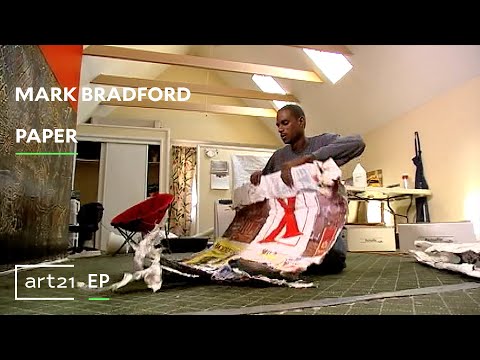
Mark Bradford's paintings can look, at a distance, like weather systems passing over a city map: scraped color, torn grids, embedded routes, sudden scars of white or black. Art21's short studio video Mark Bradford: Paper is valuable because it slows that surface down and returns it to material decisions.[1] Paper is not treated as a humble support or a craft substitute for paint. It is the subject's carrier. End papers from hair salons, street posters, advertising fragments, and layered scraps bring social information into the studio before Bradford ever begins to sand, peel, or excavate them.[1][2][3]
That distinction matters because Bradford is often grouped under broad labels: abstraction, collage, social practice, Los Angeles contemporary art. All are useful, but they can flatten the precision of his method. The Broad describes his work as built from discarded materials of urban life, including salon supplies, handbills, advertisements, and posters that act as memories of things pasted and things past.[3] Whitney similarly stresses that Bradford builds surfaces from street materials and permanent-wave end papers, connecting the physical language of the work to South Central Los Angeles and to his experience around hairdressing and sign-making economies.[4]
The Art21 video makes those written descriptions tactile. It shows why Bradford's "social abstraction" is not a slogan. The social part is already in the paper: where it circulated, whose attention it sought, what services it advertised, and what neighborhood pressures made those messages visible.[1][2][3][4] The abstraction comes later, when the materials are layered until their literal text begins to break apart. Bradford does not illustrate the street. He lets the street's paper systems become the painting's skin.
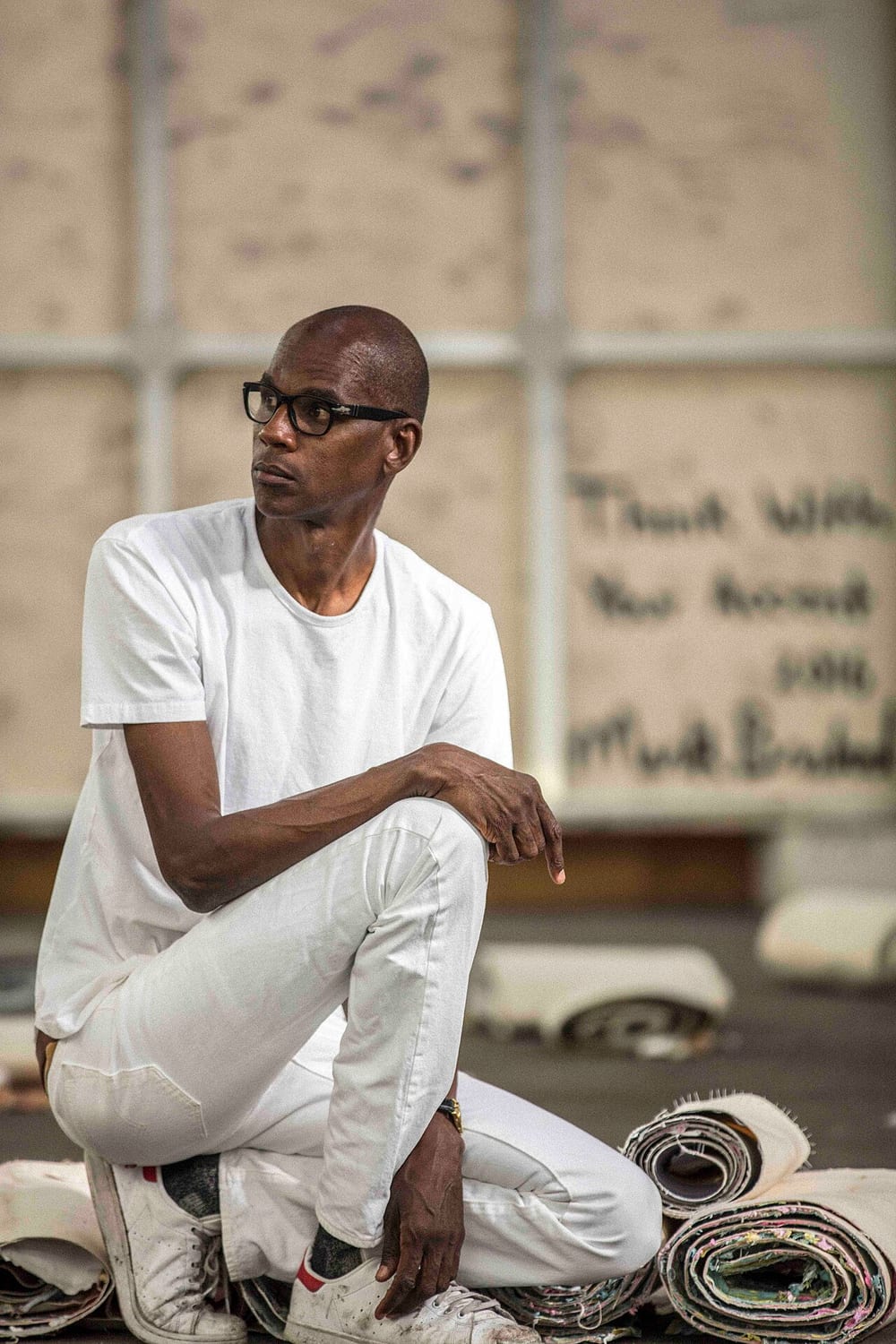
Image context: the cover uses a 2016 real photographic portrait of Mark Bradford from Wikimedia Commons. The video remains the article's main process image, but the portrait is relevant because this essay follows a living artist's studio method rather than a single historic object. The still image avoids generated illustration and keeps the post grounded in documented photographic material.[6]
Early in the video, paper becomes a record of use
The first thing to notice is Bradford's refusal to treat paper as neutral.[1] In many studio demonstrations, material appears as supply: canvas, brush, medium, tape. Here paper arrives with a prior life. Art21's profile of Bradford frames his work around painting, collage, installation, and social engagement, but the key through-line is his use of everyday materials that carry histories before they enter the artwork.[2] The Broad and Whitney make that more specific: end papers connect to hair salons and family labor, while merchant posters and street advertisements connect to urban economies, informal services, and neighborhood survival systems.[3][4]
This changes how a viewer should look at the finished surfaces. A Bradford painting is not abstract because it escapes social reference. It is abstract because social reference has been compressed, torn, sanded, and partially buried. The source material still matters even when the words stop being legible. In fact, illegibility is part of the force. The painting asks what happens when public messages are layered so densely that they become texture, memory, and pressure rather than clear instruction.
Britannica's overview helps name the method in practical terms: Bradford attaches paper and other materials to canvas, then removes, abrades, and exposes layers so that earlier colors and fragments reappear.[5] The video adds the physical reality of that process. Paper is not placed delicately and left alone. It is stressed. It is built up, attacked, reopened. That cycle gives the work its uneasy mixture of beauty and damage.
The studio labor is excavation, not decoration
Around the middle of the video, the important action is not simply adding paper but working back into it.[1] Bradford's surfaces depend on removal as much as accumulation. That is why words such as collage or mixed media are accurate but incomplete. Collage can imply arrangement on top of a surface. Bradford's method feels closer to excavation: he builds a surface thick enough to hold buried information, then cuts into it until the buried layers begin to speak through fracture.
The Broad's artist bio gives a useful phrase for this: posters become a memory of things pasted and things past.[3] The phrasing matters. Memory is not a clean archive. It is partial, worn, and reorganized by contact. Bradford's sanding and peeling operate in that same register. A merchant poster may begin as direct address - legal help, cash, housing, work, beauty, debt, promise - but in the painting it becomes broken signal. Its public urgency remains even after the words are damaged.
Whitney's account of his materials points to the same reading.[4] Beauty salon tissue, advertising posters, billboard paper, newsprint, and end papers are not chosen because they are visually quirky. They are chosen because they belong to systems of work, display, and local communication. The studio does not purify them into fine-art material. It intensifies their contradictions. Fragile paper becomes monumental. Disposable signage becomes durable. Street noise becomes a painting that still refuses to settle into one readable message.
The strongest lesson is about abstraction's social contract
The video is most useful when it prevents two bad readings at once.[1] The first bad reading is that abstraction is detached from politics because it does not depict recognizable scenes. Bradford's work makes that impossible. The materials already carry social location, and the procedures of layering and abrasion keep that location present even when representation disappears.[2][3][4] The second bad reading is that politically engaged art must become literal message. Bradford avoids that too. He does not turn the painting into a poster about posters. He turns posters into a painting that retains their unresolved pressures.
That is the article's main claim about Art21's clip: it lets us see abstraction as a contract with material history.[1] The viewer does not have to decode every scrap. The point is not to recover a single hidden sentence under the surface. The point is to understand that the surface is made from messages that once competed for attention in public space. The painting's torn beauty depends on that public afterlife.
This is also why Bradford's work can hold scale without becoming empty spectacle. Haunting size in contemporary painting is easy to fake; one can simply enlarge a gesture. Bradford's scale feels earned because every large field is built from small, handled, used units. The monumental canvas still remembers cheap paper, salon labor, neighborhood advertising, and repeated studio pressure.[3][4][5] Art21's video shows the hinge between those scales. Paper enters as ordinary stuff. It leaves as a field that looks abstract only because it has absorbed too much social life to stay legible.
Sources
- Art21, "Mark Bradford: Paper | Art21 'Extended Play'" - YouTube studio video.
- Art21, "Mark Bradford" - artist profile and practice overview.
- The Broad, "Mark Bradford" - artist bio on discarded urban materials, salon papers, posters, and street memory.
- Whitney Museum of American Art, "Mark Bradford" - artist page on street materials, advertising posters, billboard paper, newsprint, and end papers.
- Encyclopaedia Britannica, "Mark Bradford" - biography and process overview, including layered paper, sanding, and Merchant Posters.
- Wikimedia Commons, "File:MarkBradfordPortrait4.jpg" - source page for the article image.