Gabriele Münter's Jawlensky und Werefkin is a small picture with a large hinge inside it. Two figures sit on a green slope near Murnau: Alexej von Jawlensky and Marianne von Werefkin, both artists, both part of the circle that would soon help make Munich modernism feel less like a style than a working argument.[1] The scene could have become anecdote. It could have remained a casual outdoor study of friends. Instead, Münter makes it feel like a threshold: landscape, portrait, and artistic self-definition compressed into one sharp surface.
The Lenbachhaus record dates the oil-on-cardboard work to 1908/09, gives its modest size as 32.7 by 44.5 cm, and places it in the Gabriele Münter Stiftung donation of 1957.[1] Those facts matter because the painting is not monumental by scale. Its force comes from reduction. The hillside is a broad green plane. The mountains and sky lock into blue bands. The figures are treated as simplified forms rather than descriptive likenesses. Nothing is fussed over, yet the scene is unmistakably social. This is not landscape emptied of people. It is landscape turned into a stage for artistic contact.
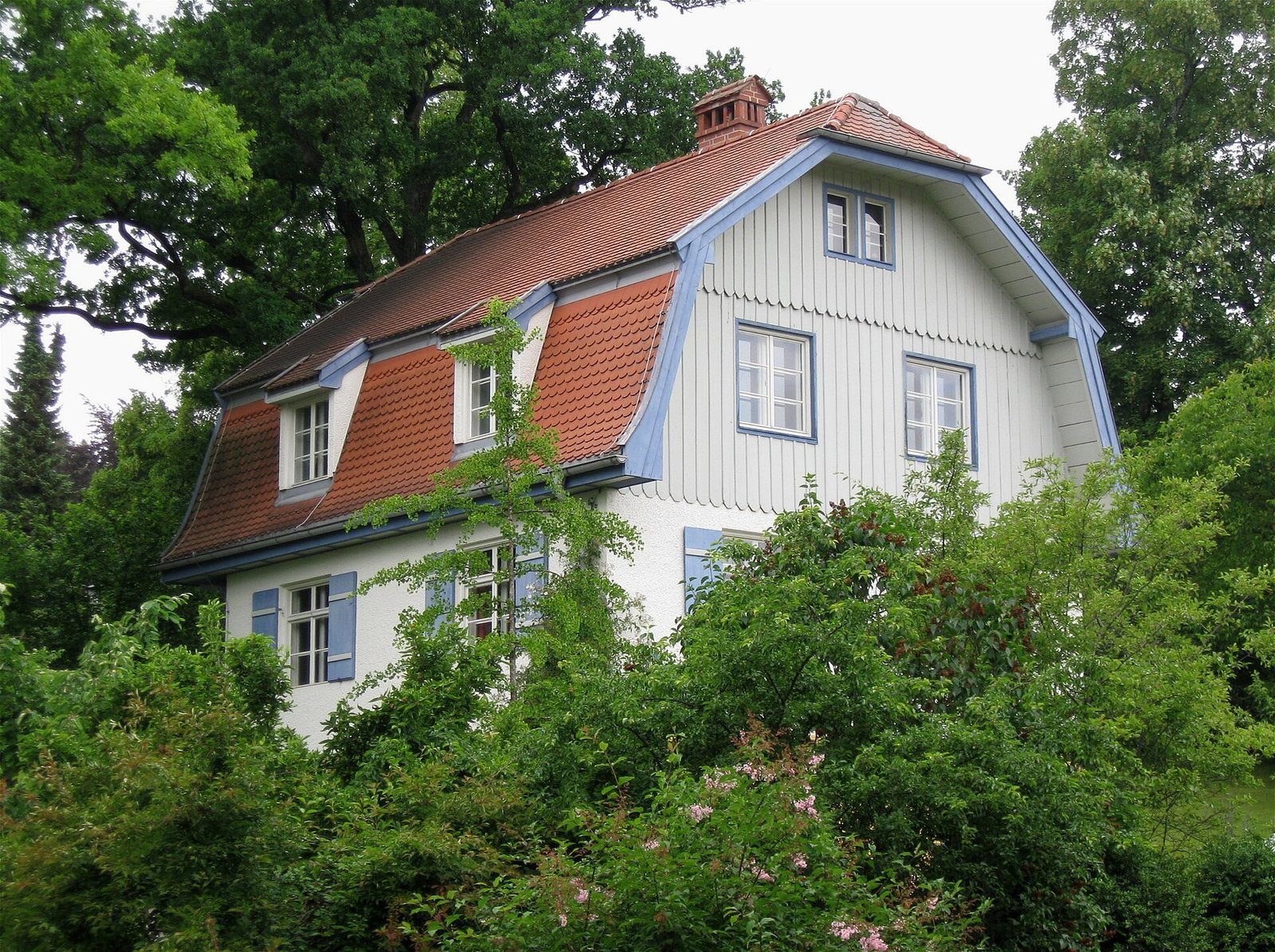
Image context: the cover is a real museum reproduction of the painting from the Lenbachhaus collection page, not a generated visual, chart, or diagram. It belongs here because the article's claims are visual: the black contours, dense color blocks, and compressed hillside have to be seen as the work's thinking apparatus.[1]
The Murnau Field Becomes A Studio
Murnau mattered to Münter as more than scenery. The Lenbachhaus work text explains that she and Wassily Kandinsky first visited the Upper Bavarian town after years of travel, then returned for a study stay with Jawlensky and Werefkin.[1] NMWA's profile gives the larger chronology: Münter and Kandinsky discovered Murnau in 1908, she later bought a house there, and in 1911 she helped form Der Blaue Reiter after first helping establish the Neue Künstlervereinigung in 1909.[3] In that sequence, Jawlensky und Werefkin sits close to the ignition point.
That closeness changes how the picture reads. The two seated figures are not decorative staffage added to a view. They are the evidence of a working circle. Murnau becomes a place where artists look together, paint near one another, absorb one another's procedures, and test how far a visible world can be simplified before it loses its pressure. The field is therefore also a studio, even without easels in view. It is a room without walls, organized by shared looking.
The painting's composition makes that social structure quiet but firm. Jawlensky and Werefkin are low in the field, almost embedded in the slope. The landscape does not frame them politely; it presses them into the same plane of color. Their bodies feel folded into the hillside, yet the dark outlines keep them legible. Münter's problem is not how to make portrait and landscape alternate. It is how to make them occupy the same compressed language.
Contour Does The Heavy Work
The strongest formal decision is the black line. The Lenbachhaus emphasizes the work's reduced outline drawing, strong color contrasts, radical simplification, and use of cloisonnist contour linked ultimately to Gauguin and mediated for Münter through Jawlensky.[1] In plain terms, the line stops being a boundary drawn after the fact. It becomes the structure that lets color stay blunt.
This is why the figures can be so simplified without becoming vague. Faces are barely described. Hats, coats, arms, and seated postures are abbreviated. Yet the two people do not disappear into abstraction. The contour holds just enough identity, just enough bodily relation, and just enough difference between person and ground. It lets Münter strip description down while keeping encounter alive.
The hillside works the same way. The green is dense rather than atmospheric. It does not flutter with Impressionist notation. The blue mountains behind it do not recede through delicate tonal transitions. They sit there, flattened and emphatic, as if distance has been translated into color pressure. Britannica's summary of Münter's Blue Rider-period work helps name the balance: she shared the group's intensity of color and expressive line while keeping figures, still lifes, and landscapes more representational than fully abstract.[4] Jawlensky und Werefkin is almost a demonstration of that balance. It wants abstraction's compression without giving up the scene.
Friendship Is Not Sentiment Here
It would be easy to sentimentalize the painting because it depicts friends in a landscape associated with artistic beginnings. Münter resists that. She does not paint Jawlensky and Werefkin as luminous personalities, romantic companions, or heroic pioneers. She turns them into compact presences inside a pictorial test.
That restraint is part of the work's intelligence. The people matter, but they matter as agents in a shared experiment. Jawlensky's role is especially visible through method rather than likeness. The Lenbachhaus text notes that Münter was in close artistic contact with him during this period and absorbed his push toward synthesis: drawing elements together into a few characteristic forms.[1] The painting quietly performs that lesson on the bodies of the people who helped make it possible.
Werefkin's presence matters too. She is not background to Jawlensky or to Kandinsky's better-known story. By placing the pair in one small Murnau field, Münter records a collaborative modernist atmosphere before later art history sorted it into larger names and cleaner genealogies. The painting keeps the group nature of the breakthrough visible. It says, without rhetoric, that new form often arrives socially.
A Small Picture Against The Kandinsky Shadow
Münter has often been read through her relationship with Kandinsky, and the Lenbachhaus exhibition text says directly that many of her achievements long remained obscured by that narrow lens.[2] That warning is useful here. Jawlensky und Werefkin should not be treated merely as evidence for Kandinsky's environment or as a footnote to Blue Rider abstraction. It is Münter's own solution to a shared problem: how to intensify the visible world without making it evaporate.
Her answer is tougher than it first looks. She does not turn Murnau into pure spiritual color. She keeps the slope, the bodies, the hats, the seated relation, the bands of mountain and sky. But she removes nearly everything that would make those details anecdotal. The result is neither conventional plein-air study nor fully symbolic abstraction. It is a middle condition with its own authority: a painting that makes simplification feel like attention rather than evasion.
That is also why the picture still feels fresh. It does not ask the viewer to choose between social history and formal analysis. The social history is in the form. The black contour tells us how one artist learned from another without simply imitating him. The compressed field tells us how a place became an engine of modernism. The two seated figures tell us that avant-garde movements are not born only from manifestos, but from afternoons, proximity, argument, looking, and the courage to throw out unnecessary description.[1][2][3]
Münter's painting is small enough to hold in the mind almost at once, but it keeps expanding as a document of method. The field at Murnau becomes a cutout stage where friendship is visible, landscape is tightened, and contour takes command. Blue Rider modernism is often remembered for spiritual ambition and color intensity. Jawlensky und Werefkin adds something more grounded: before the movement became a name, it was a way of sitting in the grass and discovering how much of the world could survive in a few decisive forms.[1][4]
Sources
- Lenbachhaus, "Gabriele Münter, Jawlensky und Werefkin, 1908/09" - official collection page with work metadata, provenance, image source, Murnau context, and discussion of contour, simplification, color contrast, and Jawlensky's influence.
- Lenbachhaus, "Gabriele Münter: Painting to the point" - exhibition page on Münter's broader practice, photography, stylistic range, and the need to read her work beyond the Kandinsky relationship.
- National Museum of Women in the Arts, "Gabriele Münter" - artist profile covering her training, Kandinsky and Murnau chronology, Neue Künstlervereinigung, Der Blaue Reiter, and later return to painting in Murnau.
- Encyclopaedia Britannica, "Gabriele Münter" - reference biography summarizing Münter's Blue Rider affiliation, 1909/1911 group chronology, intensity of color and line, and representational difference from full abstraction.