Senga Nengudi's R.S.V.P. works begin with a material so ordinary that the first response can be disbelief: pantyhose, stretched across walls and floors, knotted, pulled taut, and weighted with sand. But the ordinariness is the point. Nengudi did not choose nylon hosiery because it could impersonate a nobler sculptural material. She chose it because it already carried social pressure, bodily memory, elastic limit, color, touch, and use.[2][3]
That is why the series should be read as a medium invention, not only as a feminist image or a performance prop. Bronze can hold a pose. Stone can preserve a cut. Pantyhose does something more unstable: it submits and resists at the same time. Filled with sand, it sags; pulled against a wall, it draws; animated by a performer, it becomes a partner rather than a pedestal object.[2][5]
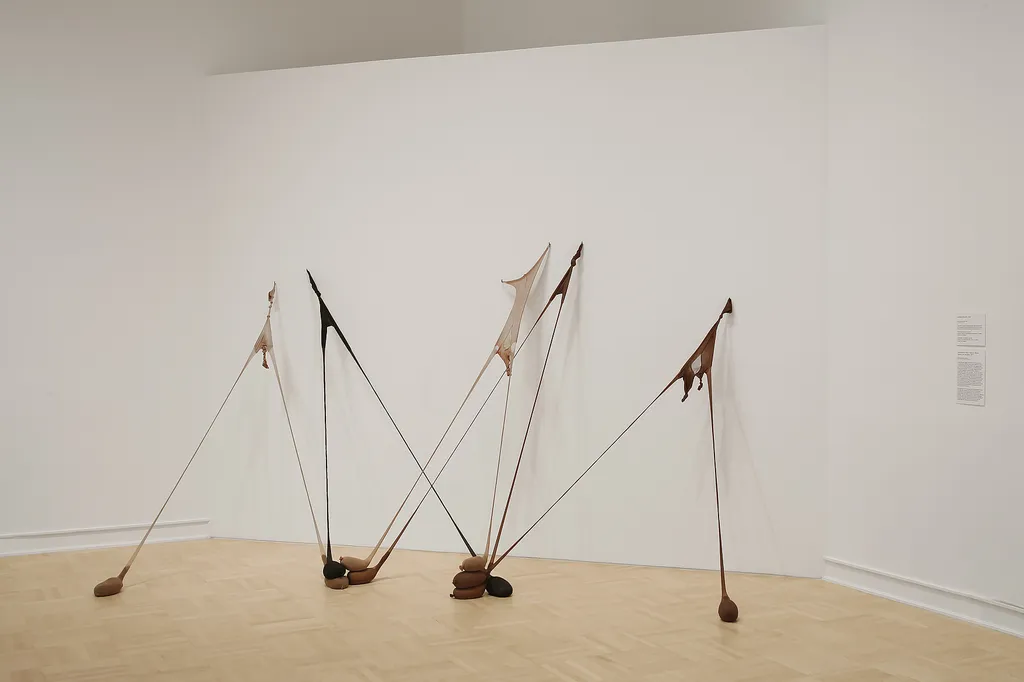
Image context: this post uses a real museum installation photograph of Nengudi's 2013 Untitled R.S.V.P. from Princeton University Art Museum. It is not a diagram or a generated illustration. The photograph is useful because it shows the work as a system of stretched nylon, sand-filled weights, pinned contact points, floor pressure, and gallery air.[1]
Nylon Makes Line Behave Like Skin
The first technical move is deceptively simple: Nengudi turns line into a bodily membrane. In Princeton's object record for Untitled R.S.V.P., the medium is listed as "nylon, sand, and mixed media," with a height of 198.1 cm, tall enough to meet the viewer at architectural scale rather than tabletop scale.[1] The work is not a freestanding mass. It is a set of relations: anchors, stretched cords, sagging pockets, and the wall that receives the pull.
That matters because nylon hosiery is already a compromised object. It is designed to fit the body closely while smoothing, containing, and presenting it for social view. It stretches because the body changes underneath it. It tears because the world catches on it. It is intimate and public at once. Nengudi exploits that double life. The nylon does not merely represent skin; it behaves like something that has known containment and strain.[2][3]
MoMA's collection page for R.S.V.P. I identifies the work as pantyhose and sand in ten pieces and describes the series as performance-based sculpture made from pantyhose filled with sand and stretched across space.[2] That phrase, "across space," is crucial. Nengudi is not adding soft material to a hard sculptural tradition. She is making space record force. Every line in an R.S.V.P. installation seems to ask what happened to pull it into that condition.
The title keeps the invitation open. The Studio Museum in Harlem notes that R.S.V.P. abbreviates the French phrase meaning "please respond," connecting the objects to performances in which dancers entered and leaned into the sculptures.[3] The title is not decorative wit. It is an instruction about medium. Nylon responds to the body; sand responds to gravity; performers respond to resistance; viewers respond by reading all of those pressures at once.
Sand Gives Softness a Weight
Soft sculpture can easily become a story about anti-monumentality: cloth instead of bronze, collapse instead of heroism, impermanence instead of permanence. Nengudi's sand complicates that reading. Sand is not simply filler. It gives the pantyhose consequence. It makes the nylon droop into sacks, bulbs, and pulled nodes. It gives line a load to carry.
In R.S.V.P. V, the Studio Museum lists the medium as nylon, mesh, and sand, and describes how flesh-toned pantyhose are stretched into elongated linear forms that gesture toward movement, resistance, and Black women's navigation of historical gender roles.[3] That interpretation begins with material behavior. The social meaning is not pasted on after the fact. It emerges because the work looks as if it has been pulled, burdened, lengthened, and made to continue anyway.
Sand also changes time. A bronze figure can pretend to stop time by freezing a body in place. In Nengudi's work, the sand keeps reminding the viewer that time has not stopped. Gravity is still operating. Tension is still distributed. The floor still receives weight. The knots and stretched skins seem temporary even when the museum record stabilizes the object as a collection work.[1][2]
The Nasher Sculpture Center's education resource puts this impermanence bluntly: using materials such as newspaper, sand, and pantyhose, Nengudi created sculptural experiences that were not meant to last forever in the conventional sense.[5] That is not a failure of craft. It is the craft. Nengudi's medium does not promise that the body can return unchanged after pressure. It asks what form remains when pressure has already done its work.
Performance Is Not an Add-On
The R.S.V.P. works become clearest when sculpture and dance are treated as one problem. Philadelphia Museum of Art's page for Senga Nengudi: Topologies places her work at the intersection of sculpture and performance and emphasizes everyday materials, archival documentation, video, sound, collaboration, and the Black female body.[4] The installation is therefore never just a still object waiting to be interpreted. It carries the memory of possible activation.
MoMA's gallery text for R.S.V.P. I states that the series grew from Nengudi observing bodily changes after childbirth and that early performances involved collaborators stretching, contorting, becoming entangled with, and expanding the nylon forms.[2] That origin matters because the work is not only about elasticity as a formal property. It is about elasticity as lived knowledge: pregnancy, aging, endurance, gendered presentation, racialized visibility, labor, and the body's refusal to remain an ideal shape.
The performer does not illustrate the sculpture. The performer tests it. When a dancer leans into an R.S.V.P. work, the nylon draws a temporary map of resistance. Too little force and the object remains inert; too much and the material can deform, tear, or lose its composure. The work's intelligence sits in that threshold. It makes sculpture into a negotiation rather than an object lesson.
United States Artists' artist page likewise frames Nengudi as a sculptor and installation artist whose R.S.V.P. works mimic the sensuality and elasticity of the body and psyche while registering inside and outside pressure.[6] That broad account is valuable because it refuses to separate the formal from the social. In Nengudi, a knot is never only a knot. It is a contact point where material memory, performance history, and social pressure meet.
The Wall Becomes a Partner
The Princeton photograph used here shows why the gallery wall should not be treated as a blank background.[1] The white wall supplies the field against which the nylon lines become readable, but it also receives the work's pull. Pins and points of attachment turn architecture into a support body. The floor catches the sand-filled weights. The empty air between the diagonals becomes part of the sculpture's anatomy.
This is one reason an R.S.V.P. work can look sparse without feeling minimal in the usual sense. Minimalist sculpture often asks the viewer to notice industrial form, repetition, module, and the object's relation to the room. Nengudi uses some of that spatial discipline, but she recharges it through garment, weight, touch, skin tone, performance, and bodily analogy.[2][4] The room becomes less a neutral container than a field of tension.
The diagonal lines in Princeton's Untitled R.S.V.P. do not merely compose the wall. They seem to pull across it like muscles or tendons stretched past comfort. The sand-filled ends lie on the floor with a heaviness that answers the wall's vertical lift. The eye moves from weight to pin to drooping membrane and back again, learning the work as a circuit. This is technique as choreography: not the choreography of a dancer's steps, but of forces held in visible relation.
Because the materials are familiar, the viewer's body supplies knowledge before art history does. Anyone who has pulled elastic too far, felt a garment lose its shape, or watched fabric change under weight can read the basic physics. Nengudi then deepens that everyday knowledge into sculptural meaning. The work does not hide its construction. It lets construction become vulnerability.
The Medium Is the Argument
The lasting force of R.S.V.P. is that Nengudi makes material choice do the conceptual labor. Pantyhose brings intimacy, gendered expectation, bodily contour, and social discipline. Sand brings weight, gravity, ritual association, instability, and time. Performance brings touch, risk, collaboration, and change. The wall and floor bring architectural constraint. None of these elements is secondary.[1][2][3][4]
That is why the work still feels current. Many artworks use everyday materials to puncture the prestige of traditional sculpture. Nengudi goes further. She chooses materials whose behavior is already a theory of the body. Nylon stretches but does not forget. Sand settles but never becomes solid. A performer can activate the work, but cannot control all the forces released by that activation. A museum can collect an object, but the object keeps pointing back toward events, bodies, and touch that cannot be fully stored.
So the technical lesson is not that pantyhose can become sculpture if an artist wills it strongly enough. The sharper lesson is that pantyhose was already a sculptural medium waiting to be read: elastic, skin-adjacent, socially loaded, fragile, cheap, intimate, and capable of showing pressure with exactness. Nengudi's achievement was to let that material speak in its own tense grammar.
In R.S.V.P., sculpture does not stand above the body. It remembers being pulled by one.
Sources
- Princeton University Art Museum, "Untitled R.S.V.P." - official object page for Senga Nengudi's 2013 nylon, sand, and mixed-media sculpture and the source of the cover image.
- Museum of Modern Art, "Senga Nengudi. R.S.V.P. I. 1977/2003" - collection page with medium, object details, and gallery text on childbirth, pantyhose, sand, performance, sag, swelling, fragility, and firmness.
- Studio Museum in Harlem, "R.S.V.P. V, 1976" - collection page on nylon, mesh, sand, the R.S.V.P. series title, dancer activation, tensile resilience, and Black women's bodily resistance.
- Philadelphia Museum of Art, "Senga Nengudi: Topologies" - exhibition page situating Nengudi at the intersection of sculpture, performance, everyday materials, archival documentation, collaboration, ritual, and the Black female body.
- Nasher Sculpture Center, "Senga Nengudi Teaching Resource" - education PDF on pantyhose, sand, impermanence, elasticity, 1970s social norms, dancer activation, and the artist's preference for experience over permanence.
- United States Artists, "Senga Nengudi" - institutional artist page describing Nengudi as a sculptor and installation artist and summarizing the bodily and psychological pressure in the R.S.V.P. series.