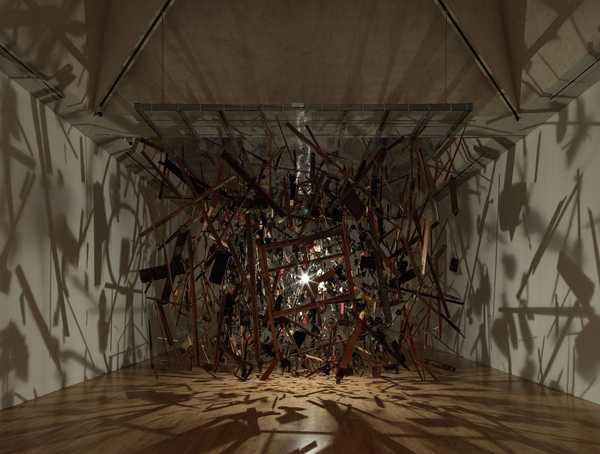
Cornelia Parker's Cold Dark Matter: An Exploded View begins with a joke so severe that it stops being funny: take a garden shed, fill it with ordinary things, have the British Army blow it up, then suspend the remains around a light bulb until the blast looks as if it has been paused in midair.[2][3] The result, first made in 1991, is not a relic of destruction and not a theatrical prop. It is a sculpture that makes aftermath behave like a room.
The work's intelligence sits in that contradiction. A shed is normally a low-status domestic container: tools, offcuts, broken appliances, old hobbies, the stuff that has not quite been thrown away. An explosion is normally a terminal event. Parker turns both into an arrangement. Tate's object record lists the materials in blunt plural form: wood, metal, plastic, ceramic, paper, textile, and wire.[1] That inventory matters because the work is not an abstract cloud. It is a smashed archive of use.
The Shed Is Not Innocent
The first mistake is to treat the shed as merely humble. Its ordinariness is real, but Parker chooses it because ordinary storage already has a strange relation to memory. Sheds collect the things that no longer have a clean role inside the house but have not yet lost all value: a bicycle wheel, wood, metal, tools, paper, the residue of postponed repair. In Cold Dark Matter, those materials become visible only after being violently separated from their container.
Open Arts Archive's account is useful because it keeps the making process concrete. Parker supervised the explosion, managed by the British Army, then suspended the charred and broken fragments of the shed and its contents from the ceiling of Chisenhale Gallery in East London.[2] The work therefore does not imitate violence by style. It imports a real destructive procedure, then refuses to let that procedure have the last word.
This is where the piece becomes more than spectacle. An explosion normally scatters evidence beyond control. Parker does the opposite: she regathers the fragments and gives them a second order. The shed is not restored, but it is not allowed to vanish. It becomes readable as a dispersed body. Looking at it, the viewer keeps switching between two kinds of attention: recognition of bits and comprehension of the whole.
The Explosion Becomes a Drawing Tool
Parker's strongest move is to make violence behave like a draftsperson. The blast breaks the shed into marks; the suspension system places those marks in space; the central light projects them outward. The shadows are not secondary atmosphere. They are the work's expanded drawing.
Professor Gill Perry's Open Arts description notes the 200-watt light bulb at the center of the installation and connects the work to Parker's interest in transformation and metamorphosis of materials.[2] That light is crucial because it converts debris into scale. A small shard can throw a large shadow. A bit of wood becomes a jagged line on the wall. The room is filled by the consequences of objects that, in themselves, may be physically modest.
That is why Cold Dark Matter does not feel like a fixed cube, even when the fragments are carefully hung. It has two bodies. One is the dense suspended core. The other is the unstable field of shadows around it. The viewer moves between matter and projection, between evidence and ghost. Parker makes the gallery feel as if it has been caught between forensic reconstruction and dream.
The Guardian's 2004 review captures the recognition sequence: one sees the darkened room, the hovering cube, and then individual ruined things begin to appear.[4] That slow identification is part of the work. If everything were instantly legible, the explosion would become a gimmick. Instead, the viewer has to reassemble domestic life from damage.
Suspension Is the Moral Form
The title's phrase "An Exploded View" borrows from technical illustration, where an object is pulled apart so its parts can be understood in relation. Parker literalizes that convention and makes it unstable. This is not a diagram that clarifies a machine. It is a real object blown apart and then arranged as if clarity were still possible.
Suspension is therefore the work's moral form. The fragments do not lie on the floor as wreckage, and they are not rebuilt into a fake shed. They hover. That hovering holds three incompatible states together: before, during, and after. The viewer sees the domestic object that used to exist, the force that destroyed it, and the sculptural decision that keeps destruction from collapsing into waste.
The Royal Drawing School biography frames Parker's broader practice around intense processes such as shooting, exploding, and burning, with ordinary objects transformed while the artist remains actively involved in their changing story.[3] Cold Dark Matter is the clearest case because the story is not hidden behind the final object. The process remains visible in every splinter.
This also keeps the work from becoming a simple antiwar metaphor. The British Army matters, and the military charge cannot be domesticated away.[2][3] But Parker does not turn the shed into a poster against explosives. She stages a stranger problem: what happens when the technologies of destruction are redirected toward attention? The answer is not redemption. It is a tense, suspended interval in which damage becomes available for looking without becoming harmless.
The Room Learns to Remember the Blast
Installation art often depends on the viewer's body, and Cold Dark Matter uses that dependence with unusual economy. You cannot read it from one perfect frontal position. From a distance, it is a dark constellation. Up close, it becomes a field of particular remains. Around the edges, shadows overtake objects; near the center, the bulb makes the arrangement feel hot and dangerous even though the violence has already happened.
A 2024 article in Edinburgh Architecture Research argues that Parker's installation disrupts fixed exhibition meaning by remaking matter, space, and perception together.[5] That academic language points toward a simple viewing fact: the work cannot be reduced to its object list. The fragments, wires, light, shadows, walls, and the viewer's own movement form one temporary architecture.
That architecture is why the work still feels fresh. Many artworks use destruction as a dramatic origin story. Parker's piece is stronger because it is not content with the origin story. It keeps asking how destruction is arranged afterward. The shed has been killed, but the gallery is not a morgue. It is a charged reconstruction where every fragment seems to remember flight.
The title's scientific echo, "cold dark matter," also matters because the piece makes absence feel gravitational. The original shed is gone; the blast is over; the ordinary lives of the objects are unrecoverable. Yet the missing whole organizes everything the viewer sees. The sculpture is held together by what no longer exists.
That is the work's central achievement. Parker does not aestheticize damage by smoothing it. She keeps the burns, splinters, wires, and shadows in tension. Cold Dark Matter is beautiful because it refuses to choose between object and event. It lets a shed become debris, debris become drawing, and drawing become a room where destruction has not ended, only stopped falling.
Sources
- Tate, "Cold Dark Matter: An Exploded View, Cornelia Parker CBE RA, 1991" - collection record and installation photograph source.
- Open Arts Archive, "Open Arts Object: Cornelia Parker, Cold Dark Matter: An Exploded View, 1991" - Gill Perry resource on the British Army explosion, Chisenhale installation, suspension, and central light.
- The Royal Drawing School, "Cornelia Parker" - artist biography describing Parker's destructive processes and transformation of ordinary objects.
- The Guardian, "Blown away" (September 18, 2004) - critical description of Cold Dark Matter as suspended shed fragments, shadows, and recognizable domestic remains.
- Subham Mukherjee and Arunima Ghosh, "Exploding all explosions: Reconfiguring art and architectural meaning, matter, and space with Cornelia Parker's Cold Dark Matter (1991)," Edinburgh Architecture Research 38, no. 1 (2023).