Niki de Saint Phalle is often remembered through a bright contradiction: the artist who shot paintings with firearms and then filled public space with huge, dancing women. That sequence can sound like a conversion from anger to joy. It is more exact to see it as a change in scale. The early Tirs made painting behave like an event; the later Nanas made the female body behave like an environment.[1][2]
The Nanas are easy to underestimate because they look delighted with themselves. They have swelling hips, small heads, raised arms, circus colors, patterned surfaces, and a physical confidence that often reads as comic before it reads as polemical. But their comedy is not lightness. It is a method. Saint Phalle built figures that could survive ridicule because they had already refused the thin, obedient, decorative body expected of women in much mid-century visual culture.[3][5]
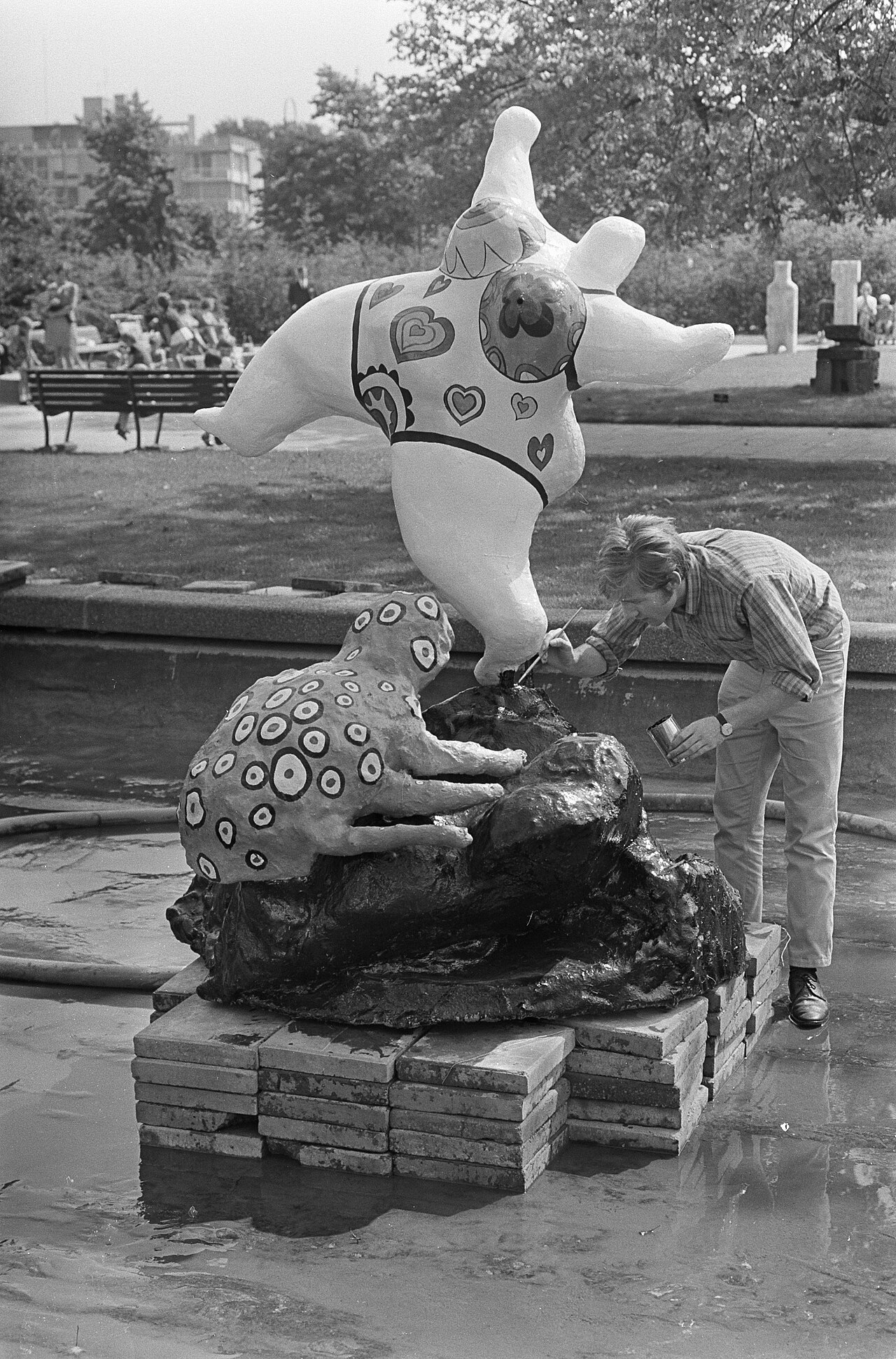
Image context: this post uses a real archival photograph taken on August 21, 1967 by Jack de Nijs for Anefo and held through the Dutch National Archives/Wikimedia Commons record. It shows why the Nanas are best read at bodily scale: Saint Phalle stands near the figure, but the sculpture owns the garden space around her.[6]
Violence Became Procedure
Saint Phalle's breakthrough was not made by color first. It was made by rupture. Britannica describes the Tirs as surfaces carrying found objects and bags of colored paint that Saint Phalle shot with a rifle, puncturing the bags so pigment dripped and splashed across the work.[1] The point was not only spectacle. The artist transferred part of composition from hand to event. Paint appeared because force had passed through the object.
Praemium Imperiale's biography gives the larger art-historical hinge: the Tirs fused anti-art practice with the production of objects, then led toward the large, naive-surreal figures that made Saint Phalle famous later in the decade.[3] That matters because the Tirs were never just angry anecdotes. They taught her that art could be completed by action, witnessed by an audience, and built from materials that did not behave like polite studio media.
This is the first reason the Nanas should not be treated as a retreat from aggression. They come after an art of impact. Their surfaces may sparkle, but they inherit a performative idea: the work has to do something in space. A Nana does not simply present a body. It changes the room's body. It blocks, invites, dances, crowds, shines, and makes the viewer negotiate scale.
The Nana Refused the Correct Body
The first Nanas appeared in the mid-1960s. Britannica dates the series to 1964 and connects it to the pregnancy of Clarice Rivers; Moderna Museet likewise says Saint Phalle made Nanas in different formats from 1964 onward.[1][2] Moderna's archival page on Hon - en katedral adds a sharper interpretive frame: the Nanas often represent a feminist perspective and testify to Saint Phalle's belief in women's divinity.[2]
That word "divinity" helps explain their exaggeration. The Nanas are not naturalistic portraits, and they are not simply celebratory cartoons. They enlarge traits that polite taste often disciplines: belly, breast, buttock, thigh, spread, reach, appetite, ornament. Their heads are often small not because the figures are unintelligent, but because Saint Phalle shifts authority away from the classical hierarchy that lets the rational head govern the unruly body. These bodies think by occupying space.
The National Museum of Women in the Arts makes the body politics plain in its 2025 exhibition text on Saint Phalle's prints. It describes the Nanas as voluptuous female figures that subvert conventional ideals for women's bodies, while noting that her practice also moved through prints, books, films, clothing, jewelry, perfume, and the financing of the Tarot Garden.[4] That range matters. Saint Phalle did not protect sculpture from popular forms. She used popular forms to give sculpture a larger social life.
Hon Made the Body Into Architecture
The decisive test came in Stockholm in 1966. Hon - en katedral, made at Moderna Museet with Jean Tinguely, Per Olof Ultvedt, and museum director Pontus Hulten, turned a reclining pregnant female figure into a building-sized installation. Moderna Museet's archive describes a 23-meter-wide, 6-meter-high "cathedral" that visitors entered; inside were goldfish, a loveseat, a bar, a small cinema, a slide for children, paintings, and other surprises.[2]
This was not just a big Nana. It was a public argument about entry, permission, and the museum. A conventional nude is looked at from outside. Hon reversed the contract. The viewer entered the body and found a social world inside it. The installation made anatomy into passage, leisure, cinema, jokes, rest, and circulation.[2][3]
Praemium Imperiale's biography emphasizes the scandal and reach of that act, describing Hon as a vast Nana that the public could enter and linking it to later monumental commissions, public sculptures, houses, playground-like structures, and the Tarot Garden.[3] The larger point is that Saint Phalle did not only make figures. She made proposals for how people might behave around figures. They could walk into them, gather near them, buy versions of them, watch them perform in fountains, or encounter them in city medians.
That shift is why the Nanas remain sharper than their cheerfulness first suggests. Their bodies are not offered for possession in the old way. They are too large, too patterned, too gleefully unashamed, and too mobile across media. They make spectators adjust themselves.
Public Joy Has Teeth
Saint Phalle's later career widened the same logic. NMWA notes that her practice included prints, books, films, clothing, jewelry, perfume, and the Tarot Garden, while its New York Avenue Sculpture Project page emphasizes scores of outdoor sculptures and public art projects around the world.[4][5] That expansion is easy to misread as diffusion. In fact, it is coherence by other means. The point was to keep making structures that could alter ordinary habits of inhabiting the world.
The New York Avenue Sculpture Project at the National Museum of Women in the Arts gives a later public-space example. Its project page describes four monumental Saint Phalle sculptures installed along Washington, DC's New York Avenue, including Nana on a Dolphin and Les trois graces, and connects them to her many outdoor sculptures, the Stravinsky Fountain, and the Tarot Garden.[5] In that setting the Nana is no longer an art-historical figure alone. It becomes traffic-scale color, civic encounter, and public visibility for women's art outside museum walls.
This is where the early violence and late joy meet. The Tirs attacked the surface of painting and let color bleed out. The Nanas attacked the social surface of the female body and let scale, pattern, and pleasure expand outward. One body of work uses rupture; the other uses exuberance. Both refuse containment.[1][2][5]
The cover photograph from 1967 catches that refusal in a quieter register. Saint Phalle stands beside a Nana in the Stedelijk Museum garden, but the sculpture does not behave like a pedestal object. It tilts the scene toward performance. The garden becomes a stage, the artist becomes a witness to her own enlarged double, and the viewer sees the crucial thing: the Nana is not only an image of liberation. It is a spatial demand.[6]
That demand is why Saint Phalle's work still feels current. In a public culture that keeps disciplining bodies through size, gender, marketability, usefulness, and respectability, the Nanas remain impolite in the right direction. They are funny, but not harmless. They are decorative, but not submissive. They are joyful, but not naive. They do not ask permission to be large. They make largeness the form of freedom.
Sources
- Encyclopaedia Britannica, "Niki de Saint Phalle" - current artist biography covering the Tir paintings, Nouveau Realisme, Nanas, Hon, Tarot Garden, activism, large-scale projects, and legacy.
- Moderna Museet, "Att minnas Hon - en katedral" - archival exhibition page on the 1966 Hon installation, its dimensions, public entry, interior features, documentation, and Nana context.
- Praemium Imperiale, "Niki de Saint Phalle" - laureate biography on the Tirs, Nouveau Realisme, Nanas, Hon, public commissions, Tarot Garden, and the crossing of painting, sculpture, architecture, and play.
- National Museum of Women in the Arts, "Niki de Saint Phalle In Print" - exhibition page on Nanas, body ideals, prints, books, films, clothing, jewelry, perfume, activism, and the Tarot Garden.
- National Museum of Women in the Arts, "New York Avenue Sculpture Project: Niki de Saint Phalle" - project page on monumental public sculptures, outdoor works, the Stravinsky Fountain, and the Tarot Garden.
- Wikimedia Commons, "File:Niki de St. Phalle in Stedelijk Museum . Een der Nans in de tuin, Bestanddeelnr 920-6197.jpg" - archival 1967 Nationaal Archief/Anefo photograph used for the cover image.