
Archival footage of postwar abstraction often gets reduced to mood. A famous painter appears in a studio, the room looks charged, and the camera seems to promise privileged access to genius. The Met's Helen Frankenthaler in her studio, 1967 is more useful than that.[1][2] What it restores is not aura but working scale. Frankenthaler is too often summarized as the artist who turned Pollock's horizontal ambition into something lighter, more lyrical, and more color-driven. The 1967 film makes a harder point. Her pictures depend on a disciplined negotiation among floor, liquid color, drying time, and the changing distance between painter and canvas.
That matters historically because Frankenthaler's breakthrough had already happened fifteen years earlier. The Helen Frankenthaler Foundation's biography identifies Mountains and Sea from 1952 as the decisive painting: thinned oil was poured directly onto raw, unprimed canvas laid on the studio floor, and she worked from all sides to build translucent fields whose edges felt both accidental and judged.[3] The Whitney's artist page sharpens the technical stakes. It describes stain painting as a process in which paint absorbs unevenly into bare fabric, producing saturated zones, thin pools, and a new emphasis on the flatness of the support.[4] By 1967, then, Frankenthaler is not being filmed at the moment of invention. She is being filmed after invention, when a method has become a full spatial intelligence.
That is the strongest reason to watch this footage now. By the mid-1960s Frankenthaler had already exhibited internationally, represented the United States at the 1966 Venice Biennale, and helped define the passage from Abstract Expressionism toward Color Field painting.[3][4] The studio film catches her after recognition but before historical summary turns the work into a clean diagram. It shows that the soak-stain method was never simply a matter of pouring and hoping. It was an exacting way of seeing from multiple distances at once.
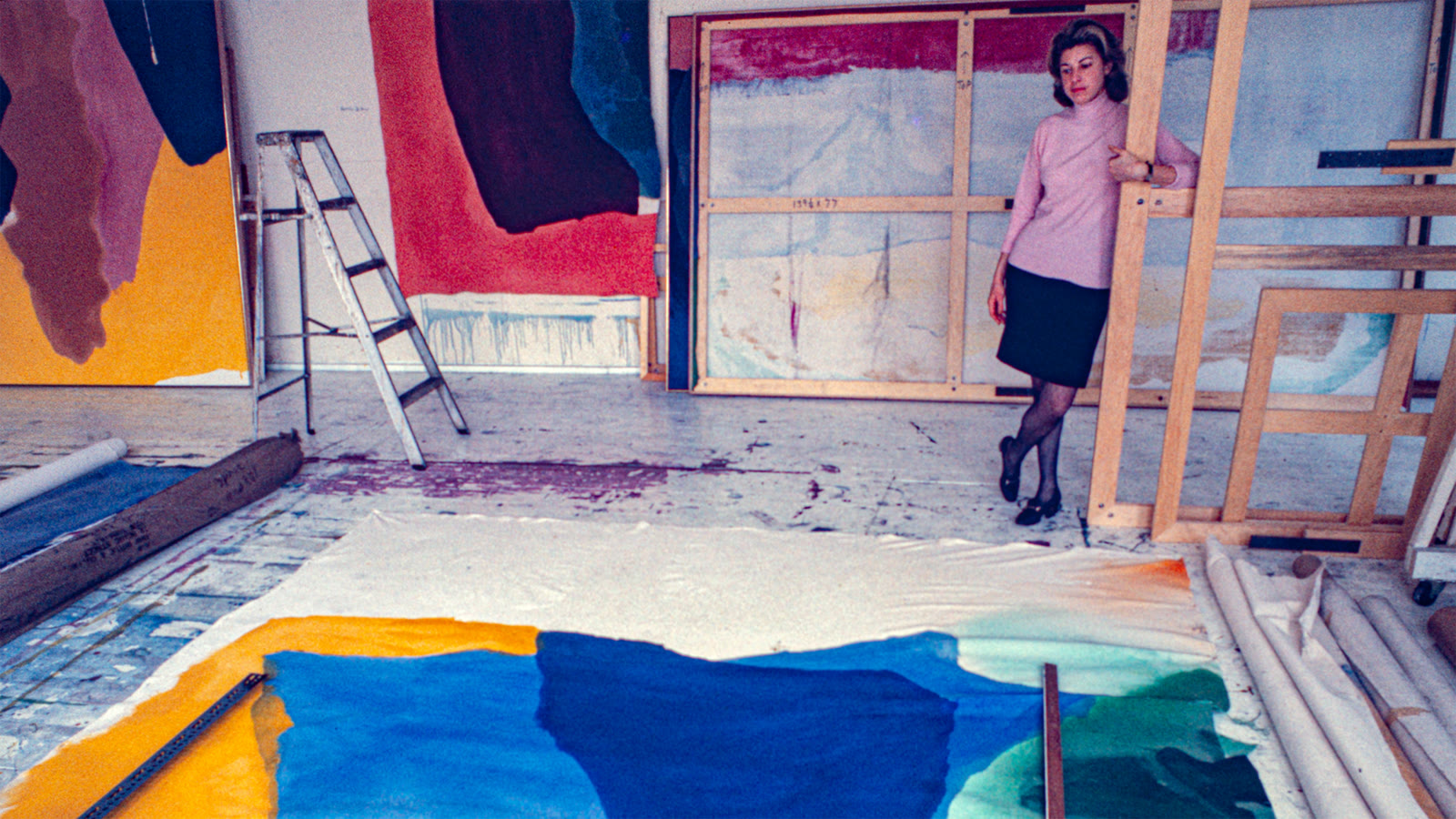
Image context: the cover uses The Met's studio photograph from the same archival package. It works because the room already contains the essay's central argument. Frankenthaler is framed not as a solitary author before one masterpiece, but as a figure positioned among wall-scale canvases, floor work, and splattered evidence of repeated adjustment.[2]
The provenance is clear. The Met visited Frankenthaler's New York studio in 1967, and the museum republished the footage in December 2025 through its From the Vaults series on both its own site and YouTube.[1][2] That republication matters because it turns a short studio portrait into an accessible primary source: a museum-backed record of how Frankenthaler wanted painting, space, and voice to meet on camera.
1) The floor is not background: it is the first compositional tool
The historical context has to begin with Frankenthaler's decision to put canvas on the ground. The Foundation biography stresses that in Mountains and Sea she worked on raw canvas laid flat, moving around it from all sides.[3] The Whitney page explains why that altered the medium so deeply: once pigment sinks into unprimed fabric, color stops behaving like a skin applied on top of the canvas and starts behaving like an event inside it.[4] Seen from that angle, the floor is not a convenient work surface. It is the condition that lets gravity, absorption, and edge formation join the act of composition.
The 1967 footage makes that condition visible in a way reproductions cannot.[1][2] Around the middle of the short film, Frankenthaler is shown kneeling into a large floor-bound canvas while immense vertical paintings stand behind her like temporary walls. That arrangement matters. The room is organized around two directions at once: downward toward the absorbent surface where liquid color spreads, and outward toward the upright canvases that will later confront viewers at eye level. The studio therefore becomes a conversion chamber. Frankenthaler works low, close, and bodily so that the finished painting can later appear spacious, open, and almost weightless.
This is why the footage corrects a common misunderstanding of stain painting. The method is often described with words like spontaneous, airy, or intuitive, and all three words can be true in part.[2][3] But the film shows that spontaneity here is engineered. Paint must be released quickly enough to stay alive, yet judged slowly enough that the whole field does not collapse into slack decoration. Frankenthaler is not merely letting color happen. She is setting up the physical circumstances in which color can happen intelligently.
2) The video turns distance into part of the technique
One of the most revealing things in the film is not any single gesture but the repeated shift between proximity and remove.[1] The camera gives close views of soaked color moving through fabric, then widens back out to Frankenthaler inside a room scaled by huge supports and open floor. Those changes in framing clarify something the written sources imply but cannot fully demonstrate. Stain painting is not only about touch. It is about distance management.
That is where Frankenthaler's relation to Pollock becomes more precise. The Whitney notes Pollock's influence on her decision to work horizontally, but the video suggests a different outcome for that choice.[4] Pollock's horizontality is often remembered as all-over propulsion, a surface activated by continuous attack. Frankenthaler's horizontality reads differently here. It creates room for pause, for watching seepage, for deciding whether an edge has opened enough or whether a pool has gone too dead. The painter must approach to release the color, then retreat to judge what the release has done.
Around the later close-ups, when the film lingers on translucent passages and sharply bounded color shapes, the soak-stain technique stops looking lyrical in any vague sense.[1] It looks material. You see how stain can leave one area diaphanous and another deeply held, how a contour can feel both soft and irrevocable. The Whitney's description of uneven absorption is crucial here.[4] The canvas does not receive color uniformly, so judgment cannot be uniform either. Frankenthaler has to read differences in saturation, spread, and pressure across the whole field. Distance, in other words, becomes part of the brush.
3) What the archival footage preserves is a transitional art history in bodily form
Frankenthaler is routinely placed between movements: after the first wave of Abstract Expressionism, before or alongside Color Field painting, adjacent to post-painterly abstraction.[3][4] Those labels are useful, but they flatten the lived problem the footage preserves. In the studio, transition is not a chapter heading. It is bodily logistics. One can see a painter inheriting the scale and freedom of postwar abstraction while refusing to let gesture thicken into heroic signature.
The Foundation biography helps explain why this mattered so much to later painters. It credits Mountains and Sea with immediate influence on Morris Louis and Kenneth Noland, artists central to Color Field painting.[3] The video lets that influence look less like stylistic succession and more like a redefinition of what a large abstract canvas could be. Instead of building pictorial force through accumulation of marks, Frankenthaler builds it through calibrated release. Instead of dramatizing the hand's pressure on the surface, she distributes pressure across the room: the floor, the body, the pool, the drying edge, the step backward.
That spatial redefinition also explains why the footage still feels contemporary. Museums and textbooks often present postwar abstraction as a sequence of recognizable surfaces: drips, stains, fields, bands. The archival film complicates that shorthand. It shows that Frankenthaler's paintings do not begin as images to be looked at frontally. They begin as environments of decision. Only later do they stand up, leave the studio floor, and become the expansive pictures that museum visitors meet on the wall.[1][2][3]
4) Why this short film matters now
The Met page says Frankenthaler reflects on life, art, and the evolution of her practice in her own words.[2] That is important, but the visual record is equally valuable. It gives viewers an art history that still has weight, mess, and orientation. You do not leave the film with a cleaner slogan about soak-stain painting. You leave with a more demanding sense of what the method required.
That is why this archival spotlight matters now. Frankenthaler's work is frequently praised for beauty, openness, and atmospheric ease. All of that is present, but the 1967 footage insists on the harder substrate beneath those qualities: a painter willing to build color through physically awkward positions, delayed judgment, and a room large enough to let decisions travel before they settle.[1][2][4] The archival value of the film lies there. It preserves the moment when Frankenthaler's paintings are still attached to the choreography that made them possible, and that choreography makes the pictures look tougher, riskier, and more spatially exact than their reputation sometimes allows.[1][3]
Sources
- The Met, "Helen Frankenthaler in her studio, 1967 | From the Vaults," YouTube video, published December 12, 2025.
- The Metropolitan Museum of Art, "Helen Frankenthaler in Her Studio, 1967" - From the Vaults feature page, published December 11, 2025.
- Helen Frankenthaler Foundation, "Biography - Helen Frankenthaler" - chronology and technique overview, including Mountains and Sea and later exhibition history.
- Whitney Museum of American Art, "Helen Frankenthaler" - artist page on stain painting, Pollock's influence, and Color Field context.