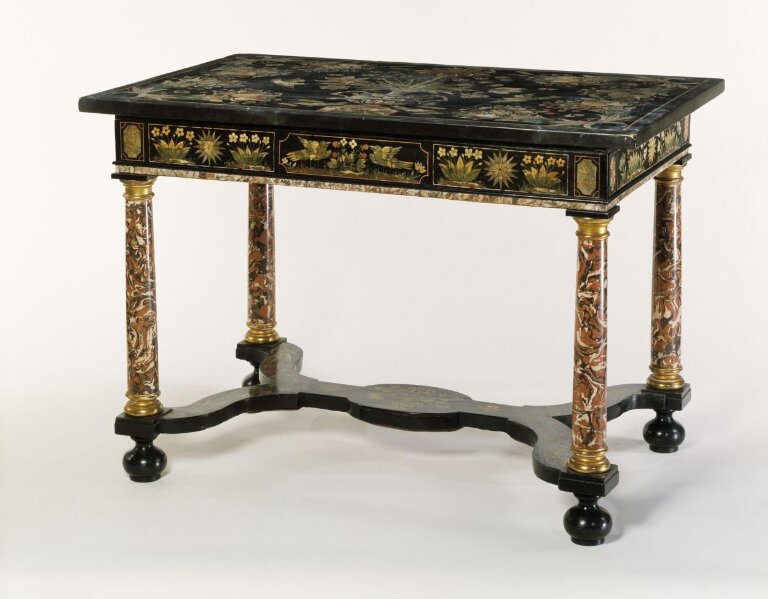
The Warwick Castle table offers two kinds of abundance: a garden of flowers, fruit, and birds, and the warm orange richness of what appears to be marble. Its decoration extends across the top, around the frame, and down toward the floor. The eye moves between things growing and stone standing still.
Much of that apparent stone began as paste. The V&A dates the table to about 1671, places its manufacture in England, and attributes it to Baldassare Artima, possibly working with Diacinto Cawcy. Its showy surfaces are scagliola: colored plaster worked and polished to resemble more costly materials.[1]
Knowing the substitution makes the object more interesting. A maker working in scagliola could compose the color as well as the pattern. The challenge was to make a yielding mixture acquire the visual confidence of stone—and to decide whether that mixture should become a wandering vein or the precise edge of a leaf.
Glue buys time
The material begins with gypsum. In its account of the Emilian tradition, the Museo Civico di Modena describes heating selenite, a crystalline form of gypsum, then grinding and sieving it. Water and rabbit-skin glue turn the powder into a workable mixture; the glue slows its hardening. Pigment supplies the color.[2]
The delay leaves room for judgment. The maker can position the mixture before hardening closes that opportunity.
Think of the difference between choosing a colored stone and preparing a colored paste. The stone offers a pattern already present in it. The paste gives the craftsperson another point of intervention. Color can be distributed deliberately before the surface is fixed.
Making a recess for the picture
For pictorial scagliola, the Opificio delle Pietre Dure describes a sequence that begins with a dried gypsum slab. The design is engraved into it, making shallow hollows. Colored liquid gypsum fills those recesses; after drying, the surface is polished, with animal glue used in the finishing process. The museum identifies tabletops, wall pictures, and altar frontals as important eighteenth-century applications.[3]
Imagine one petal. Its outline first becomes an absence, making room for another color. A graceful line is also the boundary between a cavity and its filling.
Smoothing and polishing give the surface a continuous finish. The flower looks weightless against its background; knowing the work involved gives that lightness a different appeal.
Historical practice was not uniform. Modena's museum presents two possible sequences reconstructed from seventeenth- and eighteenth-century documents: one introduces the black background after the engraved design has been filled; another establishes that background before cutting and filling the ornament.[2] These are alternatives in a regional account, not instructions we can confidently assign to every scagliola table.
The distinction also limits what a photograph can tell us. We can study the Warwick table's arrangement, but its finished appearance alone cannot recover every step of its manufacture.
Making a vein instead
A marble-like vein presents a different problem. Its credibility depends on irregularity: color should appear to wander through a material rather than obediently trace an emblem.
A University of Ljubljana heritage-science project describes one method used for stucco marble. Pigment is kneaded unevenly into a moist gypsum mixture, which is formed into a cylinder and sliced. Those slices are placed on a prepared support, then smoothed, ground, and polished. The support may be wood, stone, or plastered brickwork; oil or wax can complete the finish.[4]
Mixing begins the pattern; cutting exposes it. The artistic task is to make an arranged material retain the appearance of natural accident.
This is related to the engraved-and-filled picture, but it is a different procedure. One locates color inside a drawn boundary. The other distributes color through a mixture. Calling both scagliola should not erase that distinction.
A column at Belton House makes the material play especially clear. The National Trust records a scagliola shaft on a white marble base, one of a pair listed in the house's 1830 inventory. Its warm yellow-brown coloring comes from sienna earth pigment.[5] Manufactured stone-like color and actual marble can belong to the same object. The viewer encounters their relationship before learning their separate identities.
What the imitation makes possible
Scagliola's economy helped it travel beyond a single kind of patronage. Modena's museum connects its accessible materials and moderate cost to commissions from both large and small religious communities.[2] A richly patterned altar frontal could bring a language associated with expensive stonework into a parish with limited means.
The Warwick table occupies another social register. The V&A interprets it as furniture commissioned for display, with its orange legs imitating Siena marble.[1] Less expensive ingredients could still support conspicuous craftsmanship. Material substitution did not prescribe modest ambitions.
Nor does the resemblance settle how an object should be cared for. Ljubljana's research combines material analysis with workshop history and the study of deterioration, seeking treatments suited to stucco marble's particular construction.[4] The smooth face that encourages us to think “stone” conceals a more complicated assembly.
Return to the table with that assembly in mind. Follow a flower's edge, then let your attention drop toward a column. The pleasure is in recognizing two different visual ambitions sharing a polished surface: color held to a contour, and color allowed to drift. Scagliola gives both the apparent ease of something found in nature, after considerable work by hand.
Sources
- Victoria and Albert Museum, “The Warwick Castle table,” W.12:1, 2-1968 — object identification, attribution, materials, interpretation, and museum photographs.
- Museo Civico di Modena, “L'arte della scagliola” — Emilian materials, glue, reconstructed working sequences, and religious patronage; Italian and English text.
- Opificio delle Pietre Dure, “Scagliola” — the engraved-and-filled process, polishing, and uses of pictorial scagliola.
- Heritage Science Laboratory Ljubljana, “Stucco Marble Altars in Slovenia: Materials, Conservation, and Meaning” — veined stucco-marble manufacture and the project's conservation research objectives.
- Alice Rylance-Watson, National Trust Collections, “Sienna scagolia column,” NT 436770.2 (2018) — Belton House's composite column, pigment, and inventory evidence.