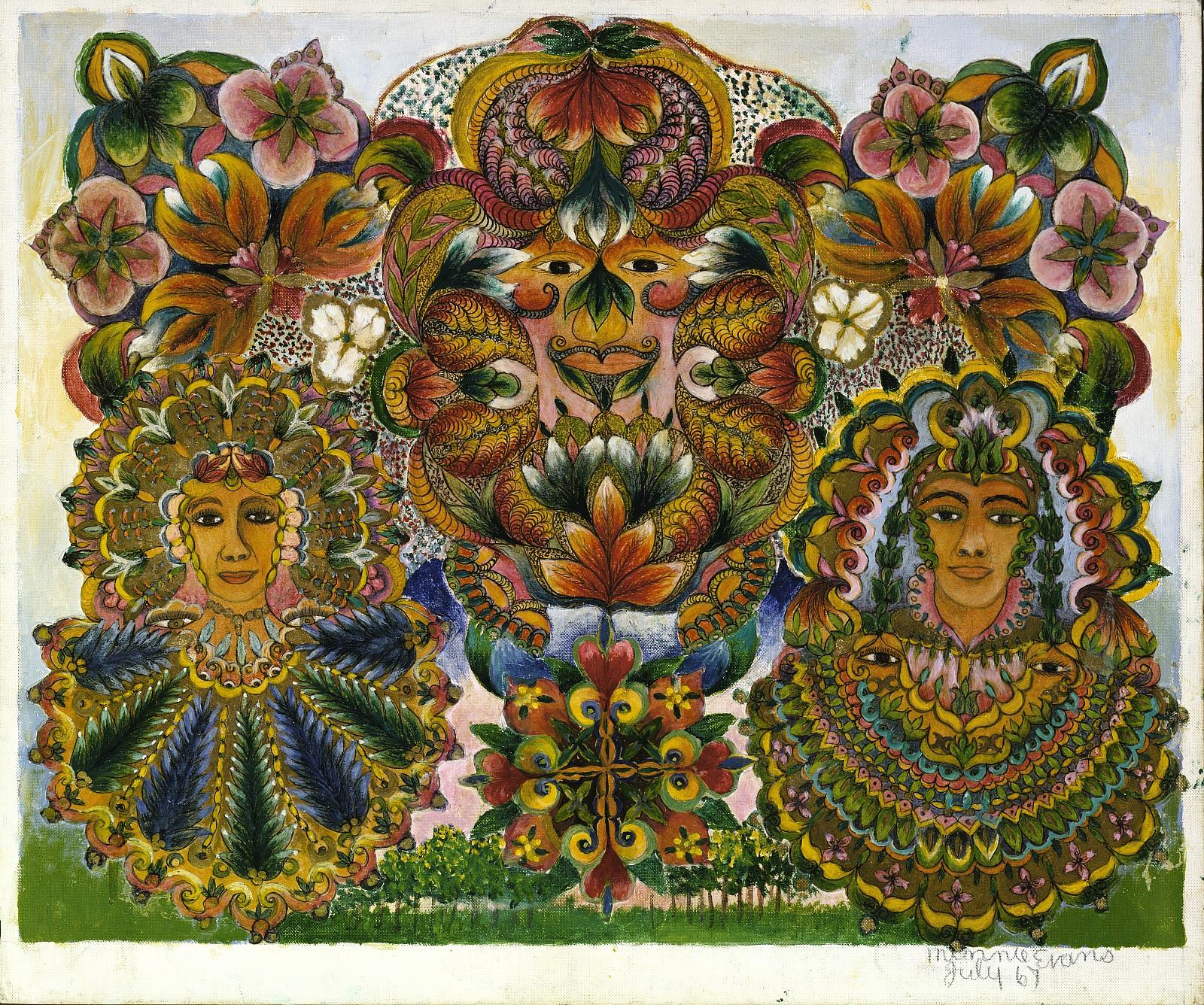
Image context: this is the Smithsonian American Art Museum's direct reproduction of Evans's 1967 painting, not a generated image or an explanatory graphic. The complete sheet, including its irregular painted edge and signature, is visible.[4]
At first, Design Made at Airlie Gardens appears to offer a single face. It rises near the center, pink and gold, beneath a headdress of leaves. Then the painting starts returning the viewer's attention from everywhere. Two more figures occupy the lower corners. Petals double as collars, feathers, scales, or eyelids. Small dark ovals hide inside the foliage. Even the bilateral structure will not hold still: the left and right sides rhyme, but they do not copy each other.
Minnie Evans made the painting in 1967, after nearly two decades of collecting admission at Airlie Gardens in Wilmington, North Carolina. Its title is literal, but not simple. The garden gave her daily access to flowers, live oaks, birds, ornament, changing light, and time in which to draw. It was also a cultivated estate where she had first worked in domestic service, and where beauty remained entangled with labor and the racial order of the Jim Crow South.[2][3][7]
That doubleness is the key to Evans's art. Her pictures can be radiant without being restful, symmetrical without becoming predictable, spiritual without turning into illustrations of doctrine. The Whitney Museum's current retrospective—the first major survey of her work in decades—brings more than one hundred drawings, paintings, and collages together as a world rather than a curiosity.[1][3] Evans had already supplied the better metaphor: a garden whose forms do not merely wait to be seen. They look back.
The gate was a job before it became a metaphor
Evans was born in 1892 in rural Pender County and grew up in Wilmington. She left school after the sixth grade and, as a teenager, entered domestic service on the estate of Pembroke and Sarah Jones. She married Julius Evans and raised three sons. Her path into art did not pass through an academy or a bohemian circle; it ran through paid work, family life, Christian faith, dreams, and a long practice of looking.[3][5][8]
Her first surviving drawings came much later. After the death of her grandmother Mary, Evans returned to a used sheet on which she had written a grocery order and began making circles, arcs, and tiny glyph-like marks. On Good Friday in 1935 she completed the drawing now called My Very First; another followed the next day. She later condensed the compulsion behind them into three severe words: “draw or die.”[3][8]
The phrase is memorable enough to flatten a life. It can make Evans sound as if she stepped fully formed from a vision, untouched by circumstance or sustained effort. She did not. She continued working for years while developing her pictures in ink, wax crayon, pencil, oil, collage, and scavenged material. A 2026 historical study by Melissa Story argues that the eventual move from exhausting domestic labor to the comparatively less consuming gatehouse role created a crucial margin of rest and creative time. That is a scholarly interpretation, not a claim that Airlie erased the pressures of Black women's work. It makes the opposite point: time to make art had material conditions.[7]
When the gardens opened to the public in 1948, the fifty-six-year-old Evans began taking admission at the gate. During quiet intervals she drew, and she displayed works on or near the wrought-iron entrance. Visitors bought or received them. The gatehouse therefore became studio, sales desk, and first gallery at once—an ordinary point of contact through which her pictures moved beyond Wilmington long before a museum certified their importance.[2][3]
Airlie was a material, not a backdrop
It is tempting to treat Airlie as a ready-made palette: azalea pink, live-oak green, coastal blue. Evans certainly absorbed its abundance. Her early singular flower and insect forms grew, by the 1960s, into crowded fields where human, botanical, and animal bodies interlock.[3] But she did not paint the garden as a view through a window. She dismantled its categories. A bloom becomes a face; a leaf becomes a wing; a human collar opens like a bed of petals.
The garden also entered the work physically. For Airlie Oak in 1954, Evans recovered skins of dried green and brown paint from cans used on the gatehouse, softened the fragments with turpentine, and built the tree's surface from the resulting pieces. The support was a wooden crate lid. In her drawings, the expansion of commercially available crayon colors similarly changed what she could do: the High Museum traces a movement from the restricted palettes of the wartime 1940s toward the explosive color of her later work.[2][3]
Calling Evans “self-taught” is accurate only if it does not become a synonym for unstudied. Airlie gave her a long education in repetition with variation. A cultivated garden repeats beds, borders, petals, and seasonal cycles, but no two leaves occupy the same history of weather and growth. Evans's mature symmetry works in much the same way. It is less a mirror than a trellis: a structure against which difference can climb.
Symmetry makes room for disquiet
In Design Made at Airlie Gardens, the largest head sits high in the center while two bust-like figures anchor the lower corners. The flanking figures are related, not identical. One wears dark blue leaf forms; the other carries green curls and a smaller face embedded at the chest. Between them, a compact winged shape spreads around two eye-like circles. The central face is calm, yet its surrounding loops resemble tendrils, feathers, intestines, and horns by turns. The composition offers order and immediately complicates it.[3][4]
The eyes sharpen that complication. Whitney curators propose several registers for their recurrence: Evans associated them with divine sight and with her visionary identity, while a contemporary historical reading also hears the pressure of surveillance on a Black woman working in the American South.[2] These meanings need not collapse into one code. An eye can promise protection and impose scrutiny. In Evans's paintings, seeing is rarely a one-way privilege granted to the museum visitor.
Her faces behave similarly. They are frontal enough to feel iconic, but too entangled with their settings to become conventional portraits. The High's exhibition materials note that the elaborate collars in Design Made at Airlie Gardens resemble Trinidadian Carnival and related Mardi Gras Indian dress, a connection made in relation to Evans's ancestral history.[3] “Resemble” matters here. Evans drew from family stories, Christianity, mythology, popular imagery, decorative arts, and daily observation; a responsible reading does not turn every visual echo into proof of a single direct source.[1][5]
The result is a world held together by affinity rather than taxonomy. Plant, animal, angel, ornament, and person share the same visual grammar. Symmetry gives that world a ceremonial poise. Unequal details, proliferating eyes, and hybrid bodies keep poise from hardening into peace.
Vision was a working method
Evans repeatedly described dreams and waking visions as the source of her pictures. Transcripts of conversations recorded by Nina Howell Starr preserve Evans's insistence that the finished works could remain “strange to me” too.[5][6] That admission is not a surrender of authorship. It describes an iterative process in which making could discover what advance planning did not contain.
Artist Alison Saar, looking at My Very First for the Whitney's guide, describes one mark calling forth the next: a loop creates an interior shape, repetition produces a new figure, and eyes arrive inside the structure.[2] This is a useful way past the false choice between supernatural dictation and formal intelligence. Vision supplied Evans with urgency and authority; responsive drawing supplied a method. Surprise was part of the craft.
The art world's labels have often made that process sound peripheral. Evans has been called folk, outsider, visionary, self-taught, and an “unconscious” Surrealist. Each term can reveal a context, but each can also define her mainly by distance from an assumed center. Evans complicated that framing herself. She titled a major 1963 painting Modern Art. In the Whitney guide, curator Barbara Haskell reads that title as evidence that Evans understood her work to belong inside twentieth-century American art, equal to anyone else's.[2]
Recognition crossed the gate in both directions
Nina Howell Starr met Evans at Airlie in 1962 and became a friend, advocate, photographer, and dealer. She helped bring the work into New York exhibitions, including a 1966 church presentation and Evans's solo exhibition at the Whitney in 1975.[3][6] Those events matter, but the familiar rescue story—unknown maker discovered by a metropolitan intermediary—misses half the traffic. Evans already had viewers. Garden visitors encountered her, acquired works, and carried her reputation outward; Starr entered a public that the gatehouse had begun.[2][3]
The institutional frame is shifting again. The High Museum organized The Lost World: The Art of Minnie Evans in 2025–26, the first major exhibition devoted to her since the 1990s. Its Whitney presentation opened on August 22, 2026, and runs through January 10, 2027.[1][3] The survey does more than enlarge her name. By placing early ink drawings, wartime images, gatehouse materials, radiant mandalas, and late collages together, it makes sustained development visible where the word “visionary” can imply an unexplained gift.
Evans's gate remains a powerful image because it separates and connects. At Airlie, it marked the line between worker and visitor, private estate and public garden, admission and exclusion. In her career, it also became a hinge between local exchange and museum recognition. Her paintings do not pretend those boundaries vanished. They make boundaries generative: an outline becomes another face, a collar becomes foliage, and a mirrored half returns altered.
There is no literal gate in Design Made at Airlie Gardens. The whole painting performs one. Its dense surface admits the eye slowly, then refuses to leave the viewer outside, looking in. By the time the central face has resolved, the flowers have acquired bodies and the ornaments have acquired eyes. Evans did not simply record a beautiful place. She gave the garden the power to meet our gaze.
Sources
- Whitney Museum of American Art, “The Lost World: The Art of Minnie Evans” — current exhibition overview, dates, work range, 1975 exhibition history, and retrospective framing.
- Whitney Museum of American Art, “The Lost World: The Art of Minnie Evans” digital exhibition guide (2026) — curatorial audio transcripts on Evans's process, eyes, gatehouse work, Airlie imagery, materials, and Modern Art.
- High Museum of Art, “The Lost World: The Art of Minnie Evans” (2025–26) — detailed exhibition chronology, object records, gatehouse circulation, material development, and interpretation of Design Made at Airlie Gardens.
- Smithsonian American Art Museum, “Minnie Evans, Design Made at Airlie Gardens, 1967” — official object record, dimensions, medium, credit line, gallery text, and source of the museum reproduction used here.
- Smithsonian American Art Museum, “Minnie Evans” — collection biography on her dreams, religious cosmology, recurring eyes, Airlie imagery, family history, and artistic development.
- Smithsonian Transcription Center and Archives of American Art, “Interview Transcripts with Minnie Evans,” April 1970, page 9 — a primary-source exchange with Nina Howell Starr in which Evans discusses Airlie's swans, recurring dream imagery, and her surprise at her own work.
- Melissa Story, “In Search of Minnie Evans's Gardens: Rest as Survival in the Jim Crow South,” Radical History Review, no. 154 (January 2026) — peer-reviewed analysis of labor, race, rest, and creative production.
- Museum of Modern Art, “Minnie Evans, Untitled, c. 1940” — official collection record and gallery text on her 1935 beginning, early materials, dream imagery, ancestry, and lack of formal art training.