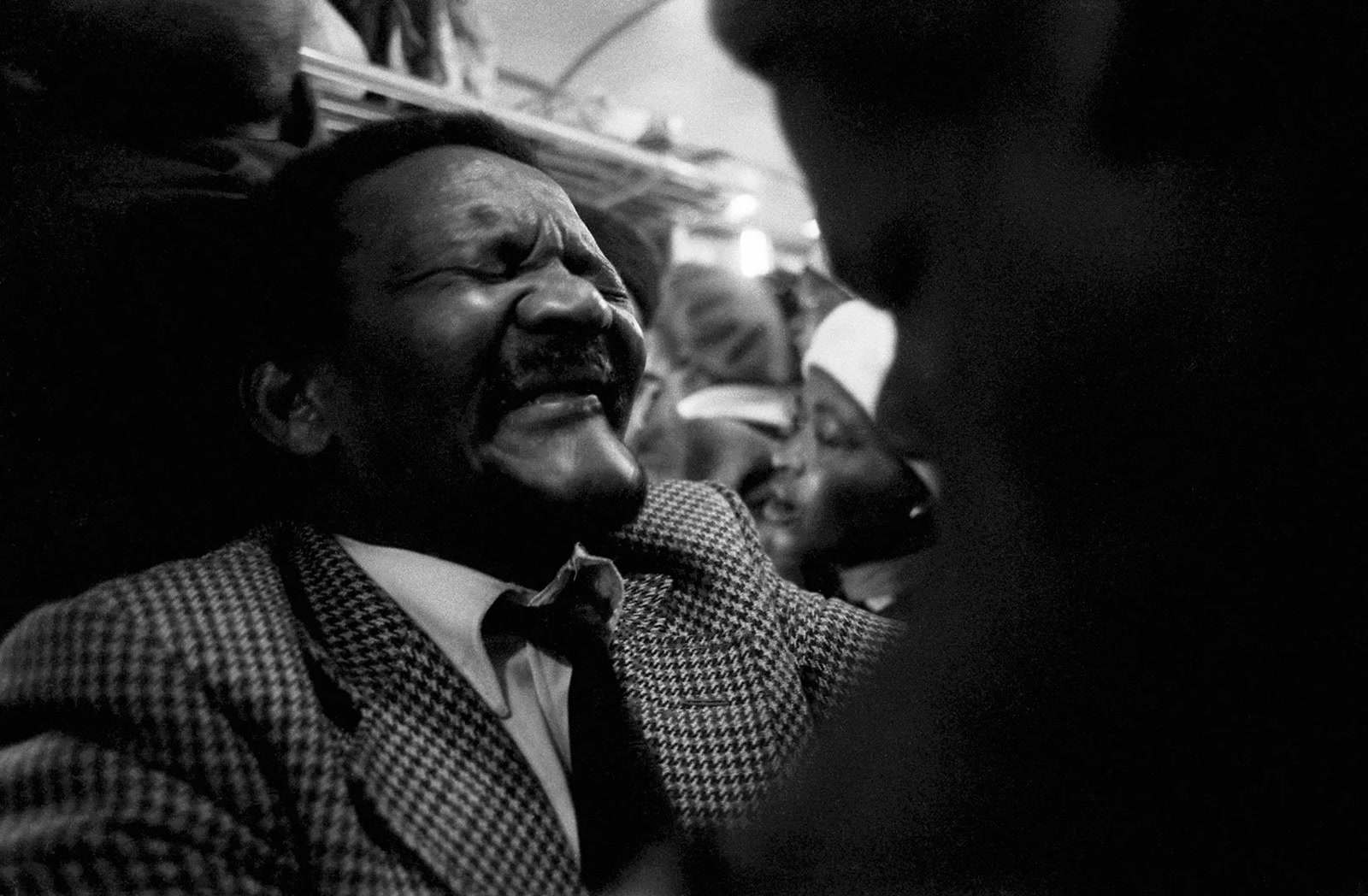
Image context: the cover is Mofokeng's actual 1986 photograph from a worship service on the Johannesburg-Soweto commuter line. It anchors the profile because the picture is exact about bodies, crowding, and place while remaining open about an experience the camera cannot settle from the outside.[1][6]
The man's eyes are shut. His mouth is open, his forehead tightened, his checked jacket pressed toward the camera by a crowd that continues beyond the frame. A second worshipper appears over his shoulder, while a dark, out-of-focus body closes much of the right side. Santu Mofokeng called the photograph Overcome/Spiritual Ecstasy. The slash is doing serious work. It offers two descriptions without pretending that either can fully name what is happening.
Made in 1986 as part of Train Church, the image records a service inside a Johannesburg-Soweto commuter carriage. It is documentary evidence: a person, a place, an event, a social system. Yet it cannot prove whether the central expression belongs to song, prayer, exhaustion, release, pain, or several of these at once. Mofokeng did not treat that limit as a defect. Across a career spanning street photography, photojournalism, archival research, portraiture, and landscape, he made the boundary of the photograph part of its intelligence.[1][2]
His pictures are often dark, grainy, occluded, or dependent on knowledge that lies outside the frame. But ambiguity in Mofokeng is never an excuse for vagueness. Locations are named. Histories are researched. Family testimony, captions, sequences, and artist texts accompany the images. Only then does he refuse the final verdict. His distinctive achievement was to make photography accountable to fact without confusing fact with complete understanding.
A documentary education, and a documentary doubt
Mofokeng was born in Soweto in 1956. He began making street portraits as a teenager, worked in darkrooms, and became a news photographer. In 1985 he joined Afrapix, the multiracial collective whose members documented apartheid, resistance, and the conditions of Black South African life. He worked at the New Nation newspaper in 1987, then spent 1988–98 as a documentary photographer and researcher with the African Studies Institute's Oral History Project at the University of the Witwatersrand.[2]
That route placed him inside photography's most urgent evidentiary tradition. Under apartheid, a clear picture of police violence, forced removal, protest, or deprivation could challenge censorship and official denial. The political need for such pictures was real. So was the danger that a global market for struggle images would turn Black life into a narrow repertoire of injury and confrontation. South African History Online describes Mofokeng as an internal critic of mainstream photojournalism and of the international picture economy through which Black South Africans were represented.[2]
His answer was not to retreat from politics into private beauty. It was to enlarge what counted as political evidence. A commute carried the geography of segregation. A family portrait carried a claim to self-presentation. A cave service carried relationships among belief, land, and belonging. An apparently empty landscape carried a history that might not announce itself to a stranger. The photograph became less like a prosecutorial exhibit and more like a meeting place between visible detail and situated knowledge.
The carriage is both route and sanctuary
Mofokeng's own account of Train Church begins with irritation and exhaustion. His journey to a darkroom job required a taxi, a train, another taxi, and a hitchhiked ride. Services in the carriage disturbed the few minutes in which he hoped to sleep. Looking longer changed the problem. He came to see train worship as the convergence of two structuring facts of South African life: compulsory commuting and pervasive spirituality.[1]
The distinction matters. These trains did not simply offer picturesque mobile churches. Apartheid's removals, resettlement, zoning, and migrant-labor system had separated Black homes from workplaces and made long, unsafe travel routine. Worship did not erase that imposed geography. It temporarily reorganized the carriage from within. Office cleaners, clerks, factory workers, and laborers turned transit time into collective song, clapping, preaching, and prayer.[1]
Mofokeng photographed close enough that no single figure can master the space. Heads interrupt heads; hands enter without explanatory bodies; the carriage roof bears down on the crowd. In Overcome/Spiritual Ecstasy, even the principal face is partly a question. The photograph's grain does not make the event unreal. It denies the clean distance from which a viewer might classify everyone at once.
This is where Mofokeng separates intensity from spectacle. The picture gives a viewer access to an instant but not ownership of another person's interior state. The title directs attention toward spiritual experience while its slash keeps interpretation provisional. What happened in the carriage is not unknowable. It is simply more than the camera can certify.
An album that looks back
Around 1989, while working as a researcher at Wits, Mofokeng began asking Black families for permission to copy studio portraits commissioned by their relatives between 1890 and 1950. The project eventually became The Black Photo Album/Look at Me: 1890–1950, presented as an eighty-slide black-and-white projection in 1997. Mofokeng scanned, enhanced, and retouched the inherited photographs, then interleaved them with names, family recollections, historical framing, and questions.[3][4]
The authorship is deliberately layered. Mofokeng did not take the original portraits. Unknown and named studio photographers made them; the sitters commissioned or accepted them; families kept, narrated, neglected, or discarded them; Mofokeng copied and sequenced them decades later. Calling the result an archive does not flatten those roles. It exposes how an archive is made through selection, custody, loss, and renewed attention.
The Walther Collection places the work against the colonial state's photographic apparatus: identification pictures, official documents, ethnographic types, and other images that rendered Black subjects as populations to classify and administer. The family portraits operate differently. Their painted backdrops, formal clothes, props, postures, and direct gazes show people participating in how they would appear. They do not stand outside colonial visual conventions, but neither are they reducible to official categories.[4]
That is why Mofokeng framed the slide show with questions rather than a triumphant correction. A4 Arts Foundation records his prompts about who is gazing, what the sitters aspired to, and whether their portraits reflected colonized ideals or challenged prevailing Western images of “the African.”[3] The force of the project lies in refusing an easy choice. Victorian studio conventions could be borrowed, desired, performed, and made locally meaningful at the same time.
Mofokeng's accompanying text notes that some families treated photographs as treasures and believed they held the subject's “shadow,” or essence; elsewhere, images disappeared through broken lineages, rejection, or neglect.[3] A photograph in this account is neither a transparent fact nor a mute object. It is a social thing whose meaning changes according to who holds it, names it, hides it, or asks it to speak again.
When the landscape withholds the event
Mofokeng carried the same discipline into landscapes and photographs of spiritual practice. In the long-running Chasing Shadows project, his subjects include prayer services, altars, worshippers, animals, rock faces, cave entrances, washing lines, and flood-marked ground around Motouleng and Mautse in the Free State. The foundation's sequence moves repeatedly between ritual action and the terrain that contains it.[5]
The shifts prevent two simplifications. First, belief is not reduced to the dramatic peak of a ceremony; it includes routes, thresholds, objects, weather, waiting, and inhabited space. Second, land is not treated as vacant scenery. A rock face can be geology, sanctuary, memory, and contested ground without the camera making all those relations equally visible.
His Landscapes of Trauma sharpen that problem. Mofokeng photographed sites marked by histories whose violence may leave no immediately legible spectacle in the present view. The Walther Collection preserves his compact formulation: “What is not in the photograph is in knowing.”[4][7] The sentence is not an alibi for weak images. It is an argument about spectatorship. Seeing historical ground responsibly requires more than retinal inspection; captions, memory, testimony, and political education become a second exposure.
This also explains why darkness in Mofokeng should not be romanticized as a mystical house style. Shadows can register literal working conditions, available light, film speed, weather, or the interior of a train or cave. They can also slow recognition and frustrate the demand for instantly consumable meaning. Their value comes from the relation between image and context, not from obscurity by itself.
Ambiguity after precision
Mofokeng's practice offers a demanding alternative to two familiar ideas about documentary photography. One says the photograph is self-sufficient proof: if the camera saw it, meaning is settled. The other says photographs are so constructed that they can prove nothing. His work occupies the harder ground between them.
The central worshipper in Overcome/Spiritual Ecstasy was present in a real carriage during a real service shaped by a real commuter system. The families in The Black Photo Album commissioned real portraits and preserved particular accounts of the people in them. The caves and fields exist in named places with religious, social, and political histories. Construction does not cancel those facts. It determines how carefully they must be approached.
Mofokeng therefore built context around the image while leaving interpretation breathable. A caption fixes a place, not a person's entire meaning. A sequence establishes relations, not a single verdict. An archive restores visibility while admitting gaps in lineage. A landscape can be accurately photographed and still withhold the history that makes it consequential.
That balance is why his work remains so useful. It asks documentary photography to be exact without becoming arrogant. It asks viewers to bring knowledge without assuming mastery. And it treats the unseen not as a license for fantasy, but as an ethical boundary: another person's belief, memory, or historical claim may be real even when the camera cannot turn it into complete proof.
In Mofokeng's photographs, the shadow is not where evidence ends. It is where responsibility begins.
Sources
- Santu Mofokeng Foundation, “Train Church” — primary artist account of the 1986 Johannesburg-Soweto series, forced commuting, worship in transit, and the source page for the cover photograph.
- South African History Online, “Santu Mofokeng” — biographical record covering Soweto, darkroom and news work, Afrapix, New Nation, the African Studies Institute, and his critique of mainstream photojournalism.
- Santu Mofokeng Foundation, “Black Photo Album” — official project page for the 1997 eighty-slide installation, its family-portrait sources, digital reworking, exhibition chronology, and Mofokeng's text on gaze, aspiration, and the photograph as a subject's “shadow.”
- The Walther Collection, “Mofokeng, Santu” — institutional essay on The Black Photo Album, the colonial photographic apparatus, family portraiture, and the knowledge carried by Mofokeng's landscapes of historical trauma.
- Santu Mofokeng Foundation, “Chasing Shadows” — official work sequence documenting worship, sanctuaries, landscapes, and everyday structures around Motouleng and Mautse.
- The Museum of Modern Art, “Santu Mofokeng, Overcome/Spiritual Ecstasy from the series Train Church, 1986” — collection record for the gelatin silver photograph used as the article image.
- Santu Mofokeng Foundation, “Landscapes of Trauma” — official series page identifying the sites, dates, and historical events that the landscape photographs require viewers to bring into the visible scene.