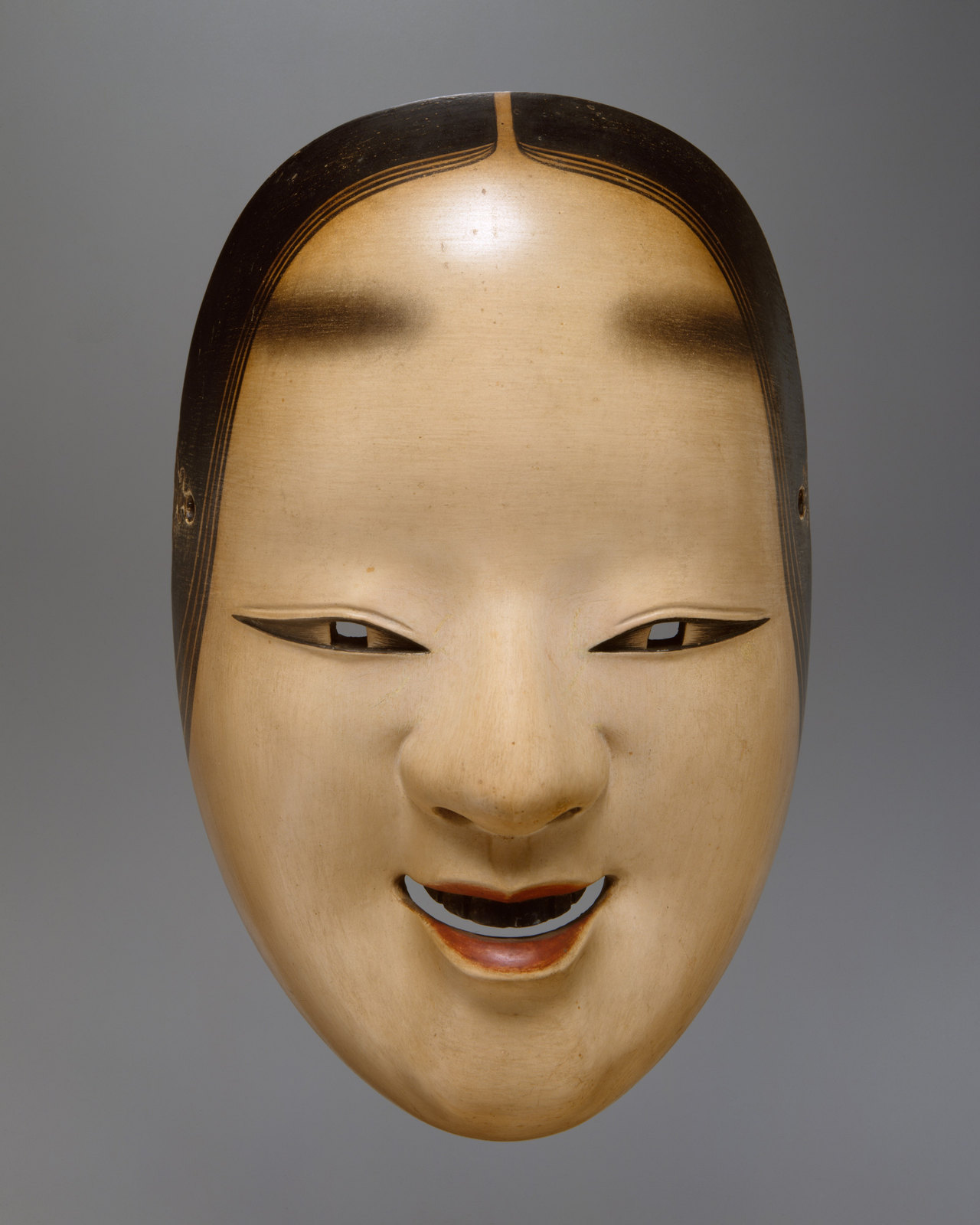
Image context: the cover is a museum photograph of the actual eighteenth-century Ko-omote mask discussed below. Its even light and frontal view are useful precisely because they withhold the stage conditions—tilt, moving shadow, costume, music, story, and audience position—that make a Noh mask appear emotionally alive.[1]
Look at the mouth first. In the museum photograph, its open arc readily suggests a smile. But the cheeks do not fully join it, and the narrow eyes hold something in reserve. Painted strands order the hair around a pale face whose apparent symmetry keeps yielding small differences the longer one looks. The expression is legible, but not settled.
The Metropolitan Museum of Art identifies this eighteenth-century Japanese object as a Ko-omote Noh mask. It is only 21.6 centimeters long and 14 centimeters wide, carved from cypress and painted in white, black, and red. Its shaved-and-redrawn eyebrows, blackened teeth, combed hair, and whitened skin refer to an aristocratic ideal associated with the Heian period. Ko-omote—literally “small face”—can represent a young woman or a supernatural being.[1]
Yet the museum photograph can make the mask seem more settled than it is. It presents one object, straight on, evenly exposed, detached from a body. In performance, the mask is not a portrait with a finished expression. It is closer to a score: materially fixed, carefully specified, and incomplete until several kinds of movement pass through it.
The usual explanation is delightfully simple. Raise the mask and it brightens; lower it and it clouds. That is true as a performance convention, but it is not the whole mechanism. A Noh mask borrows its face from the actor's posture, the light on its shallow carving, the rhythm around it, the architecture of the stage, and a spectator who has learned how to read restraint. The proof is a paradox: experiments confirm that angle and shadow change what viewers see, while also finding that isolated viewers can read those changes in the opposite direction from the theatrical rule.[2][5][6]
Neutral is not empty
Noh masks are often described as neutral, but neutrality here does not mean blankness. A carver has already narrowed the possibilities by choosing a type and giving it age, status, temperament, and degree of otherworldliness. Ko-omote belongs to a large family of masks for female roles. Other types distinguish mature women, warriors, old people, deities, demons, and spirits; a performer may still choose among appropriate masks for a role. The object therefore sets a field of possible expression rather than supplying one permanent emotion.[2]
The Ko-omote at the Met makes that field visible. Its mouth is small, but not a horizontal sign for “calm.” Its cheeks are smooth, but the modeled planes are deep enough to catch different shadows. The openings of the eyes are practical apertures and graphic marks at once. The white surface is not an untouched ground: it is a painted skin crossed by brows, hair, nostrils, teeth, and lips. What appears impassive from the front is a highly tuned arrangement of cues that can separate and recombine as the mask turns.[1]
This is why a mask type should not be treated as a detachable emoji. Ko-omote may establish youth and idealized beauty, but a play gives that face a history. The main actor, or shite, can embody a human figure, deity, demon, ghost, or other spirit. Noh joins chant, instrumental music, dance, costume, and stylized gesture; the mask enters that composite form rather than replacing an ordinary actor's mobile face with a simpler code.[4]
Even the language of wearing resists the idea of a prop pasted onto a performer. The specialist site the-Noh.com notes that actors speak of attaching or hanging a mask rather than putting it on like clothing. In the backstage mirror room, the actor faces the object before entering. The mask does not cover the entire head: part of the performer's chin or jaw can remain visible below it. A human body is never fully erased. It becomes the moving frame through which the carved face is read.[2]
To shine, to cloud
Two conventional actions give the beginner a way into this subtle system. In terasu, “to shine,” the actor angles the mask slightly upward, conventionally lightening the expression. In kumorasu, “to cloud,” a slight downward angle can register sorrow or crying. The movement is minute. Noh does not need the mask to nod vigorously toward happiness or grief; the point is to change relations among eyelids, lips, cheek planes, shadows, and the body beneath them without breaking the character's composure.[2]
The terms are more intelligent than a formula such as “up equals happy.” Shine and cloud describe conditions moving across a surface. Tilt can expose the lower face, deepen the upper eye sockets, lift the mouth in the spectator's view, or send a shadow under the lip. At the same time, a raised or lowered head changes the neck, chest, sleeves, and direction of attention. Optical change and embodied gesture arrive together.
There is also a practical constraint beneath the poetry. The mask's small eye openings severely narrow the actor's field of vision. The four pillars of the square Noh stage help a masked performer maintain orientation; the bridgeway from backstage is both an entrance route and a playing space. The Japan Arts Council describes a stage without a curtain separating actors from spectators and without large sets or theatrical effects. An empty platform becomes the world of the play, then returns to emptiness.[3]
That economy magnifies a small inclination. On a stage crowded with changing scenery and expressive lighting cues, a few degrees of head movement might disappear. On the cypress platform, framed by pillars and a painted pine, the same movement can feel consequential. Restraint is not a shortage of information. It is a way of controlling where information appears.
The experiment that breaks the neat rule
Laboratory studies make the mask more interesting because they refuse to turn tradition into an effortless law of vision. In 2000, Michael Lyons and colleagues tested photographs of a Noh mask at different vertical angles with Japanese and British participants. View angle systematically changed judgments of emotion, and cultural background moderated parts of the effect. The mask was not being imagined as mobile: a change in orientation really did reorganize the facial information viewers used.[5]
But the direction of those judgments did not simply reproduce terasu and kumorasu. In isolated images, participants often judged a downward-tilted mask happier and an upward-tilted one sadder—the reverse of the conventional stage description. Extreme angles and the visibility of the head's contour complicated the pattern further.[5]
A 2013 study by Nobuyuki Kawai and colleagues separated shadow from shape. Across two experiments, the researchers altered shadow information on frontal mask photographs and found that shadows alone could shift happy-versus-sad judgments. The original mask type also mattered. Yet this work again acknowledged the apparent reversal between common laboratory responses and theatrical convention: the visual effect of an isolated tilted mask did not amount to a universal dictionary for Noh emotion.[6]
This is not science correcting actors, or tradition overruling perception. The tests and the theater ask different questions. A laboratory presents an image, strips away the play, and requests an emotion label. Noh gives a spectator a character, text, chant, music, costume, pace, body, and sequence of actions. It asks the viewer to follow a transformation rather than diagnose a face at one frozen instant.
The discrepancy reveals where expression lives. Some of it is in the carved topology and its shadows; the experiments make that hard to deny. Some is in head and body orientation. Some is conventional: audiences learn that a restrained upward movement can brighten a dramatic state even if a cropped photograph prompts another first impression. And some is narrative. The same visual ambiguity can feel like composure before a revelation and like grief after it.
The mask is therefore not successful because it tricks every human eye in the same way. It succeeds because it remains responsive to a coordinated theatrical system.
Every seat receives a different face
Audience position completes the argument. A Noh stage projects into the seating area rather than sitting behind a proscenium picture frame. Seats directly in front offer the strongest view of mask effects, while side seats bring the spectator closer to the bridgeway. The impression of a tilted face must therefore vary with the angle from which it is encountered, even before individual experience enters the calculation.[2][3]
This makes spectatorship physical. A museum photograph can put every viewer at the same virtual center. A theater cannot. Someone near the bridgeway may feel the duration of an entrance and see more profile; someone facing the main stage receives frontal changes more clearly. Neither view is the master image from which all others are defective. Noh distributes the work across space.[3][7]
It also distributes agency. The carver does not determine the final face alone. The actor does not simply animate a passive shell. Light reveals the consequences of carving; costume enlarges a posture; musicians and chorus shape duration; architecture limits and directs sight; the play makes an inclination legible; the audience joins these cues into feeling. Expression is an achievement of relation.
That is what the frontal Ko-omote photograph preserves, even while it cannot show it. The object looks quiet because its possible movements have been suspended. Its ambiguities have not been solved; they have been stored. The mouth, cheeks, eyelids, and painted surface wait for another angle, another shadow, another body, another scene.
A Noh mask does not need to change its features. It changes the conditions under which a face can appear.
Sources
- The Metropolitan Museum of Art, “Ko-omote Noh Mask,” object 1993.341.1 — public-domain collection record and image metadata for the eighteenth-century cypress mask used as the cover.
- the-Noh.com, “Noh Masks” — specialist overview of mask history and types, performer selection, terasu and kumorasu, attachment in the mirror room, and restricted vision.
- Japan Arts Council, “Stage Structure,” Invitation to Nohgaku — official account of the square stage, pillars, bridgeway, mirror room, empty playing space, and performer orientation.
- The Nohgaku Performers' Association, “Noh for Beginners” — practitioner-led introduction to Noh as a musical drama of chant, instruments, masks, stylized movement, and human and supernatural roles.
- Michael J. Lyons et al., “The Noh mask effect: vertical viewpoint dependence of facial expression perception,” Proceedings of the Royal Society B 267 (2000) — experiments on angle, affect judgments, contour, and cultural moderation.
- Nobuyuki Kawai et al., “Shadows Alter Facial Expressions of Noh Masks,” PLOS ONE 8, no. 8 (2013) — experiments isolating the effects of attached shadow and discussing their tension with stage convention.
- the-Noh.com, “Stage” — specialist account of the bridgeway and auditorium sightlines, including the distinct mask and entrance views available from front and side seating.