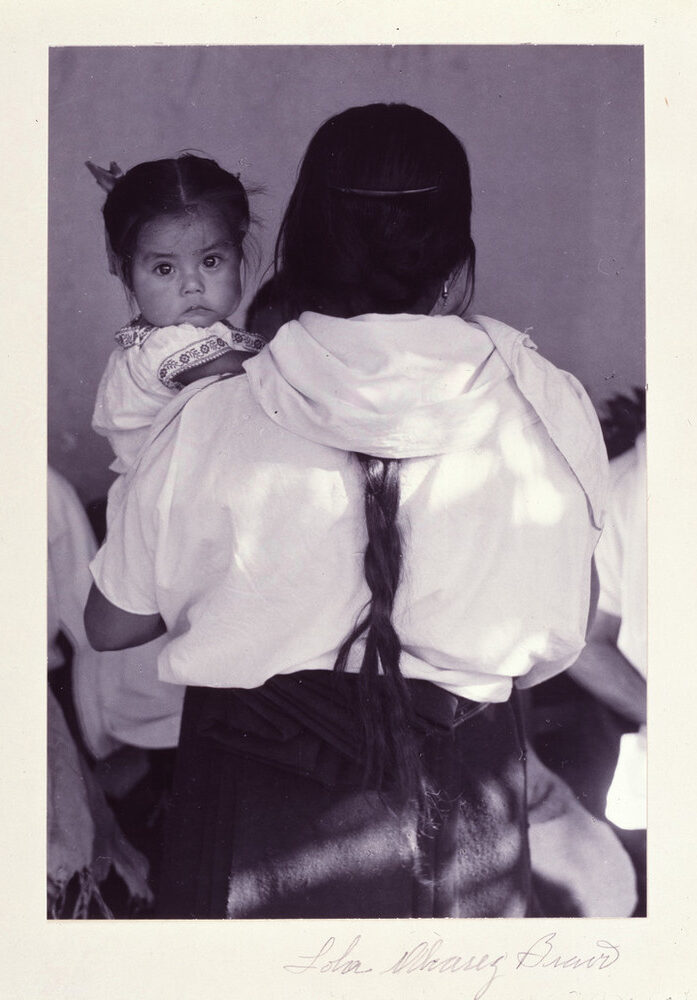
The child sees us. The woman holding her does not turn around. In Lola Álvarez Bravo’s De generación en generación, made around 1950, a long braid leads down a pale blouse toward a dark skirt. Other people enter as fragments at the edges. We are close enough to notice cloth and hair, but the woman’s face remains beyond our reach.[1]
The National Museum of Women in the Arts describes the scene as unposed and the composition as carefully planned.[1] Those qualities can coexist. A photographer can choose where to stand, wait, and frame a scene without arranging its people. For Álvarez Bravo, position became a way to explore human relationships.
A camera to work with
Álvarez Bravo learned developing and printing while assisting her husband, photographer Manuel Álvarez Bravo. They married in 1925 and initially shared equipment. According to the Center for Creative Photography, which holds her archive, access to the camera could be contentious; her own photographs took second place to his practice. After their separation in 1934, she used photography to support herself and their son.[2]
Equipment helped. As the New Orleans Museum of Art recounts, Tina Modotti sold her Graflex to Álvarez Bravo when leaving Mexico in 1930. Its portability freed her from working with a tripod and viewing hood.[3] That freedom changed where she could stand and how quickly she could respond.
Her subsequent working life included journalism, commercial photography, portraiture, and teaching. Alongside that employment, she identified a smaller body of photographs as her personal art.[2] That distinction helps us see a working artist making selections within a crowded professional life. The familiar museum photograph represents both an encounter in the world and a later decision that this particular encounter should endure.
Behind the performance
In an untitled photograph from about 1950 in New Orleans’s collection, four brass musicians appear from a backstage vantage. Curator Brian Piper draws attention to the overlapping lines and to the labor of the players. Álvarez Bravo approaches the performance from where its making becomes visible.[3]
An audience ordinarily receives a concert as an event directed toward it. This view brings us closer to people working together, with their own immediate tasks. In Piper’s reading, it gives those cultural workers prominence.[3] Position becomes the subject: where a person belongs in a situation, and where a camera might make that relationship felt.
Her institutional work gave her other forms of access. Mexico’s Instituto Nacional de Bellas Artes y Literatura records her photographic contributions to the educational magazine El maestro rural, her teaching at the Academia de San Carlos, and her leadership of the institute’s photographic department in the 1960s, documenting painters’ work. She also experimented with photomontage and photographic murals.[4]
These jobs enlarge the usual image of the solitary street photographer. She worked with artworks, publications, classrooms, and institutions as well as passing encounters. Each setting brought a different purpose for a photograph: a record to consult, an image to reproduce, an experiment to look at. Her range makes it difficult to treat documentary observation as a single, fixed method.
A portrait can keep something back
Her 1941 portrait El sueño shows the sculptor Isabel Villaseñor reclining on a tree trunk in Tenacatita, Jalisco, her eyes closed and her white dress spreading around her. The Musée cantonal des Beaux-Arts in Lausanne emphasizes the tension between the dreamlike atmosphere and the disciplined composition. It places the photograph within Álvarez Bravo’s portraits of women who helped shape Mexico’s cultural life.[5]
Here the named artist appears at rest. The portrait gives no demonstration of sculpting, no busy hands to explain a profession. Read beside the street pictures, it suggests that attention need not depend on catching someone in action. A body’s position can organize the whole encounter. The closed eyes also place a limit on it: we can study the photograph without receiving an answering look. That is an interpretation of the picture’s effect, rather than evidence of what Villaseñor was thinking.
Álvarez Bravo also helped determine how other artists reached an audience. From 1951 to 1958 she directed a gallery in Mexico City. In 1953 it hosted Frida Kahlo’s only solo exhibition in Mexico during Kahlo’s lifetime. Álvarez Bravo had already held her own first solo exhibition in 1944; her career continued until failing eyesight brought her photographic work to an end in the late 1980s.[6]
The gallery belongs in this profile because choosing what becomes visible was part of her work beyond the viewfinder. In a photograph, she positioned herself in relation to others. In an exhibition, she helped position their work before a public. These were different activities, but both required judgment about the encounter between an image and its audience.
The child’s glance connects us; the unseen adult face preserves its distance. Álvarez Bravo lets both experiences occupy one photograph.
Sources
- National Museum of Women in the Arts, “De generación en generación (From Generation to Generation)” — photograph, date, collection credit, and account of its unposed composition.
- Center for Creative Photography, University of Arizona, “Lola Álvarez Bravo” — shared equipment, separation, professional work, and selection of personal photographs.
- Brian Piper, “Object Lesson: Photographers Tina Modotti and Lola Alvarez Bravo and Mexican Modernism,” New Orleans Museum of Art, April 21, 2020 — the Graflex and the backstage view of musicians.
- Instituto Nacional de Bellas Artes y Literatura, commemorative account of Lola Álvarez Bravo, July 31, 2019 — magazine assignments, teaching, institutional photography, and experimental formats.
- Musée cantonal des Beaux-Arts, Lausanne, “El sueño (Isabel Villaseñor en Tenacatita, Jalisco)” — the 1941 portrait and its place among photographs of women in Mexico’s cultural life; French text.
- National Museum of Women in the Arts, “Lola Álvarez Bravo” — first solo exhibition, gallery activity, Kahlo’s 1953 exhibition, and the end of her photographic career.