Marina Abramovic's The Artist Is Present is often remembered through a single emotional shorthand: people sat across from the artist, looked into her eyes, and cried. That memory is not invented. It is part of the work's public afterlife. But the shorthand can make the piece sound like a museum-era empathy machine, as if its meaning came only from sentimental intensity. MoMA's short 2010 video is useful because it restores the harder structure beneath that response: a chair, a table, a fixed schedule, a queue, a silent artist, a changing stranger, and an audience watching a private encounter become public form.[1][2][3]
The historical setting matters. From March 14 to May 31, 2010, MoMA staged Marina Abramovic: The Artist Is Present, the first large-scale U.S. performance retrospective of Abramovic's work.[2][3] The exhibition traced more than four decades of interventions, sound works, video works, installations, photographs, solo performances, and collaborations with Ulay, while also presenting live reperformances of earlier pieces by trained performers.[2][3] At the center of that retrospective sat a new work by Abramovic herself. During public hours, she remained seated in the Donald B. and Catherine C. Marron Atrium and invited visitors, one at a time, to sit across from her for as long as they chose.[3]
That format looks minimal only if minimalism is mistaken for simplicity. The press release describes the work as Abramovic's longest solo piece to date and frames visitor participation as the condition that completes it.[3] The exhibition page explains the larger institutional problem: how a museum can represent, document, and transmit ephemeral, time-based, and media-based works without turning them into lifeless residue.[2] The Artist Is Present answered by putting documentation, reenactment, and live presence under the same roof. It made the museum hold both archive and event at once.
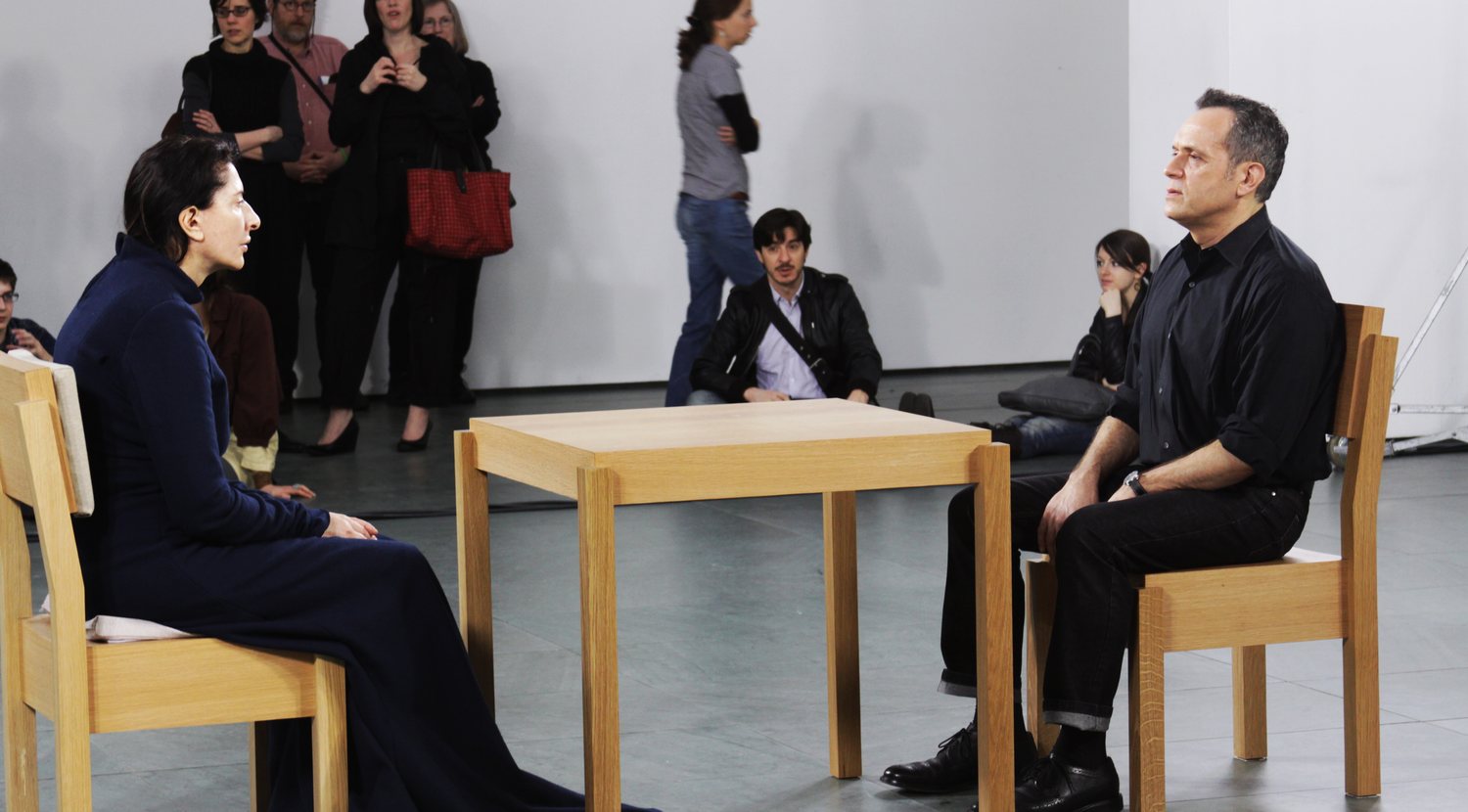
Image context: the cover image comes from a Wikimedia Commons photograph by Shelby Lessig of Abramovic performing the piece at MoMA. The photograph is a real 2010 performance view, and its value is descriptive rather than decorative: it shows the sparse furniture, the theatrical clarity of the atrium, and the way visitors become part of the visible situation around the seated pair.[5]
Video provenance
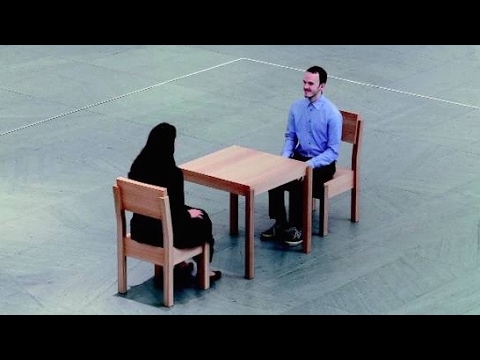
The embedded video is MoMA's official YouTube upload, Marina Abramovic: Live at MoMA.[1] It is a short institutional record rather than a feature documentary, and that brevity is part of why it works for an archival spotlight. The video does not try to explain Abramovic's entire career. It preserves a compressed view of the 2010 performance in situ: the white-lit atrium, the seated artist, the table, the participant's chair, the quiet exchange of looking, and the crowd positioned as witnesses rather than as background noise.[1]
What the archive lets us see
The first thing the video clarifies is that the work was spatially severe.[1] A more crowded stage would have softened the risk. Instead, MoMA's atrium leaves the action exposed. Abramovic and the participant face each other across furniture so plain that it becomes almost administrative: table, chair, chair. Around them, museum visitors form a perimeter. The result is not intimacy protected from the world. It is intimacy placed under conditions of public visibility. Each sitter enters a one-to-one encounter that is already being watched.
That exposure connects the new work to the retrospective's broader logic.[2][3] Abramovic's earlier performances often used the body as material, limit, instrument, and test site. MoMA's press release describes her practice as an exploration of physical and mental limits, with the artist's own body functioning as subject, object, and medium.[3] The Artist Is Present reduces that vocabulary until the body appears to do almost nothing. Yet the reduction does not cancel the test. It relocates the test into duration, stillness, social pressure, and attention.
The second thing the video shows is the role of the sitter's body.[1] The public mythology tends to center Abramovic's gaze, but the work is completed by the person across from her.[3] Some visitors arrive with ceremony, others with nervousness, still others with a visible need to compose themselves before entering the chair. The format gives them no script beyond sitting and looking. That lack of script is the point. The participant does not perform a skill. The participant becomes visible while trying to sustain attention in front of someone who will not rescue the situation with speech.
The third detail is the queue. The video gives glimpses of waiting bodies and surrounding spectators, and those glimpses matter.[1] A queue changes the meaning of the performance because it converts private desire into public order. People did not merely encounter Abramovic by accident. They waited, watched others sit, entered the chair, and then left the space for the next person. The structure made attention serial. One encounter followed another, and the museum became a device for distributing presence.
MoMA's audio material also helps keep the work from floating free of Abramovic's larger practice.[4] The playlist connects the 2010 retrospective to works such as Rhythm 0, Imponderabilia, Relation in Time, Rest Energy, Nightsea Crossing, Balkan Baroque, and The House with the Ocean View.[4] That sequence matters because The Artist Is Present did not arrive as an isolated gesture of stillness. It condensed decades of work around endurance, vulnerability, viewer responsibility, partnership, separation, and the problem of how a live act survives as art after the moment has passed.[2][3][4]
Why silence became public form
The most tempting interpretation of The Artist Is Present is psychological: the work gave people permission to feel seen. That is true as far as it goes, but the archive points to a more formal reading.[1][2][3] Abramovic did not simply offer attention. She built a situation in which attention had weight, cost, and witnesses. The visitor had to enter a marked space, sit still, accept silence, and stay before another person while being observed by strangers. The emotional force came from that structure, not from feeling alone.
This is why the table matters. It is a boundary and a bridge at once. In the photograph and the video, the table keeps the encounter legible: two people, opposite positions, shared axis.[1][5] It also prevents the gaze from becoming vague communion. There is a distance to cross and a limit to respect. The performance's generosity depends on that limit. The sitter receives attention without being absorbed into the artist, and Abramovic remains present without becoming conversational.
The work also changed the museum's usual tempo.[2][3] A visitor can often move through galleries by sampling: glance, read a label, step back, photograph, continue. The Artist Is Present slowed that logic until looking became the event itself. The artwork was not a picture of attention. It was an apparatus that required attention to happen in real time. The atrium, usually a passage space, became a chamber for duration.
That is the reason the official MoMA video still has archival value.[1] It cannot reproduce the experience of sitting in the chair, and it should not pretend to. What it preserves is the grammar of the event: how little material was used, how much pressure the format generated, how public the supposedly private exchange remained, and how the museum temporarily reorganized itself around a repeated act of looking.
Legacy
Seen from 2026, The Artist Is Present can look prophetic and vulnerable at the same time. It anticipated a culture in which faces, cameras, waiting lines, public emotion, and institutional spectacle would become tightly entangled. Yet the work also resists the speed of that culture. Its core action cannot be skimmed without losing its point. Someone sits. Someone else sits. Time passes. Nothing resolves quickly.[1][2][3]
The archival record keeps the work from turning into a meme of intensity. It shows a performance built from constraints: duration, silence, posture, mutual exposure, and the discipline of staying with another person's face.[1][3][4] The result was not endurance for endurance's sake. It was a public form for the fragile act of being visibly present with someone else.
Sources
- The Museum of Modern Art, "Marina Abramovic: Live at MoMA," YouTube video documenting the 2010 performance.
- The Museum of Modern Art, "Marina Abramovic: The Artist Is Present" - exhibition page for the March 14-May 31, 2010 retrospective.
- The Museum of Modern Art, "MoMA Presents the First Large-Scale U.S. Performance Retrospective of Marina Abramovic's Work" - 2010 press release describing the exhibition, live reperformances, and the atrium performance.
- The Museum of Modern Art, "Marina Abramovic: The Artist Is Present" - audio playlist connecting the retrospective to major works across Abramovic's career.
- Shelby Lessig, "ArtistIsPresent.jpg," Wikimedia Commons file page for a photograph of Abramovic performing The Artist Is Present at MoMA.