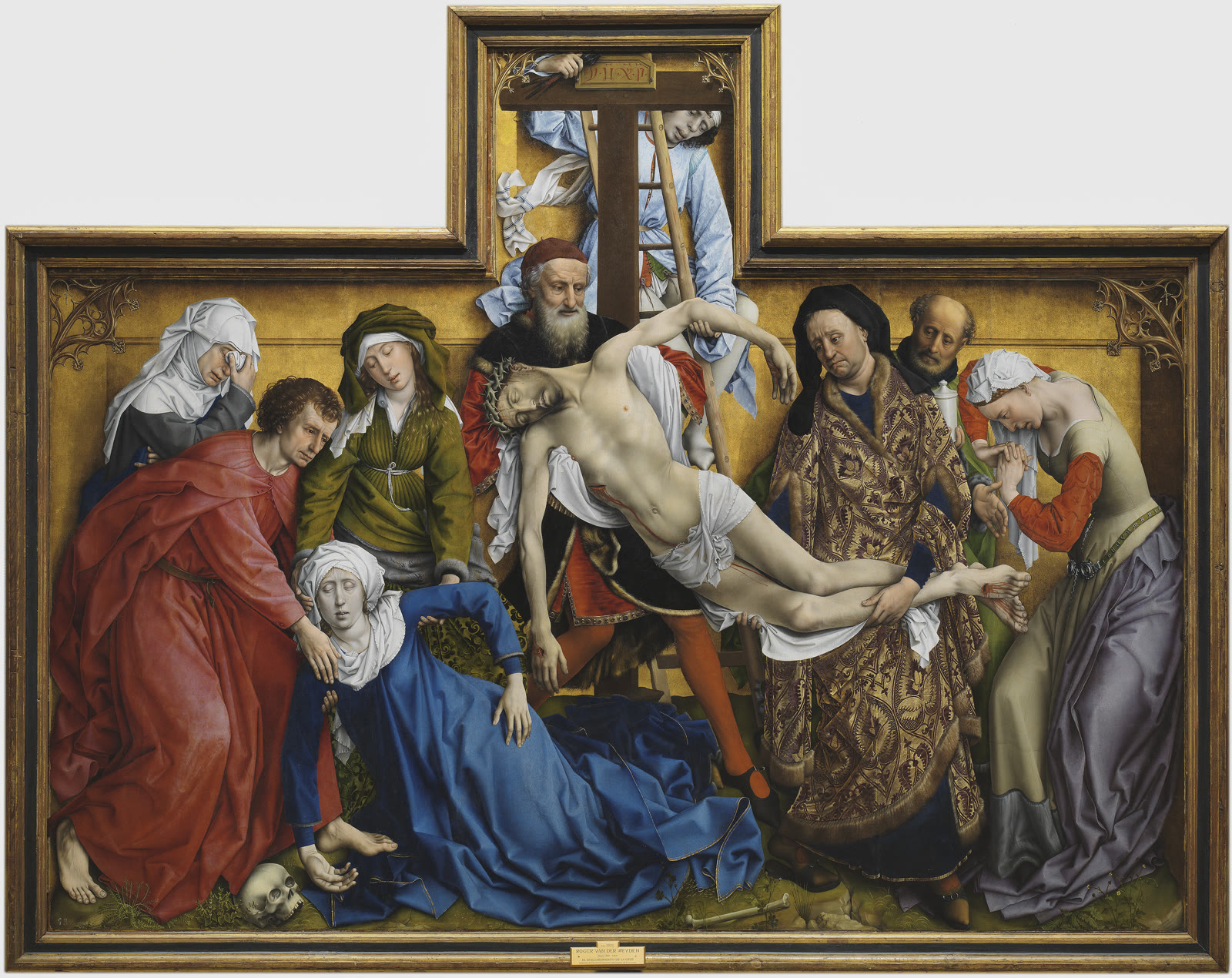
Rogier van der Weyden’s The Descent from the Cross is often introduced as one of the great paintings of grief in Northern Europe. That description is true and still too loose. The painting does not simply depict sorrow; it compresses sorrow into a box so tight that every body has to carry structural weight. The result is emotional force that feels less narrated than engineered.[1][3][4]
That engineering starts with the work’s physical premise. The Prado dates it to before 1443 and ties the commission to the Great Crossbowmen’s Guild of Leuven.[1][2] Smarthistory and Prado material both stress how insistently the figures are pushed toward the picture plane, as if they had been fitted into a carved shrine rather than released into open landscape.[2][3][4] The scene matters because of the biblical event, but it lasts in memory because Rogier treats the panel like a pressure chamber.
The box comes first
Before reading any face, it helps to read the enclosure. The figures occupy a shallow, gilded niche that feels closer to sculpted relief than to deep pictorial space.[1][3][4] There is almost no breathable distance behind them. Hats, arms, feet, and drapery crowd the front edge; even the ladder and the cross feel pressed into the same narrow register.
That choice changes the emotional temperature of the whole work. A deeper landscape would let grief disperse into air. Rogier refuses that release. He keeps the bodies close enough that each gesture becomes somebody else’s burden. The white shroud works like both practical cloth and visual sling, gathering Christ’s weight while also pulling the viewer’s eye across the center of the panel.[1][4]
This is why the painting can feel simultaneously ceremonial and immediate. Its gold background and careful framing carry devotional formality, yet the compressed space refuses distance. You are not invited to contemplate pain from afar. You are made to stand where it has no room to settle.
Mary is Christ’s visual echo
The painting’s most devastating decision is the parallel between Christ’s body and the Virgin’s collapse. Mary does not merely grieve beside him. She falls in a near-rhyming curve, pale and elongated, so that sorrow becomes bodily imitation.[1][3][4]
That echo is the picture’s emotional hinge. Christ descends from the cross in a slack, broken arc; Mary answers that arc with her own fainting body. The effect is not rhetorical excess. It is compositional logic. One body translates redemption into flesh, and the other translates witnessing into flesh. Rogier makes mourning readable as a structural correspondence rather than a side reaction.
The surrounding figures sharpen the effect by varying how grief enters the body. Saint John’s cloak snaps into angular red support at the left. Mary Magdalene bends low at the right with a concentrated grief that feels almost too tense to remain upright. Joseph of Arimathea and Nicodemus carry Christ carefully, but even their control looks strained by the scene’s narrowness.[1][3][4] No gesture is wasted because there is no excess space in which to waste it.
The commission is inside the composition
Prado’s material makes the guild context more than a footnote. The panel was made for the Leuven crossbowmen, and that civic identity enters the visual design itself.[1][2] The small crossbow motifs in the tracery are the most obvious sign, but the deeper effect is formal: Christ’s body has often been read in relation to the drawn curve of a bow.[2][3][4]
What matters here is not whether every viewer consciously registers that analogy. What matters is that Rogier binds patronage, devotion, and form into one system. The painting does not carry commission history in a caption-like way; it absorbs that history into rhythm and contour. This is one reason the panel feels so finished. Nothing is merely attached. Everything has been made to participate.
That integration also keeps the picture from dissolving into generic pathos. Many paintings can show tears. Fewer can make institutional identity, liturgical function, and bodily drama reinforce one another at the level of shape.
Surface keeps the scene bodily
Close-looking matters here because Rogier does not treat emotion as a vague cloud. He builds it through tactile exactness: polished tears, sharpened fingernails, metallic brocade, fur trim, beard texture, the taut white of the winding sheet, and the controlled fall of heavy drapery.[1][3][4] The surfaces make suffering specific.
This precision does two things at once. First, it raises the devotional stakes by insisting that sacred grief remains material. Second, it prevents the painting from turning into a sentimental blur. The sorrow is intense, but it is held inside a world of exact edges and disciplined color. Blues, reds, whites, golds, and flesh tones are arranged to keep the eye moving without letting the panel break apart.[1][4]
That balance is a major reason the picture survives reproduction so well. Even on a screen, you can feel the difference between a work that wants emotional immersion through blur and a work that reaches immersion through pressure, edge, and coordinated weight.
Why it still works in 2026
The painting still lands because it solves a problem contemporary images often mishandle: how to show collective emotion without letting the frame become noisy. Rogier answers by tightening the field. Every figure is individuated, but the panel reads as one continuous transfer of weight, grief, and attention.[1][3][4]
That is why the work feels carved into memory. Its power does not depend on surprise. It depends on compression. The box, the paired fall of Christ and Mary, the guild logic in the tracery, and the surface exactness all push in the same direction. The painting does not ask whether grief is real. It asks how form can make grief unavoidable.
60-second viewing drill
Try this sequence in front of the image:
- Lock onto the shallow box before you read the faces.
- Trace the curve of Christ’s body, then trace Mary’s and compare the two falls.
- Watch how the white shroud binds the center into one weight-bearing line.
- Check the corners and tracery for the commission logic that keeps devotion tied to guild identity.
- End on the surfaces: tears, cloth, metal, hair, and hands.
The painting usually grows harsher and more controlled on second pass. That is its real signature.
Sources
- Museo del Prado, The Descent from the Cross (collection entry with attribution, date, commission context, and object record)
- Museo del Prado, The Descent from the Cross (easy-to-read guide discussing the Leuven crossbowmen and relief-like presentation)
- Smarthistory, Rogier van der Weyden, Descent from the Cross (close-reading context on compressed space, Marian echo, and devotional force)
- Web Gallery of Art, The Descent from the Cross (object page with image details, dimensions, and subject summary)
- Wikimedia Commons, File:Weyden-descendimiento-prado-Ca-1435.jpg (image record for the reproduction used here)