
The Ghent Altarpiece is so famous that it often arrives pre-digested. Viewers know the Van Eycks, the scale, the stolen panel, the newly viral lamb face. What drops out of that summary is the thing that actually makes the object difficult and alive: it is not simply a 1432 masterpiece that survived into the present. It is a painting that has been handled, repaired, varnished, overpainted, reinterpreted, and physically re-situated for centuries.[2][3]
That is why MSK Gent's nearly two-hour lecture, "THE TURBULENT MATERIAL HISTORY OF THE GHENT ALTARPIECE," is worth the time.[1] Hélène Dubois does not treat conservation as a technical appendix to art history. She treats it as the only honest way to speak about the work at all. The Ghent Altarpiece, in her telling, is not a stable image with a few accidents attached. It is a layered object whose visual meaning has been repeatedly altered by damage, taste, liturgical change, and restoration decisions.[1][3]
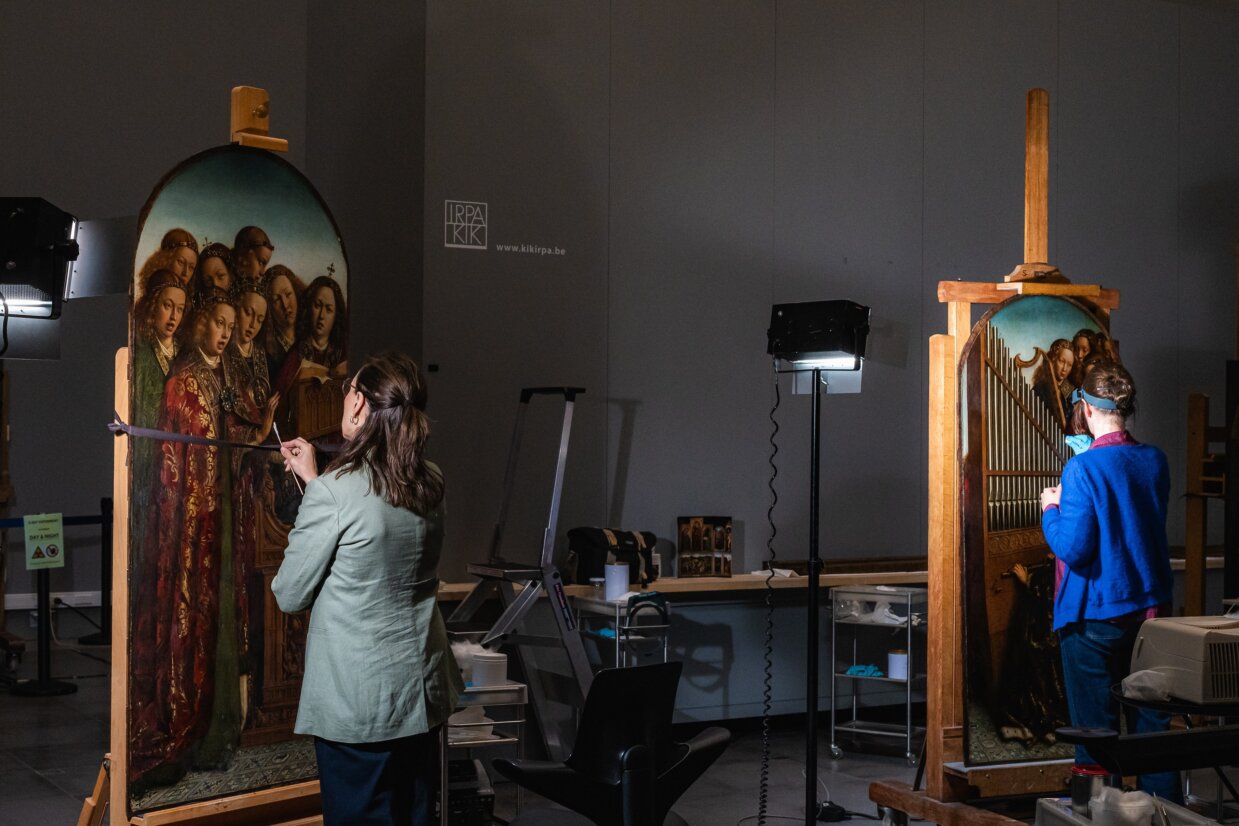
That framing also matches the way the work is currently being shown. MSK's restoration project makes the process public: the upper interior panels moved to the museum for the third phase, conservators work in a glass studio during the week, and the panels remain visible even when the restorers are absent.[2][3][5] Before you press play, that is the key premise to hold onto. You are not watching a museum explain a finished treasure. You are watching a museum explain why the treasure is still being negotiated.
Read the object as a history of interventions
Early in the lecture, Dubois makes the most useful shift a viewer can make: stop treating condition history as noise around the real artwork.[1] She walks through war, iconoclasm, theft, changing devotional settings, and restoration campaigns as part of the altarpiece's visible life, not as backstage events. That perspective lines up with the official restoration record. KIK-IRPA describes three linked modern phases: the closed polyptych in 2012-2016, the lower register of the opened polyptych in 2016-2019, and the upper interior register in 2023-2027.[3]
That timeline matters because it changes the question. Instead of asking, "What did the Van Eycks make?" the better question becomes, "Which layer of the object are we currently being allowed to see, and why?" For a work with this much devotional prestige and political afterlife, that is not a minor technical point. It is the core interpretive problem.
Around the 16-17 minute mark, the lecture becomes especially strong because it shows how cleaning can alter style judgments.[1] Dubois compares softened drapery forms shaped by later overpaint with the harder, more angular force of early Netherlandish pictorial structure. This is the kind of evidence that changes how you remember the work. "Gentle" or "monumental" are not neutral adjectives if broad passages have been literally softened by later hands.
The lamb reveal was not internet trivia
The best-known restoration result is the 2018 revelation of the original lamb on the central panel. KIK-IRPA states the point plainly: Jan van Eyck's original painting had been partially hidden under overpaintings for five centuries, and the original lamb looked very different once the 16th-century layers were removed.[3] The internet turned that into a before-and-after meme. The lecture restores the seriousness that the meme stripped away.
Dubois's argument is not merely that the old overpaint was inaccurate. It is that the overpaint belonged to a different visual and devotional logic.[1] In the lecture's middle section, she suggests that the altered morphology of the lamb may reflect a search for greater decorum, a wish to regularize an archaic and unsettling face into something more acceptable to later viewers.[1] That is a deeper point than "restorers found the weird original." It means restoration exposed a conflict between two standards of legibility: Van Eyck's frontal, piercing animal-Christ and a later culture's preference for smoother piety.
This is where the Ghent Altarpiece becomes especially modern. It reveals that authenticity is not only about chronology. It is also about tolerance for strangeness. A later repaint can feel more "correct" simply because it has already digested the image into familiar taste. Removing it does not make the work cleaner in a simple sense. It can make the work harder, sharper, and more conceptually demanding.[1][3]
Around 22-23 minutes, the lecture adds the technical hinge that keeps this from becoming mere theory: microscopic paint analysis showed overpaint layers separated from the original by oxidized varnish layers, indicating the pictures had already been varnished and restored before the later repainting campaign.[1] That sequence matters. It means the object was not protected and then suddenly falsified. It was repeatedly managed. The recovered image is therefore not an abstract original hidden under one bad decision; it is the visible survivor of a long chain of interventions.
Why the open studio matters
The current museum setup gives this argument architectural force. MSK tells visitors exactly what is happening: the conservators work Tuesday to Friday, the panels stay on view, and the public encounters restoration as a continuing act rather than a closed miracle performed offstage.[2] Visit Gent describes the same split public experience, with the upper interior panels visible at MSK during the current phase and both open and closed views integrated into the broader visitor route.[5]
That openness changes the contract between institution and audience. Traditionally, museums ask viewers to accept restoration outcomes as settled facts. Here, the museum turns conservation into a visible interpretive practice. Even the digital layer reinforces that move. The Closer to Van Eyck platform extends the first restoration phase through open-access imagery and promises further visual updates as restoration continues.[4] The implication is subtle but important: close looking is no longer reserved for specialists in the lab. The museum is teaching the public to look like conservators look, by comparing surfaces, layers, and states over time.
One of the strongest late moments in the lecture comes around the 65-minute mark, when Dubois says each restoration case has to identify additions individually and ask why the original was covered or transformed.[1] That is a disciplined position, not a purist slogan. It refuses both easy iconoclasm toward later layers and lazy reverence toward them. Some additions may carry history worth keeping. Others suppress exceptional pictorial quality without enough historical justification to remain. The point is to decide with evidence, not with sentiment.
What the video finally teaches
The Ghent Altarpiece looks stranger after cleaning because the restoration has reduced the amount of later smoothing between the fifteenth century and us. That is the real value of this video. It does not flatter the viewer with a masterpiece already explained. It shows how a canonical object becomes less comfortable when you remove the habits that accumulated around it.
If you watch the lecture in that spirit, the headline revelations fall into place. The lamb is not a curiosity. The glass studio is not museum theater. The overpaint is not just a mistake. All three belong to one larger lesson: great works do not travel intact through time. They arrive through argument, and sometimes the highest-quality restoration is the one that returns argument to the surface.[1][2][3][4]
Sources
- MSK Gent, "THE TURBULENT MATERIAL HISTORY OF THE GHENT ALTARPIECE," YouTube lecture by Hélène Dubois.
- MSK Gent, "Restoration of the Ghent Altarpiece" — live restoration schedule and public viewing setup.
- KIK-IRPA, "Restoration and research of the upper register of the interior of the Ghent Altarpiece" — restoration phases, overpaint findings, and current technical challenges.
- Closer to Van Eyck, official restoration portal — open-access imaging and restoration-phase context.
- Visit Gent, "The Ghent Altarpiece" — current public viewing logistics across Saint Bavo's Cathedral and MSK Gent.