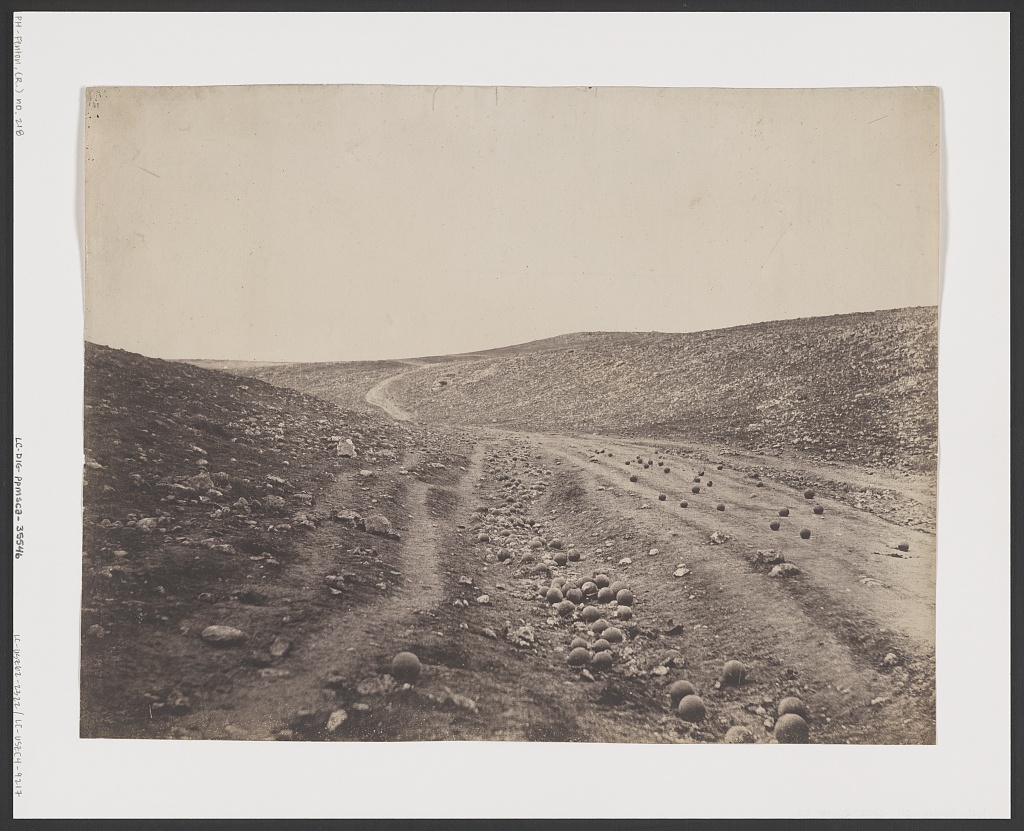
Image context: this post uses a real archival photograph from the Library of Congress, not a diagram, chart, generated image, or symbolic war graphic. The image is the artwork under discussion: Roger Fenton's 1855 The Valley of the Shadow of Death, a salted-paper print from the Crimean War.[1]
Roger Fenton's The Valley of the Shadow of Death is almost shockingly empty for one of the most famous early photographs of war. No soldier lies in the road. No gun fires. No smoke rises. The picture gives us a dirt track, a ravine, pale sky, rough slopes, and cannonballs scattered across the ground. Its violence is displaced into objects and terrain. The battlefield has become a surface after action, and the viewer is asked to read damage without being handed a body.[1]
That absence is not a weakness in the image. It is the image's intelligence. The Library of Congress record identifies the work as an 1855 salted-paper photographic print measuring 28 by 36 centimeters, with the plain summary: a dirt road in a ravine scattered with cannonballs.[1] MoMA's collection record adds the process detail: a salted paper print from a paper negative.[2] Those facts matter because the photograph's low, dry atmosphere is inseparable from its material behavior. Salted paper softens edges, absorbs light, and gives the scene a grain of historical distance. The road looks less like a stage than like a scar.
The Road Does The Human Work
The composition is simple enough to feel inevitable, but it is not passive. The road enters from the lower foreground, bends slightly, and pulls the eye into the valley. Its ruts are not dramatic, yet they give the photograph its plot. You follow the track because nothing else offers a human path. The cannonballs interrupt that path, lying in the roadbed and along the sides like hard punctuation marks. They are small enough to be countable and numerous enough to stop counting.
Fenton's choice to keep the horizon high and the road central gives the scene a strange bodily scale. There are no figures, but the picture keeps implying movement: a wagon could pass, a soldier could walk, a battery could fire from outside the frame. The road becomes a proxy for all the people missing from the image. It carries their likely direction, their vulnerability, and their exposure.
The Metropolitan Museum of Art's account of Fenton's 1855 Crimean War work places this photograph among portraits of commanders and soldiers, views of Balaklava Harbor, allied camps, and battle terrain. The Met calls Valley of the Shadow of Death one of the most understated yet moving images from that campaign: a barren landscape littered with cannonballs.[3] That understatement is exactly the point. Fenton does not show battle as spectacle. He shows a place where battle has made the ordinary act of using a road feel unsafe.
The Photograph Knows What It Cannot Show
By later war-photography standards, the image can look evasive. There is no front-line action, no casualty, no ruined building, no visibly suffering subject. But the limits are historical as well as aesthetic. Musee d'Orsay's object page stresses that Fenton's Crimean photographs were an important development in war reportage, while also noting that technical and ideological constraints kept him from producing images of combat or the dead.[4] The equipment was large, exposure times were slow, and the culture of public war imagery did not yet expect the graphic immediacy that later photography would make familiar.
The work therefore belongs to an earlier grammar of war representation. It does not say, "Here is the event." It says, "Here is the place after the event has passed through." That is why the emptiness feels so charged. The ravine is not neutral landscape. It is a mute witness. The cannonballs function almost like captions made of iron, telling the eye that this was not simply a rough track through Crimea but a zone of repeated shelling.
The title intensifies that reading. The Valley of the Shadow of Death pulls the photograph toward Psalmic and literary resonance, while Musee d'Orsay connects the image's reception to Tennyson's The Charge of the Light Brigade and the British army's language for a deadly valley.[4] The title gives the road a moral weather. Yet the picture itself stays stubbornly material: stones, dirt, ball, slope, sky. That tension between verbal grandeur and visual dryness is one reason the photograph lasts.
The Cannonballs Are A Problem, Not Just A Detail
The most famous question around the image is whether the cannonballs were moved. Public Domain Review summarizes the debate around the two related exposures: one version shows cannonballs in the ditch but not on the road; the better-known version places them on the road too.[5] Errol Morris's later investigation, as recounted there, argued that the road version was likely made second and that the scene was arranged. Musee d'Orsay, by contrast, notes the accusation but says such staging was unlikely because fighting nearby would probably have prevented it.[4]
The article does not need to resolve that dispute to read the photograph closely. In fact, the dispute belongs to the work's meaning. If the cannonballs were placed or rearranged, the photograph becomes an early example of documentary truth under pressure from composition. If they were not, the image still shows how a camera turns a dangerous scene into an ordered frame. Either way, the picture forces a modern question: when does arrangement clarify reality, and when does it replace it?
That question is not a gotcha. Fenton was not working with a handheld news camera in the twentieth-century sense. Public Domain Review points out that the nature of his equipment meant he could photograph stationary objects, posed people, and landscapes more readily than active battle.[5] The camera's slowness shaped the war it could show. The result is not pure immediacy, but neither is it mere fiction. It is a photograph trying to make war visible through what remained still long enough to be photographed.
Absence Can Be A Form Of Pressure
The photograph's power comes from refusing the viewer's easiest emotional path. A corpse would tell us where to look and how to feel. A heroic soldier would organize the scene around courage or sacrifice. Fenton gives us neither. He leaves us with an unpeopled road and a scatter of munitions. That makes the image colder, but also more durable. It asks the viewer to imagine what the camera did not or could not record.
The dry tonal range helps. The salted-paper surface does not slice the landscape into hard modern contrast. It lets dust, sky, and hillside sit close together, as if the whole scene had been bleached by exposure and danger.[1][2] The cannonballs interrupt that softness. They are the darkest, densest facts in the picture, small material certainties against an otherwise exhausted landscape.
This is why The Valley of the Shadow of Death should be read as more than a historical milestone in war photography. It is a work about the ethics of looking at aftermath. Fenton's road does not show us death directly. It shows us the route by which death could enter, leave, and return. The absence of bodies keeps the photograph from becoming a spectacle, but it does not make the image gentle. It makes the viewer supply the missing time.
Seen closely, the picture is not empty at all. It is full of withheld action: shells that have landed, soldiers who have moved on, equipment that waited outside the frame, a photographer arranging a heavy camera in a place that could not be safely occupied for long. The road carries all of that without becoming theatrical. Its quiet is the quiet after noise, not the quiet before it.
Fenton made an image that still feels modern because it understands that documentary photographs do not simply deliver facts. They arrange access to facts. In this case, access comes by way of a barren road, a disputed scatter of cannonballs, and a title that turns terrain into mortality. The photograph asks us to look at war when war has stepped out of sight and left the ground to speak.
Sources
- Library of Congress Prints & Photographs Online Catalog, "The valley of the shadow of death" - object record and digital image source for Roger Fenton's 1855 salted-paper Crimean War photograph.
- The Museum of Modern Art, "Roger Fenton. The Valley of the Shadow of Death. April 23, 1855" - collection record identifying the medium, dimensions, object number, and photography department context.
- The Metropolitan Museum of Art, "All the Mighty World: The Photographs of Roger Fenton, 1852-1860" - exhibition overview of Fenton's career, Crimean War photographs, and artistic range.
- Musee d'Orsay, "The Valley of the Shadow of Death - Roger Fenton" - object page on the print, Crimean War reportage, title context, technical limits, and staging question.
- The Public Domain Review, "Of Chickens, Eggs, and Cannonballs: Roger Fenton's Valley of the Shadow of Death (1855)" - account of the two exposures, cannonball-staging debate, and Errol Morris investigation.