
Lorna Simpson's 2025 Met exhibition Source Notes is easy to misread if the paintings are treated as a late-career departure from the photo-text works that made her reputation. The Met's own framing points in the other direction. The exhibition was the museum's first to consider the full shape of Simpson's painting practice, with more than 30 works and a focus on the previous decade, but the materials still begin with images that already circulated in public culture: vintage issues of Ebony and Jet, Associated Press photographs, and Library of Congress sources.[3][4] The medium changes. The problem does not. Simpson is still asking what a picture appears to know, what it hides, and who gets trapped inside its claim to evidence.
That is why the short Met video is useful as more than a studio visit.[1][2] It lets the viewer see Simpson preparing the exhibition while also making the paintings feel continuous with her older conceptual method. The works are not illustrations of an archive. They are encounters with images that have been cut, screen-printed, painted over, submerged, iced, enlarged, and made unstable. In an art market that often rewards a clean story of reinvention, Source Notes offers a harder one: Simpson's painting practice looks new because it has found a different pressure point for the same questions about Black representation, gendered looking, and the historical burden of photographic surfaces.[3][6]
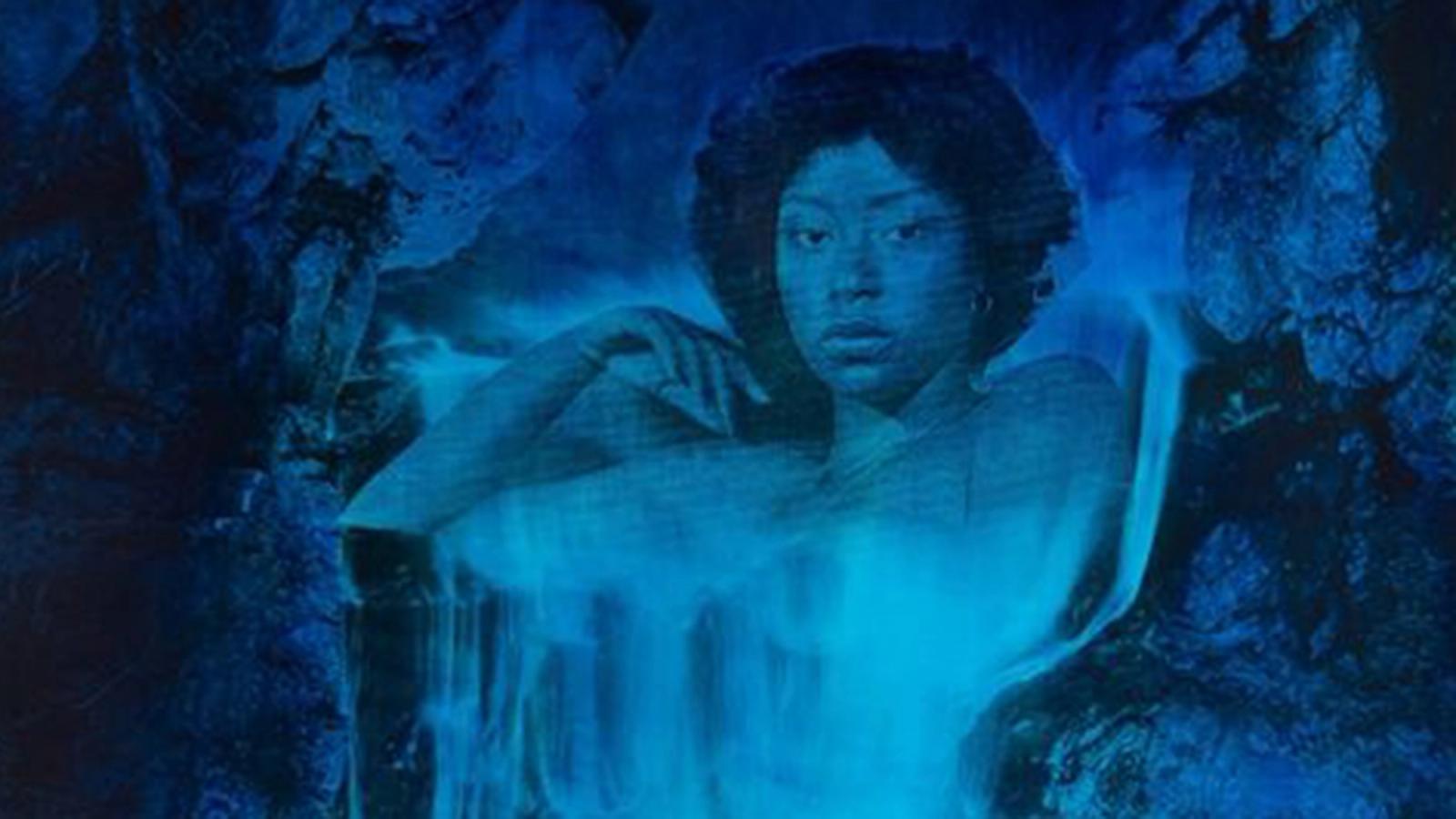
The video below is best watched with one question in mind: when Simpson moves from found photograph to painting, does the image become clearer, or does it become less willing to perform as proof?
Watch the source image refuse a single job
The first thing to notice is that the video does not present painting as escape from photography.[1][2] It shows a studio practice in which photographic source material remains active even after the surface becomes lush, blue, icy, gestural, or abstracted. The Met exhibition page describes Simpson's process as screen-printed collage combined with ink and acrylic on supports such as fiberglass, wood, and Claybord.[3] That description matters because it prevents the paintings from being reduced to expressionist mood. The image is not simply painted from memory. It is physically carried into the work through print, transfer, layering, and overpainting.
For Simpson, that technical fact is also an ethical one. A found image already has a social life before she touches it. A magazine photograph from Ebony or Jet can carry aspiration, style, glamour, racial politics, consumer address, and private longing all at once. An Associated Press photograph can carry the authority of news even when it withholds the complexity of the person pictured. A Library of Congress image can arrive under the sign of national memory while still bearing the exclusions of the archive.[3][4] Simpson's paintings do not resolve those tensions. They slow them down until the viewer has to sit with the instability.
This is the central viewing note for the video: do not look only for the moment when a source becomes a finished artwork. Look for the hesitation built into the surfaces. The figures often appear and disappear at the same time. Bodies are partial. Faces are occluded, turned away, dissolved, or made secondary to hair, water, ice, and atmospheric fields. The Met's exhibition text emphasizes this movement between figuration and abstraction, with bodies emerging and receding rather than settling into plain visibility.[3] In the video, that means the studio footage should be read as a record of refusal. Simpson is not making the archive more legible. She is making its claim to legibility harder to trust.
The older photo-text logic is still inside the paintings
The paintings in Source Notes become sharper if they are viewed against Simpson's earlier conceptual photography. The Hirshhorn's account of Five Day Forecast is especially useful here: the 1988 work crops a Black woman's face out of view, repeats her body across a Monday-to-Friday structure, and pairs the images with plaques bearing words such as "misdescription," "misinformation," and "misidentification."[5] That work is not only about what is seen. It is about the bureaucratic and cultural habits that misread a person while pretending to name her accurately.
The Met video lets the same problem reappear in a different grammar.[1][2] Instead of a row of photographs and text plaques, Simpson now uses printed fragments, scale, pigment, ice, and liquid atmosphere. But the pressure is familiar. A viewer wants the figure to stabilize into a portrait, a clue, a document, a story. Simpson's surfaces keep interrupting that desire. The body may be present, but it does not become available in the way documentary looking expects. This continuity is why the paintings should not be described as a turn away from conceptual rigor. They are conceptual in a painterly register.
Hauser & Wirth's artist biography makes the bridge explicit by placing Simpson's early photo-text work on representation, identity, race, gender, and history alongside her more recent painting, collage, and multimedia practice.[6] That broad career arc helps explain the video's quiet power. It shows an artist whose methods have expanded without abandoning the original question: how do images organize social meaning before the viewer begins to interpret them? In the paintings, the answer is no longer delivered through text alone. It is carried by thickness, veiling, scale, and the way a body can be both overexposed and unreachable.
Ink, ice, and blue make memory material
The Met press release is helpful because it names several bodies of work that the video can only pass through quickly.[4] In the Ice series and related paintings, Simpson works with frozen or glacial imagery not as simple metaphor but as a material logic: things are suspended, preserved, distorted, and made difficult to enter. In works such as Head On Ice and did time elapse, the press release connects her painted surfaces to questions of memory, history, and the unstable relation between source image and present perception.[4] The point is not that ice "stands for" memory in a one-to-one code. The point is that ice changes how an image behaves. It can hold, obscure, refract, and delay.
That is also why the dominant blues in the exhibition should not be treated as atmospheric decoration. They do visual work. Blue cools the image down, gives the photograph a distance from ordinary documentary time, and pushes the viewer toward a state between recognition and dream. When a face or body appears inside that field, it feels less like an illustration than a surfacing event. The figure is not simply there; it has to be recovered, and the recovery never feels complete. Simpson uses beauty, but the beauty is not a release from tension. It is the means by which the tension remains watchable.
The video is short, so it cannot unpack every series, but it does give the viewer an important tempo.[1][2] These works should be approached slowly. If you scan them for subject matter only, you will miss the way the printed image and painted field argue with each other. If you look only for abstraction, you will miss the politics of the source material. Simpson's recent paintings occupy the difficult middle: they are built from photographic culture while resisting the speed and authority with which photographic culture often asks to be believed.
What to carry away from the video
The strongest lesson of the Met video is that Simpson's painting practice is not a softening of her earlier critique.[1][2] It is a way of making that critique operate through time, texture, and incomplete recognition. The old photo-text works often confronted viewers with the gap between image and label. The newer paintings confront viewers with the gap between image and memory. In both cases, the artwork is suspicious of the systems that promise to identify a person from the outside.
For an annotated viewing, that means the best moments are not necessarily the most explanatory ones. Watch how the camera allows a painting to fill the frame without turning it into a clean reproduction. Watch how the scale of the works makes the figure feel less owned by the viewer. Watch how the exhibition context, the studio process, and the source materials all point back to the same problem: an image can be a record, a fantasy, a wound, a commodity, and a screen at once.[1][3][4]
That multiplicity is the force of Source Notes. Simpson's paintings do not rescue found images from ambiguity. They intensify ambiguity until it becomes the condition of honest looking. The video is valuable because it makes that process visible without overexplaining it. It shows an artist using the archive, but refusing to let archival material become a final answer.
Sources
- The Metropolitan Museum of Art, "Meet the Artist--Lorna Simpson: Source Notes | Met Exhibitions," YouTube video.
- The Metropolitan Museum of Art, "Meet the Artist--Lorna Simpson: Source Notes" official video feature page, June 27, 2025.
- The Metropolitan Museum of Art, "Lorna Simpson: Source Notes" exhibition page.
- The Metropolitan Museum of Art, "The Metropolitan Museum of Art Presents First Museum Survey of Lorna Simpson's Paintings" press release.
- Hirshhorn Museum and Sculpture Garden, "Lorna Simpson: Five Day Forecast."
- Hauser & Wirth, "Lorna Simpson" artist biography.