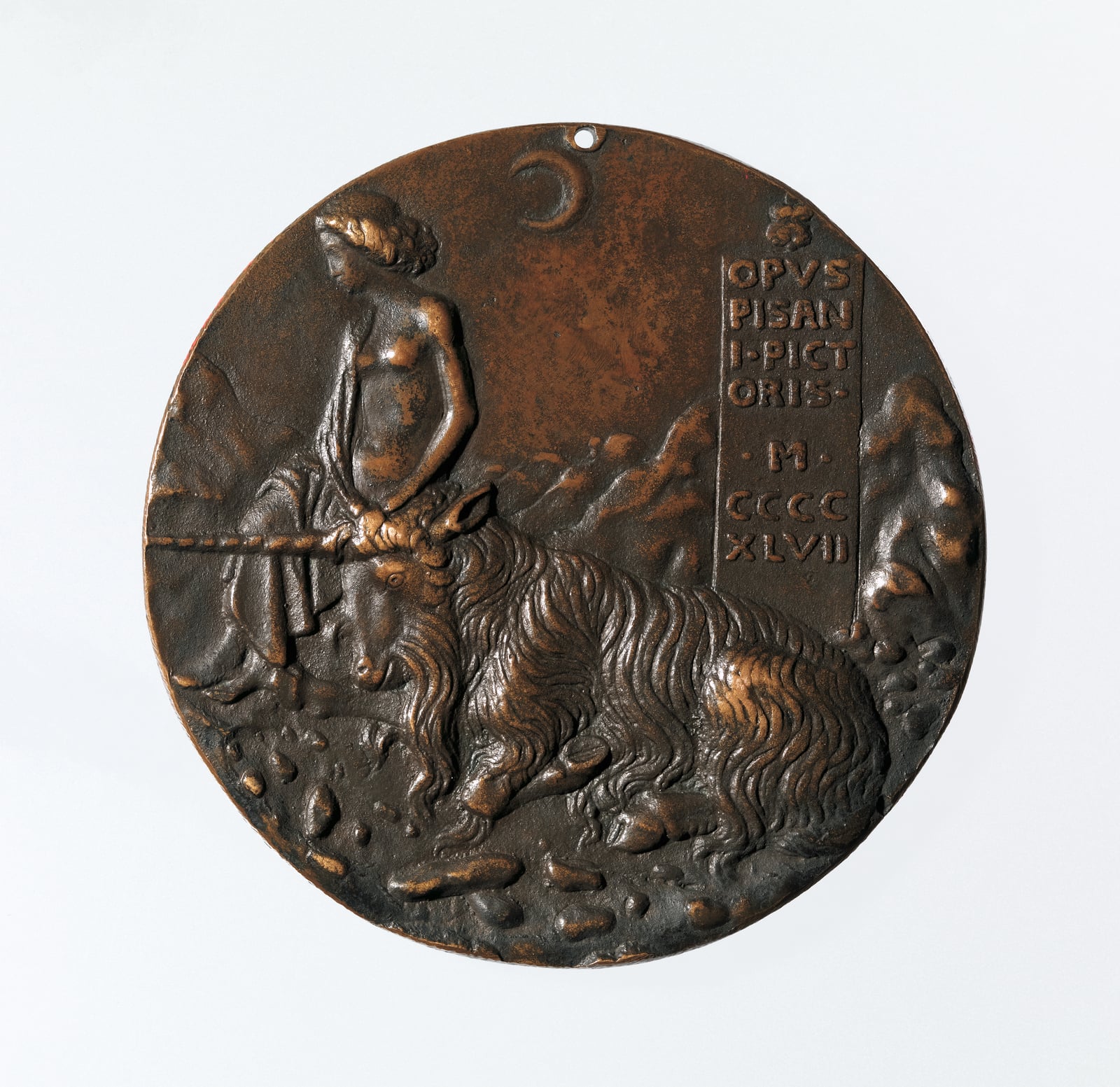
A portrait can give you a face and still leave its most ambitious claim out of sight. Pisanello’s medal of Cecilia Gonzaga pairs her profile with a woman and a unicorn beneath a crescent moon.[2] Turning it over changes the task: recognition gives way to interpretation.
That change of register is the peculiar pleasure of the Renaissance portrait medal. Its two sides let an artist put a recognisable individual and an improbable creature in the same small object. You do not have to believe that Cecilia encountered a unicorn. You have to understand why someone wanted the animal to accompany her name.
Pisanello helped establish this form in fifteenth-century Italy. The Metropolitan Museum of Art traces his first Renaissance portrait medal to the visit of the Byzantine emperor John VIII Paleologus to Ferrara in 1438. Roman coins offered an important precedent, but commemorative medals had a different purpose and did not need to meet currency standards of weight or material. Their likenesses could circulate as gifts and memorials.[1][2] The little disc carried a social introduction: here is a face, and here is how to think about its owner.
A scholar and a unicorn
Cecilia’s medal brings the distinction into unusually sharp focus. The photographed bronze is an old aftercast of Pisanello’s 1447 design; that year dates the model, rather than securely dating this particular object.[2]
Cecilia studied with the humanist Vittorino da Feltre. Although she had entered a Clarissan convent, her portrait wears secular court dress. The Met suggests an earlier likeness as a possible source.[2] Her refusal of marriage helps explain the praise developed on the other side.[3]
On the reverse, biography becomes allegory. Medieval tradition held that a virgin could tame the fierce unicorn, making the pairing an emblem of chastity.[3] The crescent invokes Diana, the virgin goddess of classical antiquity.[2] A reader of these signs could approach Cecilia’s religious choice through a landscape populated by a mythical animal and an ancient deity. The image allows several cultural languages to praise the same quality.
Look at the animal in the photograph: its heavy body folds into the lower part of the circle, while its long horn reaches across the woman’s legs. Her hand rests at its head. The creature takes up a surprising amount of space, but its crouching posture keeps that bulk close to the ground. The praise becomes persuasive through the arrangement of two bodies: strength has settled beside composure.
On the portrait side, the surrounding inscription narrows the interpretation. As the Frick’s account explains, it identifies Cecilia as a virgin and as the daughter of Gianfrancesco, marquess of Mantua.[3] Family, status and virtue arrive together. Even after entering a convent, she remains legible through the courtly world into which she was born.
There is a limit to what this beautifully coordinated praise can tell us. A medal is evidence of the identity it presents; it does not give direct access to the sitter’s private wishes. We can recognise the terms in which Cecilia is honoured without assuming that she selected them, or that they exhaust what mattered in her life. Her learning remains part of the historical record even when chastity occupies the reverse.
A teacher and a hungry nest
Pisanello’s medal of Vittorino, Cecilia’s teacher, makes an illuminating companion. Its model dates to 1446–47; the Met’s example may have been cast in the fifteenth or sixteenth century. The museum considers Ludovico Gonzaga, another former pupil, the probable commissioner around the time of Vittorino’s death. That attribution remains a probability.[4]
Again, the portrait has an animal counterpart. The reverse shows a bird feeding its young. The Met’s title calls it a pelican, but its discussion preserves an alternative identification as a phoenix. The pelican reading draws on the old belief that the bird nourished its chicks with blood from its own breast, making it an emblem of Christ’s sacrifice. The phoenix interpretation is associated with a pupil’s description of Vittorino’s self-sacrifice as a teacher.[4]
The uncertainty is useful. Symbols do not always arrive with a single uncontested translation, even when the broader tribute is clear. In either reading recorded by the museum, the teacher’s care becomes visible through the bird’s relation to its dependants. The reverse offers a way to remember what he gave to other people.
Placed beside Cecilia’s unicorn, that tribute also reveals how selective commemoration can be. Both sitters belong to a world of learning. Their medals direct attention toward different virtues: her chastity, his sustaining generosity. The difference does not prove what either sitter thought of the design. It does show how an emblem can enlarge one aspect of a life until it becomes the quality a viewer is invited to remember.
A reputation small enough to travel
The object’s manufacture helped that invitation travel. In casting, a model supplied the designs for moulds of the two faces; molten metal filled the joined moulds, and the resulting medal could be finished and treated at the surface. The form made a portrait reproducible and portable.[1] A reputation no longer depended on an encounter with a single painting in a particular room.
The Frick describes medals passing among friends or from rulers to subjects. Some were placed with the dead or in building foundations, extending commemoration beyond the immediate circle of recipients.[3] The hoped-for audience could include people who would never meet the sitter at all.
This is why the reverse deserves more than a glance after the portrait. It supplies an interpretation that can remain attached to the face as the object changes hands. The recipient may accept the praise, admire its ingenuity or question its claims; the medal has nevertheless arranged the encounter.
Return to Cecilia’s unicorn. Its distance from ordinary experience is what lets it do this work. A likeness asks us to recognise someone. The animal asks us to credit a quality that no face, however sensitively modelled, could prove. Between those two requests lies the medal’s art: the turn of a small bronze changes identification into persuasion.
Sources
- The Metropolitan Museum of Art, “Portrait Medals: History and Production Processes” (2016 exhibition text) — Pisanello’s early medal, commemorative purpose, casting and circulation.
- The Metropolitan Museum of Art, portrait medal of Cecilia Gonzaga, accession 1975.1.1307 — model date, aftercast identification, dimensions, biography, iconography and source photograph.
- The Frick Collection, “The Pursuit of Immortality: Masterpieces from the Scher Collection of Portrait Medals” (2017 exhibition press release), pp. 2–3 — inscriptions, identity, exchange and commemorative uses.
- The Metropolitan Museum of Art, portrait medal of Vittorino Rambaldoni da Feltre, accession 1975.1.1302 — model and casting dates, probable patron, and alternative interpretations of the bird.